
Mainz Biomed’s Strategic Shift to Pancreatic Cancer Diagnostics, AI, and Cybersecurity During Restructuring
With the wind-down of its colorectal cancer franchise and a high-stakes realignment toward pancreatic cancer screening and post-quantum cybersecurity, Mainz Biomed enters a phase defined by clinical validation risk, IP leverage, and integration challenges—while its financial runway and long-term sustainability remain under scrutiny.
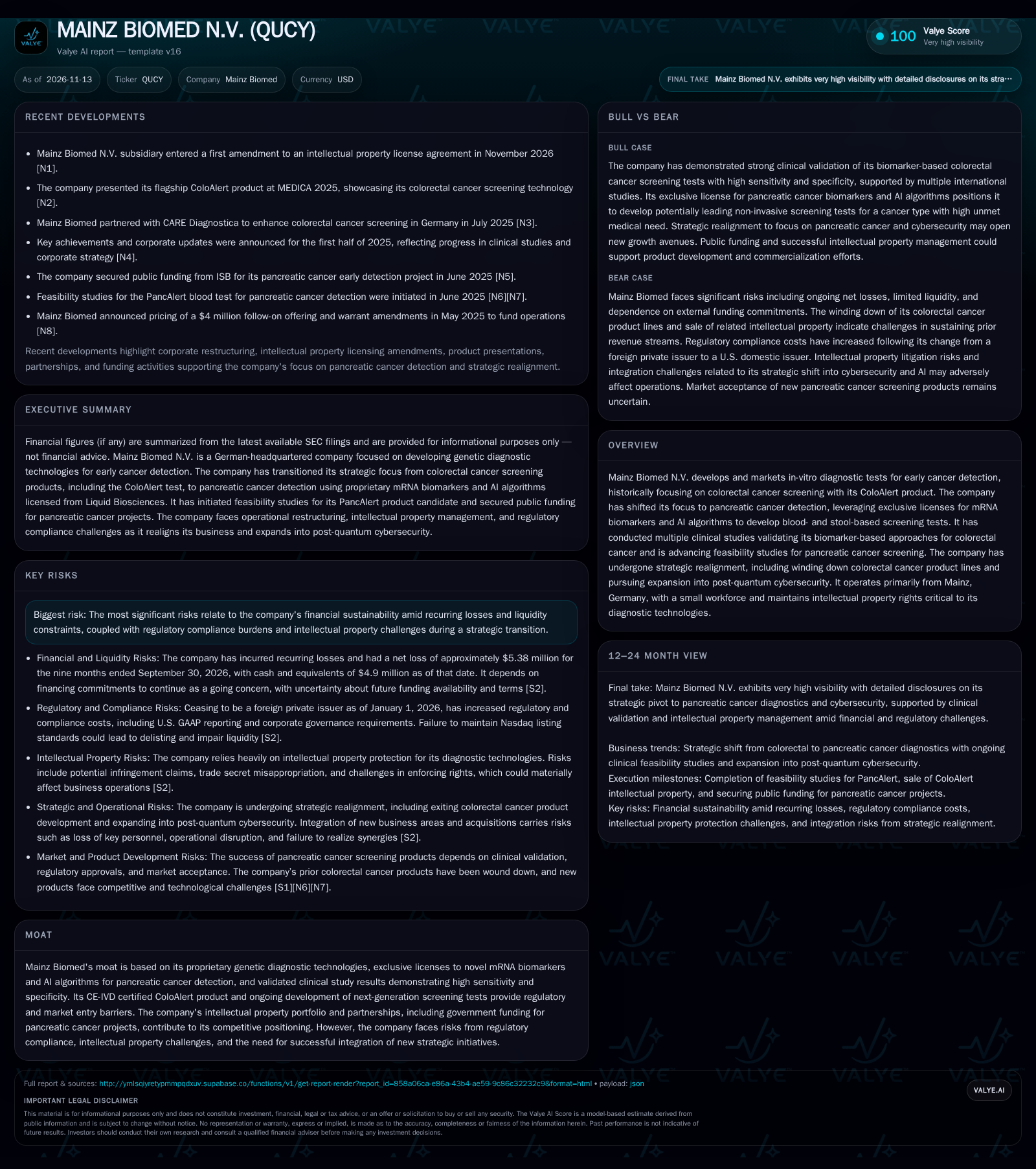
Mainz Biomed has exited its legacy colorectal cancer business, sold related IP, and now focuses on pancreatic cancer diagnostics using exclusive mRNA and AI licenses. The company is also expanding into quantum cybersecurity, with feasibility studies for PancAlert underway and public funding secured. However, recurring losses and reported cash balance put pressure on successful execution, clinical validation, and integration of new business areas. Sustained value hinges on technical success, regulatory clearance, and market traction for its new platforms, while integration risks and compliance burdens rise.
Mainz Biomed is undergoing a radical transformation: the company has exited its legacy colorectal cancer business and is redirecting its limited resources toward two high-risk, high-reward arenas—pancreatic cancer diagnostics and post-quantum cybersecurity. With feasibility studies for its new PancAlert test underway and public funding in hand, Mainz’s future now hinges on technical and regulatory success in a field with few early detection solutions. However, this pivot comes with financial strain, operational upheaval, and the daunting challenge of integrating disparate technology platforms. The next year will test Mainz’s ability to convert proprietary science and strategic ambition into sustainable value.
Mainz Biomed’s Exit from Prior Focus and New Direction
The most material recent development is Mainz Biomed’s decision to wind down its colorectal cancer screening business, including the sale of related intellectual property and the termination of associated personnel in February 2026 [S1]. This marks a decisive break from its legacy revenue stream and product focus. The company is now concentrating on developing non-invasive pancreatic cancer diagnostics—PancAlert—leveraging an exclusive license for mRNA biomarkers and an AI-driven algorithm acquired from Liquid Biosciences in March 2025 [S1]. Feasibility studies for PancAlert’s blood and stool-based tests are underway, supported by public grants and external funding [N5] [N6] [N7]. In parallel, Mainz is realigning its corporate identity and expanding into quantum cybersecurity, including a planned rebranding to Quantum Cyber N.V. [S1]. These moves signal a strategic bet on two technically demanding and commercially uncertain frontiers, while the company reported a cash balance of $4.9 million and a net loss of $5.38 million for the first nine months of 2026 [S2].
Revenue Model Prospects in Diagnostics and Cybersecurity
Mainz Biomed’s historical business model in in-vitro diagnostics (IVD) relied on a mix of upfront product sales (e.g., test kits), potential recurring revenue from consumables, and possible licensing or partnership income tied to its proprietary biomarkers and test algorithms. With the exit from colorectal cancer, the company’s near-term revenue base is effectively reset, making future cash flows heavily contingent on the successful development, regulatory approval, and commercialization of PancAlert.
In early-stage diagnostics, product sales typically follow a long and capital-intensive trajectory: significant R&D and clinical validation costs precede any meaningful commercial revenue, and gross margins can be high once scale is achieved, but fixed costs and regulatory hurdles are substantial. The economics for PancAlert will depend on test accuracy, reimbursement rates, regulatory status, and the company’s ability to forge distribution partnerships or secure licensing deals. Public funding and grants can defray R&D costs but are unlikely to cover commercialization expenses.
The planned entry into post-quantum cybersecurity introduces a dramatically different economic model, potentially based on high-value software licensing, service contracts, or integration projects. However, this is a competitive and rapidly evolving market, and Mainz will likely require further acquisitions, talent investments, and integration spending to establish a credible offering. The transition from a small diagnostics firm to a dual-discipline tech company will require new capital, operational leverage, and risk management approaches.
Market Landscape for Pancreatic Cancer Screening and Quantum Cybersecurity
In diagnostics, Mainz’s competitive advantage rests on its exclusive licenses for mRNA biomarkers and AI algorithms targeting pancreatic cancer—an area with few non-invasive early detection solutions. If PancAlert’s clinical performance matches or exceeds established sensitivity and specificity benchmarks, the company could carve out a niche in a market where late diagnosis is common and survival rates are low. However, it faces entrenched competition from established diagnostics players, academic spinouts, and emerging liquid biopsy platforms. Barriers to entry include regulatory approval, clinical adoption, reimbursement, and physician trust.
Switching costs for healthcare providers are typically moderate, but can increase if the test is embedded in care pathways or bundled with digital health platforms. Mainz’s clinical data, intellectual property position, and strategic partnerships (such as with CARE Diagnostica for colorectal cancer) may provide some differentiation, but must now be replicated in the pancreatic cancer domain.
In quantum cybersecurity, the competitive landscape is even more fluid, with large technology vendors, specialized cryptography startups, and academic research consortia all vying for early leadership. Mainz’s credibility and network in healthcare may offer some cross-domain leverage, but success will depend on its ability to source and integrate advanced cryptographic talent and technology—an area far removed from its original focus.
Potential Catalysts for Value Creation: Validation and Execution
A favorable outcome for Mainz Biomed would be driven by successful feasibility and pivotal studies for PancAlert, demonstrating clear superiority in sensitivity and specificity for early-stage pancreatic cancer detection compared to current standards. Regulatory approval in Europe or the U.S. would enable commercial launch, while positive health economic data could drive reimbursement and adoption. If Mainz can secure commercial partnerships, licensing agreements, or a buyout from a larger diagnostics or medtech firm, the economics could scale rapidly given the high unmet need in pancreatic cancer.
On the cybersecurity front, successful acquisition and integration of quantum-resistant cryptography assets, with initial customer traction or pilot projects, could open a new revenue stream and reposition the company as a dual-play innovator.
Evidence supporting this scenario would include: positive clinical data from PancAlert feasibility and pivotal trials (if disclosed), regulatory submissions or approvals, initial commercial sales or licensing deals, and concrete cybersecurity partnerships or contracts. Additional non-dilutive funding, such as grants or milestone payments, would enhance sustainability.
Challenges in Managing a Dual-Track Business Transition
The most plausible near-term scenario is that Mainz continues to advance feasibility studies for PancAlert, but faces delays or setbacks common in early-stage diagnostics—such as inconclusive data, regulatory questions, or slow enrollment. Commercial launch, if achieved, is likely at least 18-36 months away, with revenue modest in the early phase and dependent on further capital raises. The quantum cybersecurity initiative may remain in the integration or pilot stage, with limited revenue impact and continued investment requirements.
Integration risk, regulatory compliance costs, and ongoing restructuring expenses may constrain flexibility. Confirmation of this scenario would include incremental clinical progress, modest non-dilutive funding, no major licensing or partnership breakthroughs, and continued net losses.
Risks of Setbacks in Execution or Validation Impacting Mainz’s Strategy
The adverse scenario is characterized by negative or inconclusive clinical data for PancAlert, regulatory setbacks, or inability to demonstrate sufficient clinical utility to attract reimbursement or commercial partners. If feasibility studies fail or are materially delayed, Mainz could exhaust its cash reserves before reaching the next milestone, forcing a search for distressed financing, asset sales, or a further strategic pivot.
On the cybersecurity side, failure to integrate new assets or attract talent and customers could result in sunk costs and dilution of focus, without meaningful commercial return. The company’s small team and limited operational experience in cybersecurity heighten this risk.
Evidence for this scenario would include adverse clinical or regulatory updates (if disclosed), material delays in the PancAlert program, unsuccessful capital raises, or announcements of further restructuring, layoffs, or asset sales.
Key Developments Shaping Mainz Biomed’s Strategic Evolution
Progress and results from PancAlert feasibility and pivotal clinical studies (if disclosed) will be critical to establishing technical and commercial viability.
Updates on regulatory submissions or clearances for PancAlert in major markets would provide evidence of de-risking and path to market.
Securing commercial partnerships, licensing deals, or distribution agreements for pancreatic cancer diagnostics would signal market traction.
Additional non-dilutive funding sources, such as new public grants or milestone payments, would help extend financial runway and support R&D.
Any significant developments or customer wins in the post-quantum cybersecurity initiative would clarify the prospects of this new business line.
Tracking the company’s cash burn rate and disclosed plans for future financings will help assess going-concern risk.
Integration progress and retention of technical talent in both diagnostics and cybersecurity domains would help evaluate execution risk.
Resolution of any disclosed intellectual property disputes or regulatory compliance issues would impact long-term strategic stability.
Disclaimer: This is research-only, informational analysis and not investment advice. It may include AI-generated interpretation and general industry context. Always verify important details using primary sources.

Comments