
Lulu’s Fashion Lounge: Data-Driven Apparel Model Confronts Liquidity Constraints and Strategic Uncertainty
Lulu’s Fashion Lounge leverages rapid product testing, personalized digital engagement, and expanding wholesale partnerships to reach Gen Z and Millennial consumers.
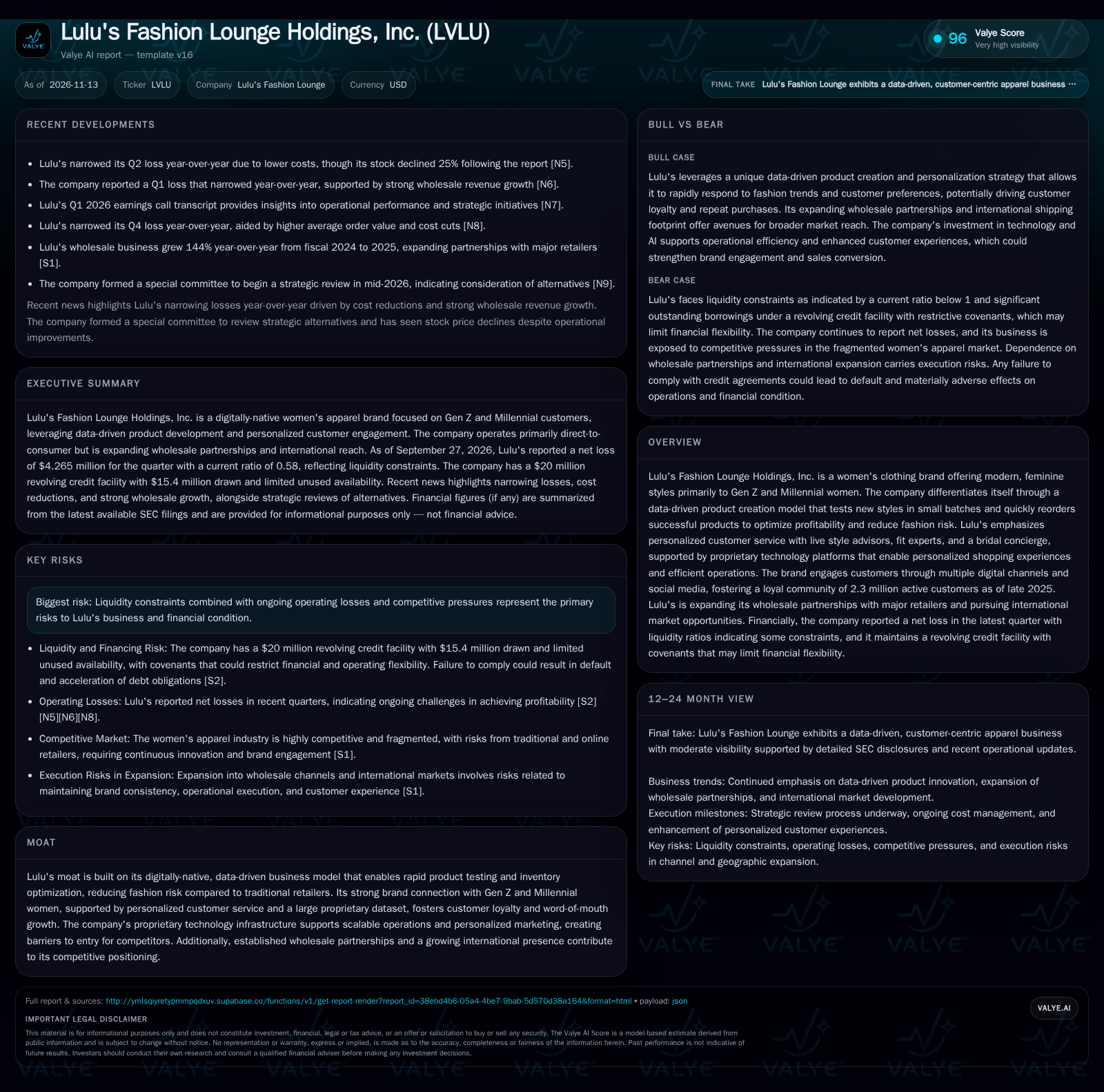
Lulu’s Fashion Lounge is a digitally-native women’s apparel brand known for its data-driven, fast-cycle product model and personalized customer experience. Strategic alternatives are under review, making execution on margin expansion and potential financial flexibility central to Lulu’s next phase. [S1] [S2] [N7]
Lulu’s Fashion Lounge Holdings, Inc. stands at a critical juncture: its innovative, data-driven approach to women’s fashion has enabled rapid design iteration and strong engagement with Gen Z and Millennial shoppers, while recent wholesale momentum suggests broader market appeal. As Lulu’s navigates the challenges of scale, margin pressure, and capital scarcity, the next year will test whether its technology-enabled model can deliver both relevance and resilience in a highly competitive apparel market.
Strategic Review and Liquidity Constraints Shape Lulu’s Near-Term Outlook
Lulu’s Fashion Lounge reported a net loss of $4.265 million for the quarter ending September 27, 2026, with both basic and diluted EPS at -$1.48. The company’s current ratio stood at 0.58 and cash ratio at 0.07, indicating a significant imbalance between short-term assets and liabilities. Cash and equivalents totaled $6.535 million, while $15.4 million was drawn on a $20 million asset-based revolving credit facility, leaving just $0.4 million in unused availability. In response, a special committee was formed in mid-2026 to review strategic alternatives, signaling that management is actively considering options such as a sale, capital raise, or restructuring. [S2]
Meanwhile, Lulu’s wholesale segment grew 144% year-over-year from fiscal 2024 to 2025, suggesting successful penetration into new retail channels alongside its direct-to-consumer foundation. The company’s large active customer base (2.3 million as of December 2025) and proprietary technology platform remain central assets as it seeks a sustainable path forward. [S1]
An additional layer of complexity in Lulu’s near-term outlook arises from the interplay between its liquidity constraints and strategic review process. The limited availability of undrawn credit capacity restricts the company’s ability to invest aggressively in growth initiatives or buffer against unforeseen operational disruptions. This financial tightness could necessitate prioritizing near-term cash preservation over longer-term innovation, potentially slowing product development cycles or marketing campaigns. Moreover, the strategic review itself may introduce uncertainty among suppliers, wholesale partners, and customers, which can affect negotiating leverage and operational flexibility. The timing and outcome of this review will be critical in shaping both internal decision-making and external stakeholder confidence.
How Lulu’s Makes—and Risks—Money in Fast-Fashion Retail
Lulu’s monetizes modern, feminine apparel primarily through direct-to-consumer e-commerce, complemented by a growing wholesale channel. Its ‘test, learn, and reorder’ approach means new styles are launched weekly in small batches, with successful items reordered rapidly based on data-driven sell-through analysis. This model aims to maximize full-price sell-through, reduce inventory markdowns, and minimize fashion risk, a key differentiator from traditional fashion cycles. The company’s proprietary technology and AI further support personalized marketing, customer segmentation, and operational efficiency, potentially driving higher conversion rates and customer lifetime value. [S1]
Wholesale provides incremental volume and brand exposure but likely at lower margins than direct e-commerce sales, as retailers demand discounts and may exert more negotiating power. The rapid wholesale growth (144% y/y) suggests a mix shift that could pressure gross margins even as it supports top-line growth. Fixed costs include technology infrastructure, distribution centers, and marketing spend, which can create operating leverage if sales scale, but also amplify losses if revenue falters.
The economics of Lulu’s fast-fashion model hinge on a delicate balance between rapid inventory turnover and cost control. While the ‘test, learn, and reorder’ approach reduces markdown risk, it requires highly responsive supply chain capabilities and data analytics infrastructure. If the supply chain cannot consistently meet the rapid replenishment demands, the company risks stockouts that frustrate customers or overproduction that erodes margins. Additionally, wholesale expansion, while boosting volume, introduces complexity in demand forecasting and inventory allocation across diverse retail partners. The margin dilution from wholesale sales must be carefully managed against the benefits of scale and brand visibility. Fixed cost absorption improves with scale, but only if incremental revenues contribute positively to the bottom line, underscoring the importance of disciplined cost management as Lulu’s grows.
Differentiation, Defense, and the Challenge of Imitation in Women’s Apparel
Lulu’s competitive position rests on several pillars: rapid product iteration, a strong digitally-native brand targeting Gen Z and Millennials, and a technology-driven personalization engine for customer engagement. Its proprietary data and ability to quickly adjust inventory could reduce markdown exposure compared to slower-moving traditional retailers. The company’s active customer base and high social media engagement support its brand relevance.
However, the women’s apparel market remains highly fragmented and intensely competitive, with both established retailers and digital upstarts targeting similar demographics. Fast-fashion giants, specialty boutiques, and large e-commerce platforms all compete on trend velocity, price, and convenience. While Lulu’s technology stack and personalized service create some barriers to entry, these advantages are not insurmountable: larger players can invest heavily in AI, logistics, and influencer marketing. Wholesale expansion also exposes Lulu’s to retailer demands and potential margin dilution, while execution missteps can erode brand equity and customer loyalty.
Sustaining differentiation in a crowded women’s apparel market requires ongoing investment in proprietary technology and brand experience. Lulu’s personalization capabilities, powered by AI, can enhance customer lifetime value by tailoring product recommendations and marketing communications, but these advantages depend on continuous data quality and algorithm refinement. The risk of imitation by larger competitors with deeper pockets means Lulu’s must also innovate beyond technology, cultivating authentic brand narratives and community engagement that resonate with its target demographic. Furthermore, reliance on wholesale partnerships introduces vulnerability to retailer bargaining power and shifts in retail channel dynamics. Maintaining a balanced channel strategy that leverages direct consumer relationships while optimizing wholesale growth is critical to preserving margin and brand integrity.
If Wholesale Momentum and Tech-Driven Personalization Drive a Turn to Profitability
A favorable outcome for Lulu’s would see continued wholesale growth providing scale benefits, while the company successfully maintains or even expands gross margins through disciplined inventory management and full-price sell-through. If Lulu’s proprietary technology enables further gains in marketing efficiency and customer retention, both direct and wholesale channels could become increasingly profitable. Evidence supporting this scenario would include sustained double-digit wholesale revenue growth, improving gross margin trends, and narrowing net losses—potentially leading to positive operating cash flow.
Confirmation would also come from new or expanded wholesale partnerships with major retailers, increased international sales, and stable or rising active customer counts. If the strategic review results in a capital infusion or acquisition by a partner with stronger balance sheet resources, Lulu’s could accelerate investment in technology and brand expansion, solidifying its competitive position.
Navigating Margin Pressure and Strategic Uncertainty While Maintaining Relevance
The most plausible path for Lulu’s is a period marked by modest revenue growth, primarily from wholesale, but offset by ongoing net losses and constrained liquidity. The company may be forced to slow innovation or marketing spend to preserve cash, risking erosion of its brand momentum. Margin pressure could persist as wholesale becomes a larger revenue share and customer acquisition costs remain elevated. The strategic review process may lead to a sale, recapitalization, or further cost-cutting, but execution risks abound—especially if restrictive debt covenants limit flexibility.
Key confirming evidence would be flat or slightly improving revenue, stable or declining active customer counts, and persistent negative cash flow. Signs of delayed product launches, reduced marketing, or weaker engagement metrics would further support this scenario. The question is whether Lulu’s can maintain enough differentiation and customer loyalty to remain relevant as a standalone brand, or if its future depends on integration with a larger retail or digital commerce player.
When Liquidity Constraints and Execution Risks Force Drastic Restructuring
Continued net losses, covenant breaches, or a failed strategic review could force asset sales, downsizing, or bankruptcy protection. Wholesale partners might reduce orders or demand steeper discounts, while consumer engagement could wane amid reduced investment in product and marketing.
Evidence for this scenario would include further declines in the current ratio, disclosure of missed covenant targets, layoffs or store closures (if any), and a spike in short-term borrowing costs. If the special committee’s review results in a distressed sale or liquidation, equity value could be impaired. Customer attrition and negative sentiment on social platforms would reinforce a downward spiral.
Signals That Will Determine Lulu’s Strategic and Financial Trajectory
Quarterly wholesale revenue growth rates and gross margin trends, particularly as the mix of wholesale versus direct-to-consumer shifts.
Net income and operating cash flow progression, with emphasis on narrowing or widening losses.
Active customer count and engagement metrics (site visits, repeat purchase rates, loyalty program participation), if disclosed.
Updates regarding the outcome of the strategic review, including potential sale, capital raise, or new partnership announcements.
Wholesale partnership announcements or terminations, especially with major retailers.
Any signs of inventory build-up, markdown activity, or write-downs that could pressure margins.
Changes in technology investment levels or evidence of new AI-driven personalization features launched.
Disclaimer: This is research-only, informational analysis and not investment advice. It may include AI-generated interpretation and general industry context. Always verify important details using primary sources.

Comments