
Willamette Valley Vineyards: Direct-to-Consumer Ambitions Tested by Volume Declines and Competitive Encroachment
Despite a premium brand and a strategic push toward higher-margin direct sales, Willamette Valley Vineyards faces rising net losses, softening wine club membership, and intensifying competition from larger players leveraging the Oregon wine narrative. Profitability and growth now hinge on the company's ability to reverse volume declines and deepen customer relationships while managing cost pressures and financial leverage.
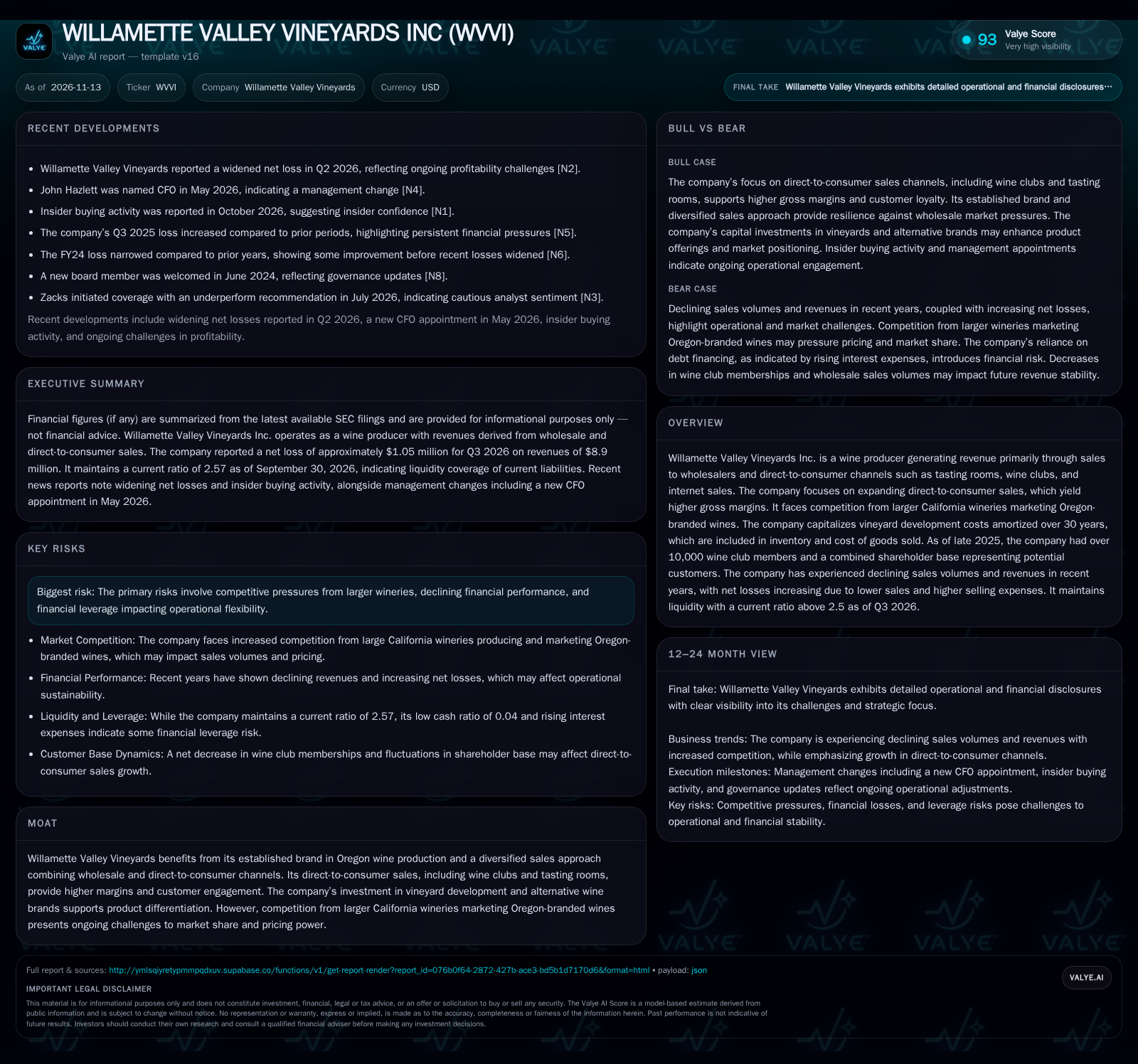
Willamette Valley Vineyards is experiencing falling sales volumes and net losses, despite focusing on higher-margin direct-to-consumer channels. Competition from larger wineries and rising financial leverage are pressuring the business. The company’s future depends on stabilizing core wine club and tasting room traffic, offsetting cost inflation, and maintaining brand differentiation in a crowded Oregon-branded wine market. [S2] [N2]
Willamette Valley Vineyards, long known for its premium Oregon Pinot Noir and direct-to-consumer sales focus, is confronting a confluence of adverse trends: a notable drop in wine volumes, rising net losses, and eroding wine club membership. These developments come as larger wine companies aggressively expand their presence in the Oregon-branded segment, threatening Willamette’s ability to command price and retain loyal customers. The company’s ongoing investments in vineyard development and its broadening product range offer potential levers for recovery, but near-term performance is increasingly tied to reversing volume declines and managing operational costs amid heightened financial leverage and competitive pressure. [S2] [N2]
Recent Volume Declines, Losses, and Customer Attrition: Where the Pressure Is Most Acute
The most material current facts shaping Willamette Valley Vineyards’ outlook are a 7.2% decline in wine case sales to 173,014 in 2025, a widened net loss of $1.05 million for Q3 2026 on $8.9 million in revenue, and a 702-member drop in wine club memberships to 10,481 by year-end 2025. All key sales channels—wholesale and direct—saw declines, intensifying the impact of fixed cost absorption and raising questions about the company’s ability to sustain its premium brand positioning and direct-to-consumer growth strategy. At the same time, competition from larger California wineries marketing Oregon-branded wines is increasing, directly challenging Willamette’s pricing power and share in both grocery and specialty retail. The company’s current ratio of 2.57 reflects balance-sheet liquidity, but a reported cash ratio and higher interest expense highlight growing financial leverage and reduced margin for error. [S2] [N2]
Direct Sales Versus Wholesale: Margin Structure and the Economics of Customer Engagement
Willamette Valley Vineyards’ business model relies on a mix of wholesale distribution and direct-to-consumer (DTC) channels such as tasting rooms, wine clubs, and online sales. DTC sales generally carry higher gross margins due to full retail pricing and deeper customer engagement, but also require significant ongoing investment in hospitality, marketing, and fulfillment. Wholesale sales, while offering higher volume potential, are subject to lower margins and greater price competition, especially as larger out-of-state wineries enter the Oregon segment with scale advantages.
The declining sales volumes and wine club membership suggest that fixed costs—including vineyard development (capitalized and amortized over 30 years), winery operations, and DTC infrastructure—are less effectively absorbed, reducing operating leverage and pressuring profitability. The company’s rising interest expense, linked to higher average loan balances, further erodes net margins and signals a need for careful capital management. If DTC growth stalls, the economics of the business could become increasingly unfavorable unless cost structures are adjusted or new sources of customer acquisition are found. [S2]
Brand Strength and the Erosion of Oregon Exclusivity
Willamette Valley Vineyards has historically benefited from a strong regional brand and the cachet of Oregon Pinot Noir, but its competitive position is being eroded as large California wineries leverage their distribution muscle to market Oregon-branded wines at scale. These entrants can undercut prices in wholesale channels and use sophisticated marketing to attract both casual and premium wine buyers, diminishing Willamette’s pricing power and differentiation.
The company’s multi-label strategy (including Domaine Willamette, Griffin Creek, and others) and investment in direct customer relationships via wine clubs and tasting rooms remain strategic assets, but their effectiveness hinges on the ability to deliver unique experiences and maintain loyalty amid a crowded premium wine landscape. Customer switching costs are moderate: wine club members can easily defect to competing offers, and retail shelf space is highly contested. The question is whether Willamette can use its heritage and DTC channels to offset scale disadvantages and avoid further share loss.
Recovery Hinges on Revitalized Direct Engagement and Premiumization
A favorable scenario sees Willamette Valley Vineyards stabilizing and then regrowing its wine club and tasting room traffic, leveraging its brand heritage, new product introductions, and enhanced customer experiences to reignite direct-to-consumer momentum. Success here would yield higher-margin sales and potentially improve operating leverage, as fixed costs are spread over a growing volume base.
Evidence supporting this scenario would include a reversal in wine club membership declines, sustained or increasing average order values in DTC channels, and positive same-location tasting room sales trends. Complementary indicators could be a reduction in selling expenses relative to sales, improved gross margins, and new customer acquisition campaigns yielding measurable results. If Willamette can also command higher price points through premiumization, it could partially offset competitive pricing pressure from larger rivals.
Stagnant Volumes and Incremental Adjustments Define the Status Quo
The most plausible near-term outcome is that Willamette Valley Vineyards experiences flat to slightly declining sales volumes, with modest improvements in operational efficiency offsetting only some of the margin pressure from lower throughput and rising costs. The company may pursue incremental cost controls, targeted marketing to stem wine club attrition, and selective product innovation, but wholesale channel headwinds and competitive pricing continue to weigh on overall growth.
This scenario would be confirmed by continued softness in wine club and tasting room metrics, stable or only marginally improved gross margins, and persistent but manageable net losses. If disclosed, metrics such as customer retention, average order value, and direct channel growth would help validate this middle path. Any material improvement would likely come slowly and require either a sustained marketing push or a broader industry tailwind boosting Oregon wine demand.
Further Volume Erosion and Margin Compression as Competitive Pressures Mount
An adverse trajectory would see Willamette Valley Vineyards continue to lose volume and wine club members, with fixed costs and rising interest expense outpacing any gains from cost containment or limited product innovation. Larger competitors’ ability to market Oregon-branded wines at scale could further erode both wholesale and direct-to-consumer market share, forcing Willamette to discount or cede shelf space.
Confirmation of this outcome would include accelerating declines in wine club membership, lower tasting room foot traffic, deteriorating gross margins, and increased reliance on debt financing to cover operating losses. Watchpoints would be a spike in inventory write-downs, higher-than-expected churn rates (if disclosed), and negative cash flow from operations. The risk in this scenario is that persistent losses limit the company’s ability to invest in recovery or innovation, potentially leading to asset sales or restructuring.
Milestones That Will Reveal the Trajectory of Willamette Valley Vineyards’ Consumer and Financial Strategy
Quarterly wine club membership changes: Faster-than-expected declines or stabilization would clarify the effectiveness of customer retention efforts.
Tasting room and direct sales growth rates (if disclosed): Trends here would indicate whether experiential investments are translating into higher-margin sales.
Average selling price and gross margin by channel: Shifts in channel mix or margin compression could signal competitive or pricing pressure.
Customer acquisition cost and retention rates (if disclosed): These would help test the sustainability of direct-to-consumer economics.
Interest expense as a percentage of revenue: A rising ratio would suggest growing financial leverage risk.
Inventory turnover and write-downs: Slower turnover or higher write-downs could reveal demand weakness or product misalignment.
Wholesale volume trends: Ongoing share loss to larger competitors would be a warning sign for broader sales health.
New product or brand launches: Uptake and mix shift toward higher-priced SKUs would test the success of premiumization and innovation strategies.
Disclaimer: This is research-only, informational analysis and not investment advice. It may include AI-generated interpretation and general industry context. Always verify important details using primary sources.

Comments