
First Capital Inc: Regional Bank Expansion Hinges on Merger Execution and Earnings Stability
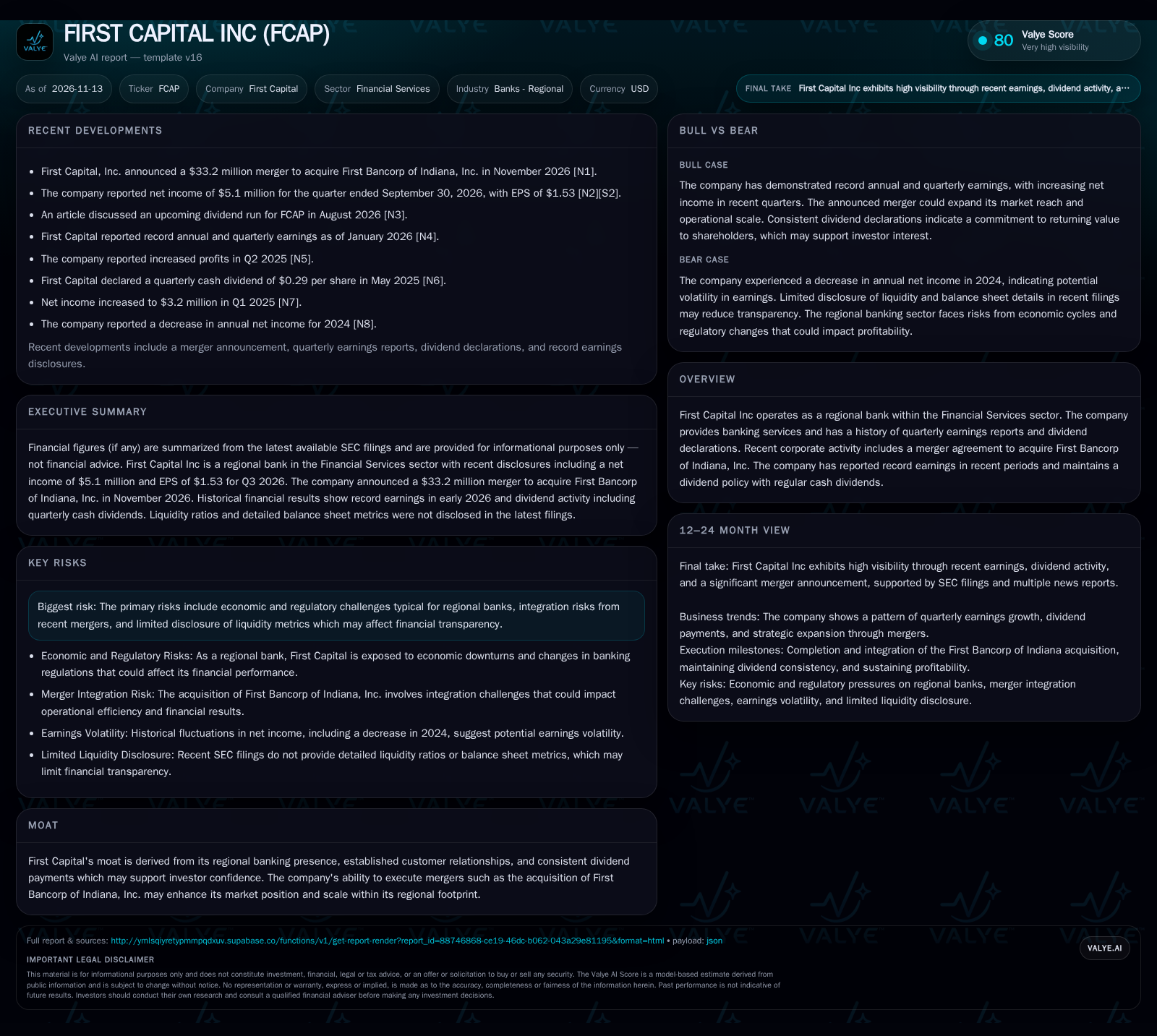
First Capital Inc reported $5.1 million in net income for Q3 2026 and is acquiring First Bancorp of Indiana for $33.2 million.
First Capital Inc reported $5.1 million in net income for Q3 2026 and is acquiring First Bancorp of Indiana for $33.2 million. The success of the acquisition and the continuity of dividend payments will be central to the bank’s near-term value trajectory. [S2] [N1] [N4] [N8]
First Capital Inc, a regional banking player, is riding a wave of recent record earnings and is now set to expand its presence through the announced $33.2 million acquisition of First Bancorp of Indiana. Much depends on the bank’s ability to integrate its acquisition and maintain stable earnings in a sector where economic and regulatory volatility can quickly shift the landscape. [S2] [N1] [N4] [N8]
Earnings Momentum and M&A Activity Define the Latest Chapter
First Capital Inc reported net income of $5.1 million and basic/diluted EPS of $1.53 for the quarter ended September 30, 2026, extending a streak of quarterly profitability. This comes on the heels of record annual and quarterly earnings declared in early 2026, indicating a recovery from a net income decline in 2024. The company announced a $33.2 million merger to acquire First Bancorp of Indiana in November 2026, marking a significant move to expand its regional footprint and scale. Meanwhile, regular cash dividends—including $0.29 per share in May 2025—highlight a continued shareholder return policy, though future payments remain discretionary and subject to regulatory and financial conditions. The company reported cash and liquidity metrics for the period; these figures do not by themselves establish operating runway, investment capacity, financial flexibility, or financing capacity. [S2] [N1] [N4] [N8] [N6]
How First Capital Makes Money: Spreads, Scale, and the Leverage of Expansion
As a regional bank, First Capital’s core economics derive from net interest income—earning a spread between interest paid on deposits and interest earned on loans and securities. Fee income from ancillary banking services likely supplements this, though its magnitude is not disclosed. The recent pattern of record earnings and rising quarterly profits suggests positive operating leverage, likely driven by prudent cost management and stable credit quality. However, the underlying margin dynamics are sensitive to funding costs, loan growth, and local economic conditions.
The announced acquisition of First Bancorp of Indiana introduces the potential for revenue and cost synergies: increased loan/deposit volume, broader customer reach, and potential expense rationalization. However, integration costs and the risk of customer attrition or credit issues could offset these benefits in the near term. Capital needs may rise with the acquisition—both for transaction funding and to support a larger balance sheet—while regulatory capital requirements could constrain flexibility if credit quality deteriorates or asset growth outpaces retained earnings. The absence of current liquidity and capital ratio disclosure makes it difficult to assess how much financial headroom First Capital retains for further expansion or shock absorption. [S1] [S2]
Beyond the immediate financial metrics, the sustainability of First Capital’s earnings hinges on the interplay between interest rate cycles and asset-liability management strategies. If interest rates rise, the bank’s net interest margin could benefit from repricing assets faster than liabilities, but this depends on the composition and duration of the loan portfolio and deposit base. Conversely, a flattening or inverted yield curve could compress margins, especially if funding costs increase faster than asset yields. The bank’s ability to hedge interest rate risk or adjust its product mix will be critical to maintaining profitability in varying rate environments. Additionally, the balance between loan growth and credit quality will determine whether earnings growth is durable or vulnerable to future charge-offs.
Regional Roots, Customer Relationships, and the Race for Scale
First Capital’s competitive position is grounded in its regional market presence and established customer relationships—typical advantages for community and regional banks. Local knowledge can support better credit decisions and customer retention, but this is offset by exposure to local economic cycles and limited geographic diversification. Larger regional and superregional banks, as well as digital-first competitors, may pressure margins through superior technology, lower cost structures, or broader product offerings.
The ability to execute and integrate acquisitions, such as the First Bancorp of Indiana deal, could enhance First Capital’s scale and relevance, potentially unlocking efficiencies and cross-selling opportunities. However, the risk is that integration missteps, cultural friction, or legacy credit issues from acquired portfolios could erode value. The bank’s consistent dividend history may strengthen shareholder loyalty, but it is not an inherent competitive moat without underlying earnings power and prudent risk management.
In the context of competitive dynamics, First Capital’s regional focus offers both strengths and vulnerabilities. While deep local ties and tailored service can foster customer loyalty, these advantages may be offset if competitors leverage technology platforms to offer more convenient or lower-cost services. The bank’s capacity to invest in digital transformation—potentially accelerated by merger-related scale—will influence its ability to compete effectively. Moreover, competitive pressures could intensify if regional economic conditions deteriorate, as borrowers may seek alternative financing or defer borrowing, thus impacting loan demand and fee income. The bank’s strategic choices around balancing traditional relationship banking with innovation will shape its medium-term competitive positioning.
If Integration Proceeds Smoothly, Scale and Earnings Resilience Could Accelerate
The most positive scenario involves a seamless integration of First Bancorp of Indiana, resulting in expanded market share, improved operating efficiency, and enhanced profitability. Successful cross-selling, cost synergies, and retention of key personnel and customers could drive double-digit earnings growth in the next several quarters.
Confirmation would come from continued record or rising quarterly earnings, disclosure of improving efficiency or profitability metrics post-merger, and clear evidence of deposit and loan growth attributable to the combined franchise. Conversely, early signs of integration delays, customer attrition, or unexpected credit losses would challenge this scenario.
If the integration unlocks meaningful operational efficiencies, First Capital could realize improved cost-to-income ratios, which would enhance return on equity beyond mere revenue growth. This would require disciplined expense management and successful consolidation of overlapping functions without disrupting customer-facing activities. Furthermore, enhanced scale could enable the bank to invest in risk management infrastructure and technology platforms that improve underwriting precision and operational resilience. The ability to demonstrate these improvements through transparent disclosures would further validate the positive trajectory.
Sustained Profitability with Integration Friction and Sectoral Crosswinds
The most plausible path is steady core profitability, with moderate earnings growth as the First Bancorp merger is absorbed over several quarters. Some integration costs and churn are likely, but not enough to derail the company’s overall trajectory. Dividend payments may be maintained, subject to earnings and regulatory approval, and the combined bank could gradually realize scale benefits.
Signs of significant expense spikes, rising non-performing assets, or dividend cuts would suggest the base case is being challenged.
Merger Disruption, Credit Stress, or Regulatory Shocks Could Reverse Gains
The adverse scenario would see the First Bancorp acquisition strain First Capital’s resources—through integration delays, customer loss, or unexpected credit deterioration. If local economic conditions weaken or integration issues dominate management attention, costs could spike and earnings could fall below pre-merger levels. Regulatory scrutiny, particularly in the absence of robust capital and liquidity metrics, could lead to restrictions on dividends or growth.
This scenario would be confirmed by declining quarterly earnings, rising non-performing loans or charge-offs, negative integration commentary, or a suspension of the dividend. External shocks—such as a regional recession or regulatory intervention—would further amplify downside risk.
Measuring the Impact of Expansion and Underlying Resilience at First Capital
Quarterly net income and EPS trends, especially post-merger, to gauge whether earnings momentum is sustained. [S2]
Disclosure of capital ratios (if provided), to assess potential financial flexibility and regulatory headroom after the acquisition.
Updates on integration progress—including cost synergies, customer retention, and any restructuring charges—following the First Bancorp transaction. [N1]
Loan growth and deposit trends, especially any material shifts attributable to the merger or changing market conditions.
Credit quality metrics, such as non-performing assets or charge-off rates (if disclosed), to monitor for early signs of asset stress.
Regulatory commentary or filings that might signal heightened scrutiny, restrictions, or required remedial actions.
Any unexpected changes in management or key personnel retention, particularly in the context of integration and customer relationship risk.
Disclaimer: This is research-only, informational analysis and not investment advice. It may include AI-generated interpretation and general industry context. Always verify important details using primary sources.

Comments