
Tennessee Valley Authority: Federally Protected Utility Economics Under Regulatory and Technological Crosswinds
TVA’s unique government-backed monopoly and regional mandate provide rare revenue security, but mounting regulatory, environmental, and cybersecurity demands expose both cost structure and operating flexibility to new stress tests.
However, intensifying regulatory, legal, environmental, and cybersecurity obligations threaten to erode operating leverage and strategic optionality, with the potential for future legislative or compliance shocks to reshape its economics.
The Tennessee Valley Authority (TVA) stands as one of the U.S.’s most distinctive utilities—a federally owned, regionally focused electric provider whose legal protections and public obligations both shield and constrain its business model. TVA’s fiscal 2026 net income of $2.121 billion and a current ratio of 1.06 highlight the enduring power of its regulatory moat, yet the landscape is shifting. Cybersecurity threats, environmental compliance pressures, and the potential for legislative or legal disruption increasingly test TVA’s cost structure and strategic flexibility. The question for investors and policymakers alike is whether TVA’s traditional strengths can offset the mounting complexity and risk embedded in its unique hybrid mandate.
TVA’s 2026 Financials and Regulatory Position: What Has Changed and Why It Matters
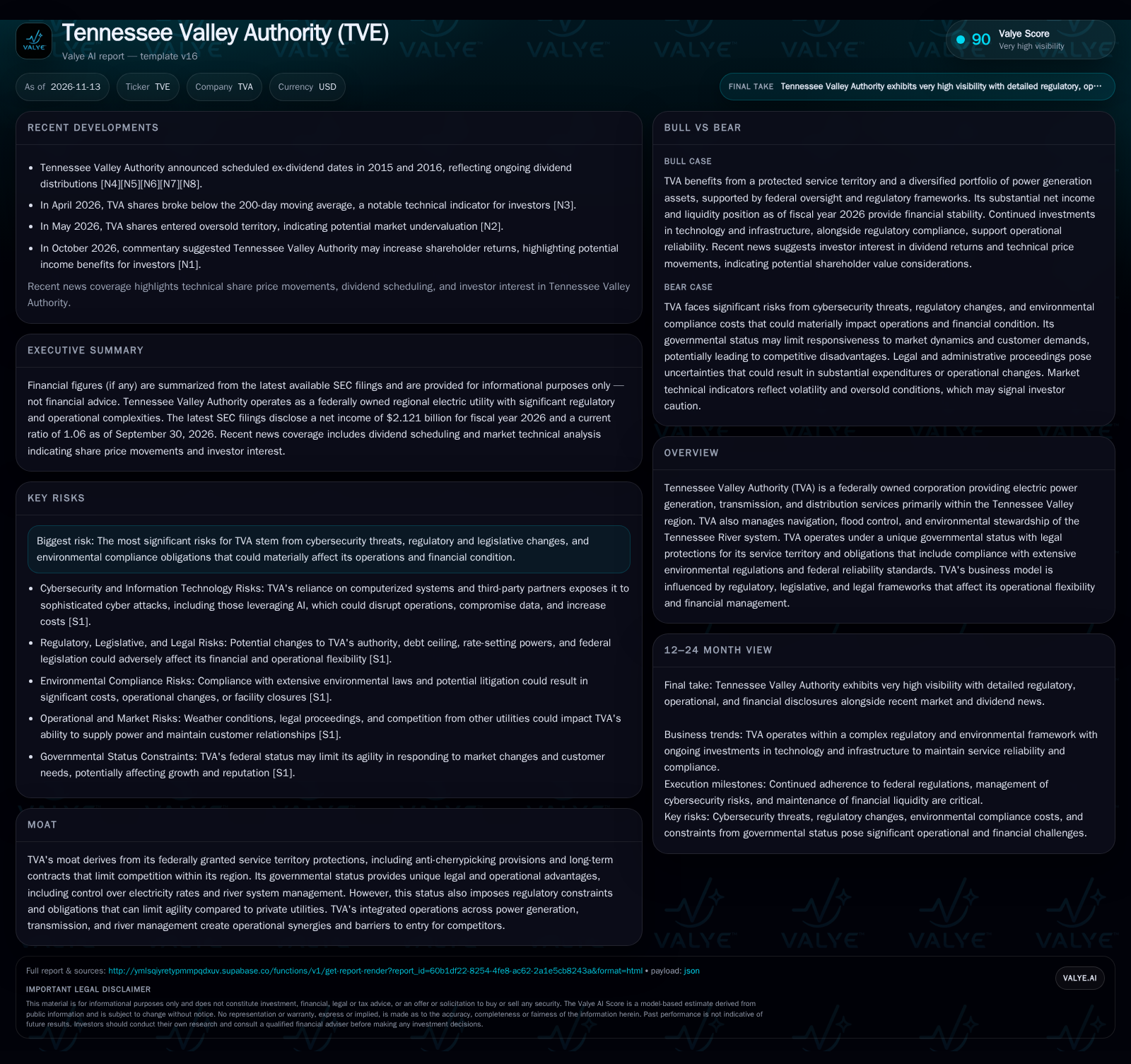
TVA reported net income of $2.121 billion for fiscal year 2026, underscoring its ability to generate stable profits within its federally protected service area [S1]. This performance reflects the continued value of TVA’s monopoly status, which insulates it from direct competition and stabilizes cash flows. However, the current ratio of 1.06 as of September 30, 2026, while above one, suggests a relatively thin liquidity cushion and does not indicate substantial excess capital [S1].
TVA’s operations remain governed by extensive regulatory and legislative frameworks, including obligations for river management and environmental stewardship [S1]. The company is subject to rising cybersecurity threats, with sophisticated attacks—including those leveraging AI—posing nontrivial operational and financial risks [S1]. Finally, recent market commentary has raised the prospect of increased shareholder returns, but technical indicators such as oversold territory and breaks below the 200-day moving average in 2026 indicate uncertainty among investors [N1] [N2] [N3].
How TVA’s Monopoly Structure Shapes Revenue, Costs, and Investment Needs
TVA’s business model is fundamentally anchored in its government-granted regional monopoly, which allows it to generate, transmit, and distribute electricity to a captive customer base. Revenue is derived primarily from regulated rates set to recover costs and provide for infrastructure reinvestment, rather than being subject to market-driven price competition. This cost-plus structure supports stable margins under normal circumstances but can limit upside from efficiency gains or demand surges.
The utility’s fixed cost base is substantial, driven by the capital intensity of power generation and transmission assets, as well as its obligations for river system management. While this creates operating leverage—where incremental revenues can disproportionately boost profits—rising compliance, cybersecurity, and environmental costs may erode this leverage over time. TVA’s capital needs are ongoing, as maintaining grid reliability, upgrading infrastructure, and meeting evolving environmental standards require continual investment. Because TVA’s debt ceiling and rate-setting authority are regulated, its potential financial flexibility is constrained relative to private utilities.
[S1] Any major regulatory, legal, or environmental cost spike could thus impact its ability to self-fund new initiatives or respond rapidly to unforeseen challenges.
Legal Moats and Competitive Boundaries: TVA’s Advantages and Vulnerabilities
TVA’s primary competitive advantage is its legally protected service territory, which restricts other utilities from serving its customers and is reinforced by long-term contracts and federal statutes [S1]. This protection essentially eliminates direct competition for electricity provision within its region, creating a stable and predictable demand base.
However, this same governmental status introduces unique vulnerabilities. TVA is exposed to political risk—federal legislation or regulatory changes could alter its authority, rate-setting power, or even its service area protections [S1]. Indirect competition from alternative energy providers, distributed generation, or regulatory changes that enable customer choice could also erode its effective monopoly over time.
Compared to private utilities, TVA’s agility in adopting new technology, adjusting rates, or responding to customer needs is limited by its public mandate and layers of oversight. Environmental and cybersecurity obligations are also more complex and expensive, given the scale and regulatory scrutiny of its operations. In essence, TVA’s moat is deep but not immune to erosion from shifts in policy, technology, or public sentiment.
What Would Drive Sustainable Value Creation? Regulatory Stability and Cost Discipline
The most compelling upside scenario for TVA is one in which its legal and regulatory framework remains stable, allowing it to continue operating as a protected monopoly with predictable revenues and manageable cost growth. In this environment, TVA could leverage its scale to achieve efficiency gains in generation and grid management, while ongoing investments in technology and cybersecurity prevent major disruptions.
Cost discipline—especially in managing compliance and environmental expenditures—would be critical to sustaining or even expanding operating margins. If TVA is able to secure regulatory approval for incremental rate increases to offset new investment needs, while avoiding large-scale litigation or legislative changes, it could maintain reliable cash flows and potentially increase distributions to stakeholders.
Evidence that would confirm this scenario includes: ongoing net income stability or growth, absence of major regulatory or legal changes affecting TVA’s mandate, and sustained operational performance without significant cybersecurity or compliance incidents. Conversely, material increases in regulatory costs, legal expenses, or abrupt changes to TVA’s rate or debt authority would falsify this optimistic pathway.
Navigating Complexity: TVA’s Most Likely Operating and Financial Trajectory
The most plausible pathway for TVA is continued stable operations within its protected territory, punctuated by incremental increases in compliance costs and periodic regulatory or legal challenges. Net income is likely to remain robust in the near term, but margin pressure could build if environmental or cybersecurity spending accelerates faster than allowed rate increases.
Capital expenditures will remain high, as TVA must constantly invest to meet reliability standards and environmental obligations. Legal and administrative proceedings may periodically drive up costs or require operational changes, but absent a dramatic shift in federal policy, TVA’s fundamental business model is likely to persist.
Confirmation of this scenario would include steady net income, manageable increases in compliance spending, and the continuation of TVA’s legal and regulatory protections. Signals of deviation would include sudden cost spikes, legislative efforts to curtail TVA’s authority, or major cybersecurity incidents resulting in operational or financial losses.
How TVA’s Model Could Be Disrupted: Regulatory, Cyber, and Environmental Shockwaves
A negative scenario for TVA would be triggered by a combination of regulatory, legal, or technological shocks that upend its cost structure or protected status. Examples include federal legislative changes reducing TVA’s monopoly, capping its allowable debt, or imposing new environmental or cybersecurity mandates without commensurate rate relief.
A successful major cyber attack—especially one exploiting AI-driven vulnerabilities—could disrupt operations, trigger costly remediation, and erode public and regulatory trust. Similarly, large-scale environmental litigation or new compliance requirements could force unplanned capital expenditures or even facility closures, straining TVA’s reported liquidity position buffer.
Confirmation of this scenario would include: material adverse regulatory or legislative actions, legal judgments requiring substantial payments or operational changes, or a high-profile cyber incident resulting in sustained outages or financial penalties. Early warning signs would be rising compliance costs, legal settlements, or political momentum for altering TVA’s mandate.
Benchmarks for Testing TVA’s Resilience Amid Regulatory and Technological Change
Annual net income trends and margin evolution, especially relative to compliance and cybersecurity cost growth, would help test TVA’s ability to defend its economics [S1].
Capital expenditure levels and the proportion devoted to regulatory, environmental, and cybersecurity projects—if disclosed—would clarify the drag on operating leverage.
Any federal or state legislative developments that threaten TVA’s service territory protections, rate-setting authority, or debt ceiling should be closely monitored.
The frequency, severity, and financial impact of cybersecurity incidents—if disclosed—would provide a direct test of operational risk management.
Updates on legal and administrative proceedings, including settlements or new litigation, would offer an early warning for potential financial or operational shocks.
Changes in technical indicators (e.g., sustained share price volatility or persistent oversold conditions) may reflect investor sentiment around underlying risks [N2] [N3].
Announcements or evidence of rate-case outcomes, especially those affecting TVA’s flexibility to recover rising costs, would be important for the long-term thesis.
A useful metric would be customer demand trends, especially shifts toward distributed generation or alternative energy sources, as these could pressure TVA’s monopoly economics if the regulatory landscape changes.
Disclaimer: This is research-only, informational analysis and not investment advice. It may include AI-generated interpretation and general industry context. Always verify important details using primary sources.

Comments