
NeoVolta: Debt-Driven Discipline and Dealer Expansion in Residential Energy Storage
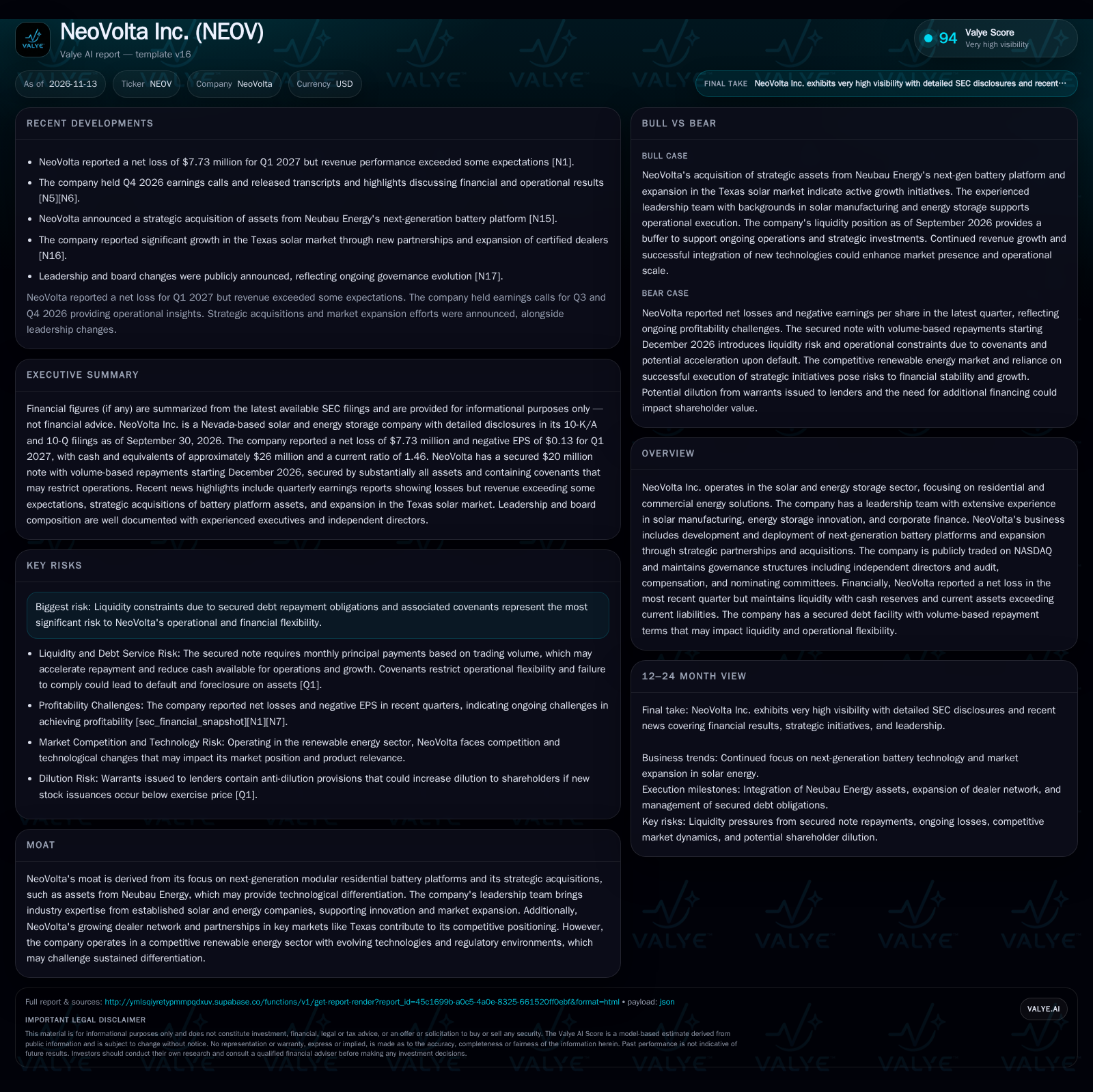
NeoVolta’s next-generation battery strategy and Texas dealer growth are counterbalanced by a looming debt repayment schedule and operational covenants. The company's ability to scale, innovate, and manage financial constraints will determine whether it can carve out a durable position in a competitive, fast-evolving energy storage market.
Execution on dealer expansion, technology integration, and debt management will be critical as the company navigates competition and evolving residential storage economics. [S1] [S2] [N5] [N6]
As repayments commence in December 2026, NeoVolta’s ability to monetize its dealer network expansion, integrate new technologies, and maintain compliance will be tested against intensifying competition and shifting economics in residential energy storage. The next 12-24 months will likely reveal whether NeoVolta can transition from growth to sustainable value creation—or whether financial constraints will force strategic retrenchment. [S1] [S2] [N5] [N6]
Dealer Network Growth Meets Imminent Debt Repayment
NeoVolta’s recent expansion of its dealer network in Texas marks a significant strategic push, aiming to capture share in one of the fastest-growing residential solar and storage markets. The company reported cash and liquidity metrics for the period; these figures do not by themselves establish operating runway, investment capacity, financial flexibility, or financing capacity. However, a $20 million secured note requires volume-based principal repayments beginning December 2026 and mandates maintaining at least $5 million in unrestricted cash. These covenants, coupled with operational restrictions, create a delicate balance between pursuing growth and preserving potential financial flexibility. Breaching these terms could trigger default and possible foreclosure on substantially all assets. [S1] [S2] [N5] [N6]
Residential Storage Economics: Fixed Costs, Dealer Leverage, and Debt Constraints
NeoVolta’s business model is anchored in the sale and deployment of modular energy storage systems, primarily through certified dealers and strategic partnerships. Revenue is likely driven by a mix of hardware sales, potential software integrations, and installation services—though the exact revenue split and contract structures are not disclosed. Margins in residential energy storage are typically pressured by hardware commoditization, customer acquisition costs, and the necessity for ongoing R&D to maintain technological relevance.
The company’s fixed cost base—manufacturing, R&D, and administrative overhead—could benefit from operating leverage if dealer expansion translates to higher sales volumes. However, the secured note’s volume-based repayment structure means that cash outflows will rise with growth, potentially offsetting the benefits of scale unless gross margins improve meaningfully. Warrant-driven dilution risk further complicates the capital structure, making it harder to rely on equity for future funding without impacting existing shareholders. [S1] [S2]
Modular Battery Platform as Differentiator—But for How Long?
NeoVolta’s competitive thesis rests on its next-generation, modular residential battery platforms and its ability to rapidly scale through a growing dealer network, particularly in high-growth geographies like Texas. Its leadership team brings experience from established solar and storage firms, and recent acquisitions (e.g., Neubau Energy assets) may provide a technological edge. However, the U.S. residential storage market is intensely competitive, with incumbent inverter and battery manufacturers, vertically integrated solar installers, and new entrants vying for share.
The durability of NeoVolta’s moat depends on continued product innovation, dealer engagement, and the ability to translate technology into tangible customer value—such as longer lifespans, superior integration, or better economics. Regulatory dynamics and utility rate structures can also shift the value proposition quickly. Without clear evidence of recurring revenue, differentiated retention, or proprietary ecosystem lock-in, NeoVolta’s competitive advantages could erode if larger players accelerate innovation or undercut on price. [S1]
Path to Scale: Dealer Expansion Unlocks Volume and Margin Gains
If NeoVolta’s Texas dealer expansion achieves critical mass, the resulting increase in installation volumes could drive meaningful operating leverage. Higher sales would enable better utilization of fixed manufacturing and R&D investments, potentially improving gross and operating margins. Successful integration of acquired technologies could yield product features that command premium pricing or enhance system compatibility, fostering dealer loyalty and customer retention.
Upside would be confirmed by sequential revenue acceleration, improving gross margin trends, and positive cash flow from operations—despite the onset of debt repayments. Evidence of recurring service or software revenues, increased dealer productivity, and the ability to enter additional high-growth geographic markets would further support the bullish thesis. If NeoVolta can maintain compliance with debt covenants while funding growth internally, the risk of future dilution or liquidity stress would diminish. [S1] [N5] [N6]
Dealer Growth Offsets Debt Drag, But Margin and Cash Remain Tight
The most plausible trajectory is that NeoVolta sustains modest growth via its expanded dealer network, particularly in Texas, but faces persistent margin compression and cash flow constraints as debt repayments commence. Revenue may grow, but incremental cash generation could be offset by required principal payments and the need to maintain a minimum unrestricted cash balance.
While operational execution improves, competitive pressures and possibly undifferentiated product offerings limit pricing power and gross margin expansion. The company manages to avoid covenant breaches, but limited potential financial flexibility restricts R&D investment and broader market expansion. Shareholder dilution risk remains due to warrant overhang and the potential need for additional capital raises if external conditions worsen or growth underdelivers. Confirmation would come from stable or slightly improving margins, consistent compliance with debt covenants, and steady dealer-driven volume growth. [S1] [S2] [N5] [N6]
Liquidity Squeeze: Debt Covenants Trigger Strategic Retrenchment
In a negative scenario, slower-than-expected dealer ramp, margin erosion, or unforeseen market headwinds (such as regulatory shifts or technology obsolescence) lead to cash burn and approach of covenant thresholds. If NeoVolta fails to maintain the $5 million unrestricted cash minimum or breaches other operational covenants, lenders could accelerate debt repayments or move to foreclose on assets, potentially forcing asset sales, restructuring, or bankruptcy.
Shareholder dilution could accelerate if the company is forced to issue equity at depressed prices to shore up liquidity, especially given anti-dilution warrant provisions. Evidence would include declining cash balances, missed sales targets, margin contraction, public disclosure of covenant breaches, or emergency financing activities. Failure to execute in Texas or expand into new markets would further jeopardize the company’s ability to absorb fixed costs and compete sustainably. [S1] [S2]
Milestones That Will Test NeoVolta’s Scalability and Financial Resilience
Sequential revenue growth in Texas and other core markets, particularly as a function of dealer network productivity, would help validate the expansion strategy.
Gross margin trends, if disclosed, will illuminate whether scale and technology integration are translating into improved unit economics.
Cash flow from operations and unrestricted cash balance, especially as debt repayments begin, are critical to monitoring the sustainability of growth and compliance with covenants.
Incidence of covenant breaches or amendments to the secured note agreement would signal financial stress or operational misalignment.
Evidence of recurring revenue streams—such as software services, maintenance contracts, or long-term dealer agreements—would strengthen the argument for business model resilience.
Market share gains in targeted geographies (if reported) would clarify NeoVolta’s competitive traction relative to larger incumbents.
Announcements of additional capital raises, equity issuance, or dilution events—particularly those tied to warrant exercise or below-market pricing—would test the company’s ability to fund growth without eroding shareholder value.
Integration milestones for acquired technologies (such as Neubau Energy assets), including commercial launches or dealer adoption rates, would serve as proof points for product innovation and differentiation.
Disclaimer: This is research-only, informational analysis and not investment advice. It may include AI-generated interpretation and general industry context. Always verify important details using primary sources.

Comments