
Altimmune’s Pemvidutide Ambitions: Progress, Capital, and the Unresolved Path to Commercialization
With a reported cash position, a lead metabolic drug in Phase 3, and recent board reinforcements, Altimmune is at a pivotal juncture. The company’s future will hinge on clinical outcomes, regulatory navigation, and the ability to bridge execution risks with disciplined capital deployment.
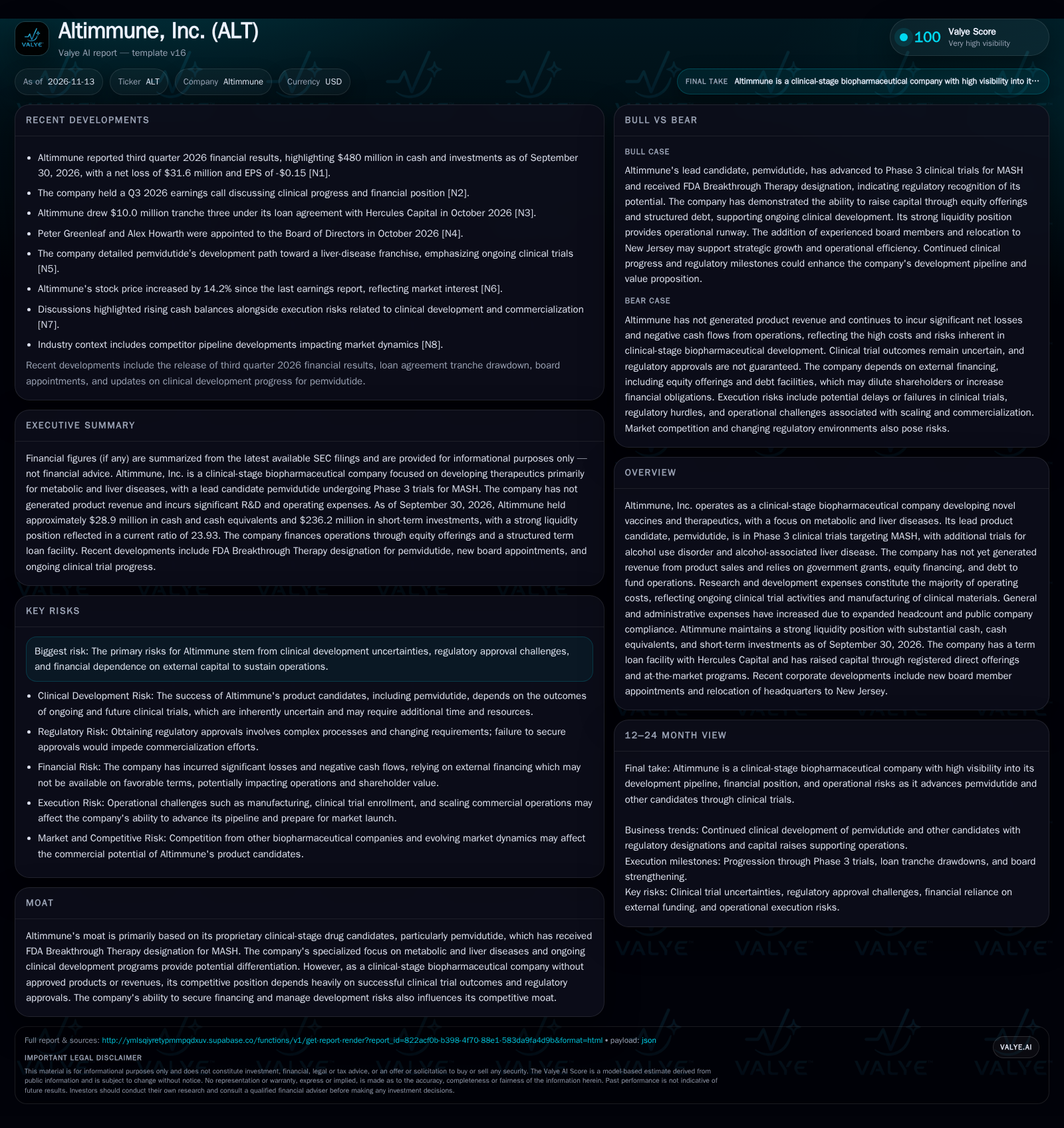
Altimmune remains a clinical-stage biotech with no product revenue, but stands out for its reported liquidity position ($28.9 million in cash, $236.2 million in short-term investments as of September 2026), advanced pemvidutide trials (Phase 3 for MASH, FDA Breakthrough Therapy designation), and active capital-raising. Execution will require managing clinical, regulatory, and operational hurdles to convert pipeline progress into durable value. [S2] [N1]
Altimmune, Inc. sits at a classic inflection point for a clinical-stage biotech: its lead candidate, pemvidutide, is advancing through late-stage trials for metabolic and liver diseases, and the company brandishes a substantial liquidity cushion. Yet, without any product revenue, Altimmune’s future is dependent on successful clinical outcomes, regulatory approvals, and a disciplined transition from R&D to commercialization. The recent strengthening of its board and the FDA’s Breakthrough Therapy designation for pemvidutide signal both opportunity and heightened expectations—but also underscore the execution risks that can derail even well-capitalized drug developers. [S2] [N1] [N4]
Recent Milestones and Their Strategic Implications
As of September 30, 2026, Altimmune reported $28.9 million in cash and cash equivalents and $236.2 million in short-term investments, resulting in a current ratio of 23.93 and a cash ratio of 23. This substantial liquidity reflects both recent capital raises—$70.4 million via a direct offering and over $140 million in at-the-market equity since 2025—and a $10 million draw on its Hercules Capital loan facility in late October 2026. [S2] [N3]
Pemvidutide, Altimmune’s lead drug candidate, has advanced to Phase 3 trials for MASH and received FDA Breakthrough Therapy designation in early 2026, indicating regulatory recognition of its potential to address high unmet need in metabolic liver disease. [S2] [N5]
Operations have been further bolstered by the appointment of experienced board members Peter Greenleaf and Alex Howarth in October 2026, and the relocation of headquarters to New Jersey, which may signal a strategic positioning for commercialization or access to specialized biotech talent. [N4] [S2]
The Economics of a Pre-Revenue Biotech: Fixed Costs, Funding, and the Long Road to Profitability
Altimmune’s business model is typical of clinical-stage biotechs: it incurs high fixed costs—primarily research and development expenses, clinical trial costs, and manufacturing of clinical materials—without any offsetting product revenue. The company’s R&D expenses decreased by 19% in 2025 as certain trials wound down, but remain significant as new trials for alcohol use disorder (AUD) and alcohol-associated liver disease (ALD) ramp up. General and administrative costs have also risen, reflecting increased headcount and public company compliance. [S2]
Without commercialized products, Altimmune relies entirely on external capital—primarily equity raises and structured debt—to fund operations. This provides flexibility and runway but introduces dilution and eventual repayment obligations. The Hercules Capital term loan facility, structured in four tranches up to $125 million (with $10 million drawn as of October 2026), adds non-dilutive funding but requires careful cash flow management as the company approaches potential commercialization. [S2] [N3]
If pemvidutide or other pipeline candidates reach approval, future economics could shift rapidly. Commercialization would bring a transition to variable cost structures (COGS, sales and marketing) and the potential for substantial operating leverage, as revenue from a successful metabolic/liver disease therapy could far outpace incremental costs. However, this scenario is contingent on regulatory success and market adoption.
Assessing Altimmune’s Prospects in a Crowded Metabolic Disease Arena
Altimmune’s competitive position is anchored by its lead asset, pemvidutide, which aims to address MASH—a sizable market with limited approved therapies. The FDA Breakthrough Therapy designation may confer regulatory advantages, such as expedited review and enhanced guidance, but does not guarantee approval or commercial success. [S2] [N5]
The company operates in a highly competitive space, facing both established pharmaceutical firms and innovative biotechs targeting metabolic and liver diseases. Many competitors are advancing GLP-1 analogs or other novel mechanisms, some already with approved drugs or larger clinical datasets. The question is whether pemvidutide can demonstrate superior efficacy, safety, or differentiated positioning in subpopulations with unmet needs.
Switching frictions in the metabolic space are high if a product achieves strong clinical outcomes, but the lack of recurring revenue or network effects at this stage means Altimmune’s moat is currently tied to intellectual property, clinical progress, and the strength of its data package rather than entrenched commercial relationships.
How a Positive Pemvidutide Readout Could Transform Altimmune’s Trajectory
If Phase 3 data for pemvidutide demonstrate statistically significant and clinically meaningful benefits for MASH—particularly on endpoints that matter to regulators and payers—Altimmune could rapidly transition from a pre-revenue biotech to a commercial-stage company with a high-value asset. Breakthrough Therapy designation could accelerate review, and strong data might facilitate partnerships, out-licensing, or even acquisition interest.
Confirmation would come from top-line Phase 3 results showing efficacy and safety, positive regulatory feedback, and tangible progress in pre-commercialization activities (such as hiring commercial leadership or manufacturing scale-up). Early licensing deals or partnership announcements would further validate the upside scenario.
Falsification would come from negative or equivocal clinical results, regulatory setbacks, or an inability to secure commercialization partnerships even after positive data.
Navigating the Costly Middle: Ongoing Trials, Capital Management, and Delayed Commercialization
The most plausible near-term scenario is that Altimmune continues to progress through its Phase 3 and other clinical programs, incurring high R&D and G&A expenses while drawing on its liquidity reserves. Additional equity or debt financing may be required if timelines extend or operating costs rise.
Key evidence for this scenario would be continued clinical trial enrollment, milestone announcements, and further capital raises or loan drawdowns. The company’s ability to manage its burn rate, adjust spending as trials wind down or ramp up, and maintain access to capital markets will be crucial.
If clinical data are delayed, equivocal, or only modestly positive, Altimmune may need to pursue additional indications, seek partnerships, or consider strategic alternatives—prolonging the pre-commercial phase and increasing dilution risk.
Clinical and Regulatory Setbacks Could Trigger a Funding Crunch
If pemvidutide fails in Phase 3 trials—either due to efficacy, safety, or regulatory hurdles—Altimmune’s thesis would be materially impaired. The company’s lack of product revenue would force a retrenchment, likely involving cost cuts, pipeline reprioritization, and an urgent search for alternative assets or partnerships.
Confirmation of this scenario would come from negative clinical trial results, FDA rejection or requests for additional studies, and a sharp decline in share price or capital market access. In this case, even a large cash reserve could be quickly depleted if ongoing expenses are not curtailed.
Falsification would require evidence of successful clinical progress, ongoing regulatory engagement, and continued investor support even in the face of temporary setbacks.
Milestones That Will Determine Whether Altimmune Converts Promise Into Value
Phase 3 pemvidutide trial enrollment rates and top-line data releases—timing, quality, and regulatory alignment will be critical.
Updates on FDA interactions, including feedback on clinical endpoints and any requests for additional data.
Changes in cash runway projections—especially if disclosed burn rates change or additional capital is raised.
Evidence of commercial readiness initiatives, such as hiring sales/marketing leadership or investing in manufacturing scale-up, if disclosed.
Announcements of partnership, licensing, or co-development agreements with larger pharma companies.
Progress in AUD and ALD clinical trials, which could diversify the pipeline and reduce single-asset risk.
Board and executive team changes that could signal shifts in strategy or readiness for commercialization.
Any regulatory setbacks, clinical holds, or safety signals emerging from ongoing studies.
Disclaimer: This is research-only, informational analysis and not investment advice. It may include AI-generated interpretation and general industry context. Always verify important details using primary sources.

Comments