
AVAX ONE TECHNOLOGY: Digital Asset Treasury and Bitcoin Mining—Synergies, Risks, and Execution After a Radical Pivot
After a full departure from ag-tech, AVAX ONE TECHNOLOGY now operates at the intersection of digital asset treasury management and sustainable Bitcoin mining.
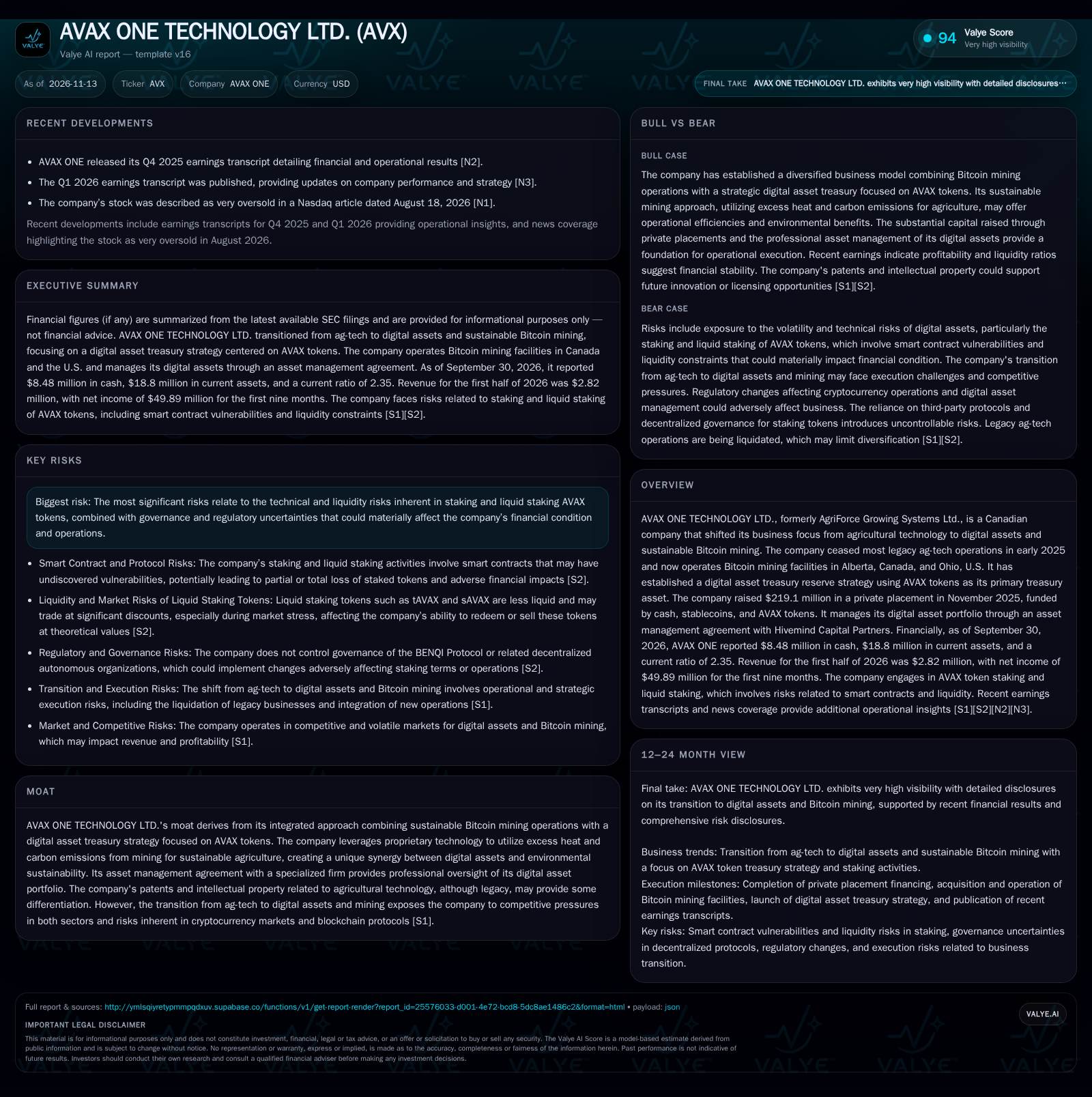
AVAX ONE TECHNOLOGY has transformed itself from an ag-tech operator into a digital asset and Bitcoin mining company, with a treasury strategy centered on AVAX tokens. The company raised $219.1 million in late 2025, operates mining facilities in Canada and the US, and reports strong net income for 2026 to date. However, its exposure to liquid staking, AVAX token price swings, and decentralized protocol risks creates significant uncertainty around future cash flows and asset values. Execution on mining efficiency and risk management will be critical to sustaining profitability in a volatile sector. [S1] [S2]
AVAX ONE TECHNOLOGY’s abrupt transformation—from a struggling ag-tech player to a digital asset and Bitcoin mining operator—has reshaped its risk profile, capital structure, and business model virtually overnight. Its $219 million capital raise and asset management partnership signal ambition to capture both digital asset appreciation and operational alpha in sustainable mining. The next phase will test whether AVAX ONE can turn crypto-native volatility and protocol risk into durable returns—or if its pivot leaves it overexposed to the sector’s sharpest downside shocks.
AVAX ONE’s Strategic Pivot: New Assets, Fresh Risks, and a Recast Financial Profile
AVAX ONE TECHNOLOGY completed its transition from ag-tech to digital assets and Bitcoin mining in early 2025, liquidating almost all legacy operations except the Manna business, which itself is being wound down. The company now operates Bitcoin mining facilities in Alberta, Canada, and Ohio, US, both acquired within the last two years. [S1]
In November 2025, AVAX ONE closed a $219.1 million private placement—funded through a mix of cash, stablecoins, and AVAX tokens—enabling the establishment of a digital asset treasury reserve strategy that centers on AVAX as the main reserve asset. [S1]
As of September 30, 2026, the company reported $8.48 million in cash, $18.8 million in current assets, and a current ratio of 2.35. For the first nine months of 2026, net income reached $49.89 million, with basic and diluted EPS of $6.11. [S2]
AVAX ONE’s digital asset strategy includes delegated and liquid staking of AVAX tokens via the BENQI protocol, exposing it to smart contract vulnerabilities and token liquidity constraints, particularly during market stress. [S2]
How AVAX ONE Could Earn: Mining Margins, Treasury Volatility, and Management Fees
AVAX ONE’s economics now combine two volatile but potentially synergistic streams: Bitcoin mining and digital asset treasury management. Mining revenues depend on Bitcoin prices, mining difficulty, power costs, and the efficiency of mining hardware. Fixed costs include facility leases and capital expenditures for mining rigs, while variable costs are dominated by electricity—potentially mitigated by the company’s focus on sustainable energy and heat utilization.
The digital asset treasury strategy is more complex: the company holds AVAX tokens as a primary reserve asset, actively delegates and stakes these tokens (including liquid staking via BENQI), and pays a 1.25% annual management fee to Hivemind Capital Partners for professional oversight. Treasury returns depend on AVAX token appreciation, staking yields, and the ability to exit or redeploy into liquid markets. Liquid staking introduces the risk that tAVAX and sAVAX may trade at discounts to AVAX, especially in stressed conditions, potentially leading to realized losses if forced to sell.
Operating leverage is theoretically significant: mining operations are capital intensive but can scale revenue rapidly with higher Bitcoin prices, while asset management and staking rewards could expand with digital asset appreciation. However, if digital asset prices fall or staking protocols fail, both revenue streams could contract sharply. The company’s capital needs are front-loaded, but ongoing reinvestment in mining hardware and potential margin calls or redemptions in digital asset protocols could create cash flow volatility.
Competing in Mining and Digital Asset Management: Where AVAX ONE May Find—or Lose—Advantage
AVAX ONE operates in two highly competitive arenas: industrial-scale Bitcoin mining and digital asset investment management. In mining, the primary sources of advantage are low-cost, reliable electricity (potentially from sustainable sources), operational efficiency, and the ability to rapidly deploy or upgrade hardware. The company’s focus on using excess heat and carbon emissions for sustainable agriculture is an intriguing differentiator, but its practical economic impact remains to be proven at scale.
On the treasury side, AVAX ONE’s digital asset reserve strategy and staking activities set it apart from pure miners, but expose it to competition from both institutional digital asset managers and crypto-native funds. The asset management agreement with Hivemind Capital Partners brings professional oversight, but also introduces a fixed cost structure (1.25% of assets) and potential alignment issues. Crucially, the company’s concentration in AVAX tokens ties its fate to the performance and governance of a single blockchain ecosystem—unlike diversified treasuries or multi-protocol staking operations.
Switching costs for digital asset treasury clients are low, but the company’s own capital structure is now highly path-dependent: unwinding large AVAX or liquid staking positions could be costly in illiquid markets. Regulatory and protocol risks are also higher than for traditional miners or asset managers.
If AVAX Tokenomics and Mining Efficiency Align, Value Creation Could Be Substantial
The most favorable scenario for AVAX ONE is a period of strong AVAX token appreciation, robust staking yields, and stable or rising Bitcoin prices. In this environment, the company’s treasury would benefit from both capital gains and staking income, while mining operations could achieve high margins if energy costs remain contained.
If liquid staking protocols like BENQI prove resilient—maintaining liquidity and minimizing smart contract failures—AVAX ONE could convert protocol yield and token appreciation into distributable cash flow. The professional asset management overlay could optimize yield strategies and risk management, capturing upside from digital asset innovation while limiting downside from protocol-specific shocks.
Confirmation of this scenario would come from sustained net income growth, increasing asset values on the balance sheet, and evidence of high mining uptime and efficiency. Additional signs would include successful reinvestment of staking returns into productive assets and the ability to exit liquid staking positions at or near par value, even during periods of market stress. [S2]
Likely Outcomes: Volatility, Episodic Profitability, and Ongoing Execution Risk
The most plausible path for AVAX ONE is continued exposure to the volatility of both Bitcoin and AVAX token markets, with profitability swinging quarter-to-quarter based on digital asset prices, mining output, and staking yields. Mining operations may deliver positive gross margins if energy costs remain competitive, but will face margin compression during Bitcoin price downturns or if regulatory costs rise.
Digital asset returns will likely be mixed: periods of high staking yields and token appreciation may be offset by drawdowns in AVAX value, illiquidity in tAVAX/sAVAX, or losses from protocol issues. The company’s professional asset management agreement may help optimize risk-adjusted returns, but also locks in a fixed fee regardless of performance.
Evidence supporting this scenario would include fluctuating—but not collapsing—quarterly earnings, periodic rebalancing of the treasury portfolio, and disclosures of realized gains and losses from staking activities. Neutral or modest changes in current assets, with no sharp drawdowns, would further confirm a steady-state business exposed to sector cyclicality. [S2] [N2] [N3]
When Digital Asset Risks Materialize: Protocol Failures, Forced Liquidations, and Mining Headwinds
The bear scenario unfolds if AVAX token prices fall sharply or if liquid staking protocols suffer smart contract failures, governance attacks, or prolonged illiquidity. In this case, AVAX ONE could face both mark-to-market losses on its treasury and the inability to exit or redeem tAVAX/sAVAX positions at reasonable prices, materially impairing liquidity and solvency.
Simultaneously, if Bitcoin prices decline or mining difficulty rises, the company’s mining operations could become cash-flow negative, especially if energy costs are not fully hedged. Regulatory or tax changes affecting crypto mining in Canada or the US could further erode margins or force costly operational adjustments.
Confirmation of this scenario would come from large, sudden write-downs in digital asset values, negative operating cash flow, asset impairment charges, or disclosures of failed redemption attempts in staking protocols. A rapid deterioration in the current ratio or cash balance, combined with negative earnings, would further validate this adverse outcome. [S2]
What Will Determine Whether AVAX ONE’s Digital Asset Strategy Delivers on Its Ambition?
Quarterly changes in the fair value of AVAX tokens and liquid staking positions (tAVAX, sAVAX), as disclosed in SEC filings, will be critical for tracking treasury performance and risk exposure. [S2]
Actual realized returns and losses from staking, delegation, and mining operations—if disclosed—would clarify how much yield is being captured versus risk absorbed.
Mining facility uptime, hashrate, and energy cost per mined Bitcoin—ideally disclosed in earnings transcripts or filings—would help estimate operating leverage and margin sustainability.
Fee payments and performance under the Hivemind Capital Partners asset management agreement, including any changes to the management fee structure, would indicate cost discipline and alignment.
Progress on the liquidation of the legacy Manna business and any further divestiture of non-core assets could impact available cash and management focus.
Any regulatory developments affecting digital asset custody, staking protocols, or mining activities in the company’s jurisdictions could materially alter business economics.
Evidence of the company’s ability to exit or rebalance liquid staking positions at or near par value, especially during periods of market stress, would test the resilience of its digital asset strategy.
Management commentary on risk mitigation, treasury rebalancing, or hedging strategies—if provided in earnings calls or filings—would help assess preparedness for adverse scenarios.
Disclaimer: This is research-only, informational analysis and not investment advice. It may include AI-generated interpretation and general industry context. Always verify important details using primary sources.

Comments