
Bio-Techne: Navigating Profitability Pressures and Strategic Expansion in Life Science Tools
The company’s ability to translate its scientific expertise and broad portfolio into high-value diagnostics and research tools will be tested by industry complexity and operational execution demands.
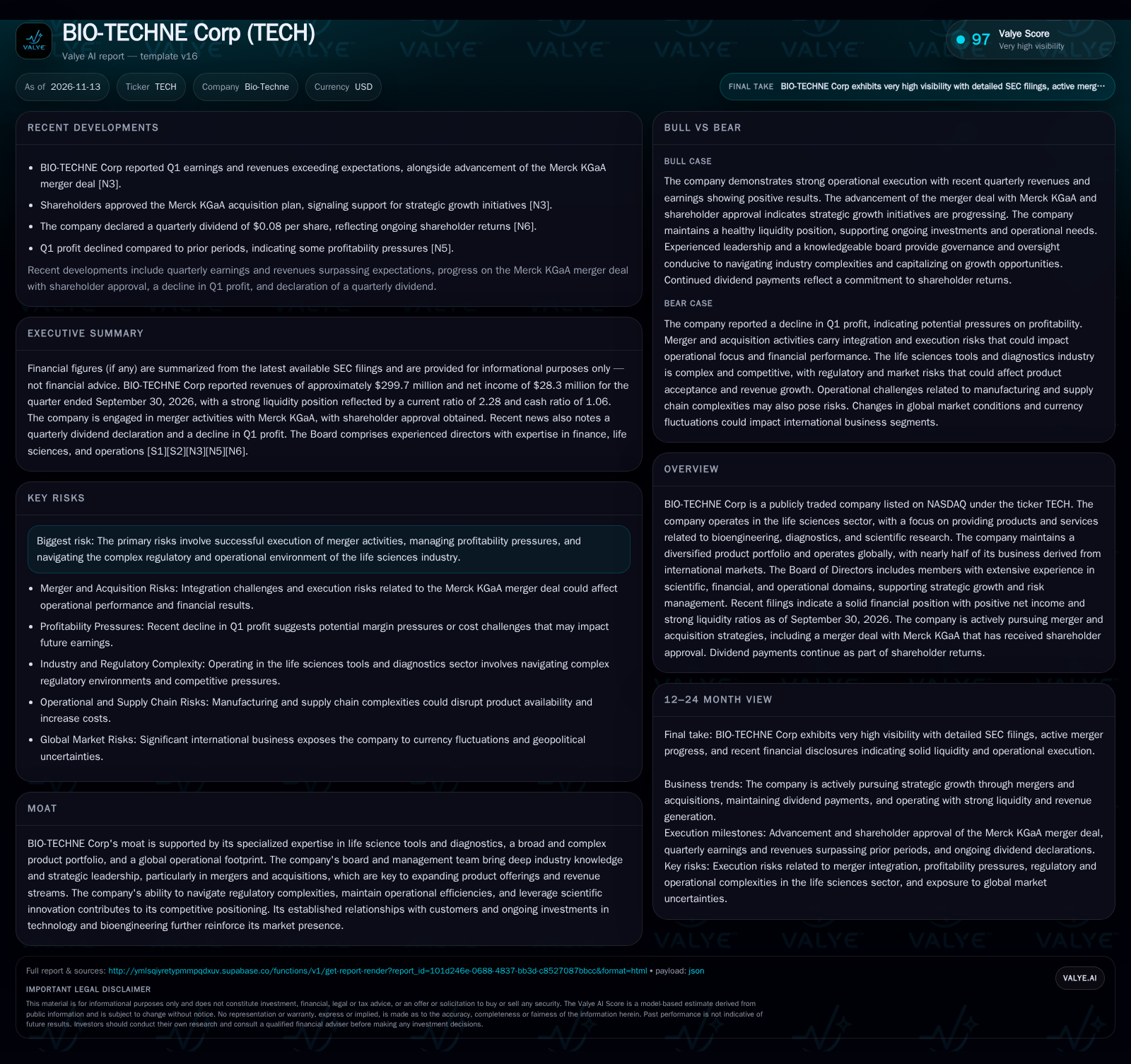
Bio-Techne reported $299.7M in Q3 2026 revenue and $28.3M net income, maintaining reported liquidity position (current ratio 2.28), despite a year-over-year profit decline. The company is progressing in its merger with Merck KGaA, continues to pay dividends, and relies on a global, diversified product base. Execution on integration and margin improvement will shape its performance in the coming year. [S2] [N3] [N5] [N6]
Bio-Techne Corp stands at a strategic crossroads as 2026 closes, balancing the strengths of a large, global life sciences platform with emerging profitability pressures and the complexity of a major merger. As Bio-Techne moves to deepen its diagnostics and research tools leadership—supported by a seasoned board and ongoing investments—the next year will test its ability to integrate acquisitions, defend margins, and capitalize on a broadening market opportunity.
Strategic Merger Moves and Margin Pressures Define Late 2026
Bio-Techne reported $299.7 million in revenue and $28.3 million in net income for the quarter ended September 30, 2026, translating to basic and diluted EPS of $0.18 per share [S2]. The company reported a current ratio of 2.28 for the period. [S2] [N5] The company is also advancing its merger with Merck KGaA, which raises the stakes for integration execution and future financial performance [N3]. The cited source reports dividend-related activity; that disclosure alone does not establish dividend-policy continuity, management confidence, or a material constraint on capital flexibility. [N6] Together, these developments highlight a business that is solidly resourced for growth but navigating heightened operational and strategic complexity.
How Bio-Techne’s Product Mix and Global Scale Influence Profitability
Bio-Techne’s core economics are shaped by its broad portfolio of biotechnology reagents, instruments, and services for research and clinical diagnostics. The company’s revenue is likely driven by a mix of consumable reagents (such as proteins, antibodies, and assay kits) and higher-ticket instrumentation, with recurring revenue potential from consumables and service contracts. Gross margins in life sciences tools tend to be robust for proprietary reagents but can be pressured by competition, input cost inflation, and currency swings—especially for global players. Fixed costs in R&D, manufacturing infrastructure, and regulatory compliance are significant, but scale and product breadth can yield operating leverage if volume growth outpaces overhead. The recent profit decline suggests that cost pressures or unfavorable mix effects are offsetting revenue gains, at least temporarily. The advancing Merck KGaA merger, if completed, could alter the company’s capital structure and integration costs, but also offer new revenue streams and scale benefits if synergies are realized.
A nuanced understanding of Bio-Techne's profitability dynamics requires considering the elasticity of demand across its product categories. Consumables typically exhibit more inelastic demand due to their recurring necessity in experimental workflows, which can provide a steady revenue base and buffer against short-term volume fluctuations. Conversely, instrumentation sales are often more cyclical and sensitive to capital expenditure trends within research institutions and clinical labs. This dichotomy implies that shifts in customer investment behavior or funding availability could disproportionately impact segments, influencing overall margin profiles. Furthermore, the company's exposure to foreign exchange risk is amplified by its global supply chain and sales footprint, necessitating sophisticated hedging strategies to mitigate volatility that can erode reported earnings.
Operational leverage within Bio-Techne's business model is contingent on achieving scale efficiencies in manufacturing and R&D, but also on optimizing the product portfolio mix toward higher-margin offerings. The company's ability to innovate proprietary reagents or assays that command premium pricing can enhance gross margins, yet this requires sustained investment and successful commercialization. Additionally, regulatory compliance costs remain a fixed overhead that can disproportionately weigh on smaller or emerging product lines. Therefore, strategic prioritization of products with favorable risk-reward profiles and potential for market differentiation is critical. The merger integration introduces complexity in aligning disparate cost structures and realizing synergies, which if delayed or incomplete, could suppress operating leverage benefits in the near term.
Defending Differentiation in a Crowded Life Sciences Landscape
Bio-Techne’s competitive positioning rests on its specialized expertise in life science tools, diagnostics, and a broad scientific product catalog. The company faces competition from both large diversified life science conglomerates and specialized reagent or instrument providers. Its moat is reinforced by proprietary technology, depth in protein sciences, and long-standing customer relationships in research and diagnostics. However, barriers to entry are moderate for many reagent categories, and price competition is intense. Switching costs for academic and pharma customers can be meaningful if protocols are tied to specific reagents or instrumentation, but genericization and new entrants remain persistent threats. The company’s global footprint and ability to navigate regulatory complexity provide some defense, but also expose it to currency volatility and compliance risks. Successful integration of the Merck KGaA merger could strengthen Bio-Techne’s market position by expanding its product set and customer reach, but integration missteps could erode these advantages.
In a competitive landscape characterized by rapid technological advancement and evolving customer needs, Bio-Techne’s differentiation depends not only on product quality but also on its ability to anticipate and adapt to emerging scientific trends. For example, the rise of personalized medicine and advanced molecular diagnostics demands increasingly sophisticated tools, which can provide opportunities for companies that invest in cutting-edge R&D and agile product development cycles. However, this also raises the bar for maintaining proprietary advantages, as competitors may rapidly replicate innovations or develop alternative solutions. The company’s success in sustaining its competitive moat will likely hinge on its capacity to foster strong collaborative relationships with key opinion leaders and integrate customer feedback into iterative product enhancements.
Moreover, Bio-Techne’s global reach exposes it to heterogeneous regulatory environments, each with distinct approval processes and market access challenges. Navigating these complexities requires robust compliance frameworks and localized market strategies, which can increase operational costs but also create barriers to entry for less established competitors. Currency fluctuations and geopolitical factors add further layers of uncertainty that can impact pricing strategies and supply chain resilience. The company’s ability to balance these risks while leveraging its scale to negotiate favorable supplier terms and distribute fixed costs across a wider base will be instrumental in preserving its competitive position over time.
Unlocking Value Through Successful Merger Integration and Margin Recovery
If Bio-Techne executes a smooth integration with Merck KGaA, realizes cost and revenue synergies, and stabilizes or expands margins, the company could accelerate both top-line and bottom-line growth. Upside would be confirmed by sequential margin improvement, growing revenue per customer, and evidence of cross-selling or expanded market share in research and diagnostics. A successful merger could also catalyze further innovation and portfolio differentiation, especially if R&D pipelines are combined effectively. Falsification of this scenario would be signaled by persistent integration costs, margin compression, or customer churn following the merger.
Gradual Progression Amid Margin Headwinds and External Complexity
The most plausible trajectory is for Bio-Techne to maintain steady revenue growth, supported by its global footprint and diversified offerings, while navigating moderate margin pressure from input costs, integration expenses, and pricing competition. Modest improvements in profitability could occur if operational efficiencies are realized or if the product mix shifts toward higher-margin categories. This scenario could be falsified by a sustained decline in margins, revenue stagnation, or major disruptions from the merger process.
Merger Disruption and Margin Erosion Threaten Core Value Proposition
A negative outcome could materialize if the Merck KGaA merger creates operational dislocations, drives up integration costs, or results in significant customer or key employee losses. Margin erosion could be exacerbated by ongoing input cost inflation, supply chain disruptions, or intensified price competition from both established peers and agile new entrants. Downside would be confirmed by a further decline in quarterly profit, negative operating or free cash flow, or a cut to the dividend. Additional warning signs would include delayed or missed integration milestones, regulatory setbacks, or visible customer attrition in core segments.
What Could Shift Bio-Techne’s Thesis in 2027 and Beyond
Quarterly gross and operating margin trends—especially post-merger—would help test whether profitability is stabilizing or eroding.
Integration progress metrics for the Merck KGaA deal, such as disclosed synergy realization, cost savings, and retention of key talent.
Revenue growth and customer retention rates in core reagent and diagnostics segments, if disclosed, to gauge organic momentum.
Trends in R&D spending and new product launches, signaling continued innovation and potential differentiation.
Geographic revenue mix and currency impact disclosures to assess sensitivity to international market swings.
Evidence of supply chain stability or disruption, especially as the company scales post-merger.
Disclaimer: This is research-only, informational analysis and not investment advice. It may include AI-generated interpretation and general industry context. Always verify important details using primary sources.

Comments