
QuoteMedia’s Liquidity Strain and Competitive Stakes: Is Product Breadth Enough for SaaS Scale?
QuoteMedia, a financial data SaaS provider serving brokerages and media, reported Q3 losses and acute liquidity pressure despite diversified offerings and technical strengths. The company’s future hinges on its ability to monetize product breadth, manage funding gaps, and withstand intensifying competition from larger data vendors.
The company’s broad SaaS product suite and scalable data infrastructure serve diverse financial clients, but competitive and funding pressures pose substantial risks. Sustainable growth will depend on QuoteMedia’s ability to convert product depth into higher-margin, recurring revenue while addressing short-term potential financial flexibility challenges. [S2]
As a provider of real-time financial data and analytics to brokerages, banks, and media, QuoteMedia’s ability to leverage its technology platform and product breadth is tested by fierce industry competition and the immediate need for improved potential financial flexibility. The company’s next phase will be defined by its capacity to translate technical differentiation into recurring, higher-margin revenue streams while navigating funding and regulatory risks. [S2]
Liquidity Risks Dominate Amid Persistent Net Losses
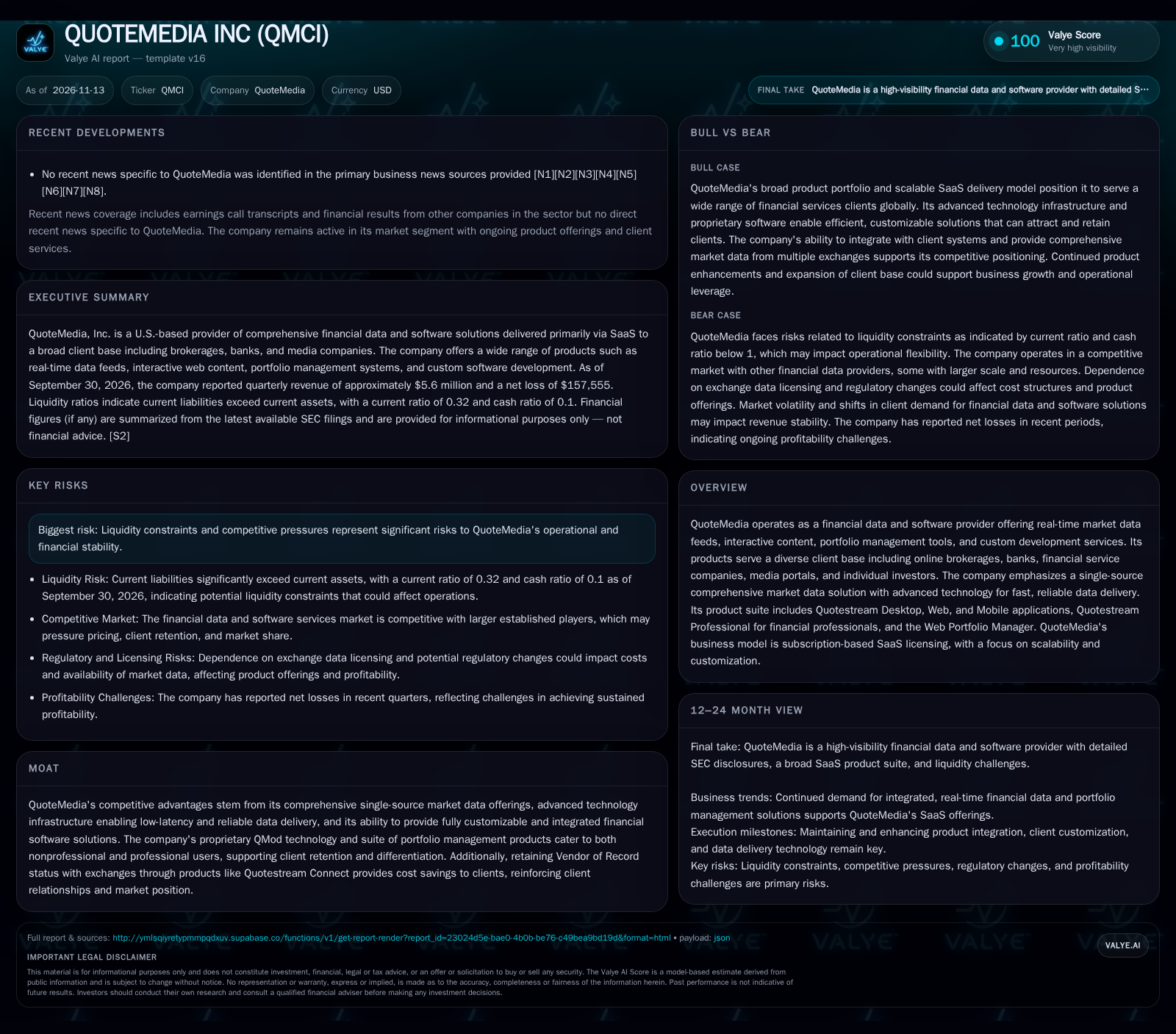
As of September 30, 2026, QuoteMedia reported $5.6 million in quarterly revenue, but continued to post a net loss of $157,555 for the third quarter and $1.14 million for the first nine months of the year. More critically, its current assets stand at $2.1 million against $6.5 million in current liabilities, yielding a current ratio of 0.32 and a cash ratio of 0.1. These metrics highlight a pressing liquidity challenge, raising questions about the company’s ability to meet near-term obligations and maintain operational continuity without external funding or improved cash flow. [S2]
The company’s operating expenses for Q3—spanning sales and marketing, general administration, and software development—reflect the resource demands of a SaaS and data infrastructure business. While revenue generation remains robust, the persistence of net losses and the acute liquidity gap are now central to the investment and operating thesis. [S2]
In addition to the liquidity ratios, it is critical to consider the timing and structure of QuoteMedia’s liabilities and cash flow cycles. If a significant portion of current liabilities comprises short-term debt or payable accounts with inflexible payment terms, the liquidity strain could intensify, potentially forcing the company to prioritize creditor payments over operational investments.
How QuoteMedia’s SaaS Model Could Unlock Operating Leverage
QuoteMedia’s business model is characterized by subscription-based SaaS licensing for real-time market data, analytics, and custom web solutions. Revenue is primarily driven by recurring contracts with brokerages, banks, and media entities, who depend on timely, high-quality data feeds for their end-users. The company’s technological infrastructure, which aggregates and delivers data from over 70 exchanges, enables scalable delivery at relatively low marginal cost once fixed systems are in place. This model, in theory, should support operating leverage as incremental clients add revenue with limited variable expense.
However, the current cost structure—evident in ongoing net losses—suggests that either pricing power, client scale, or retention is not yet sufficient to cover the fixed costs of maintaining and enhancing the platform. Operating expenses include significant outlays for software development and marketing, both essential for client acquisition and product improvement in a competitive sector. The capital-light nature of SaaS is counterbalanced by the need for continuous investment in technology and data licensing, as well as regulatory compliance costs. Without a step-change in revenue scale, improved pricing, or a shift in the expense base, QuoteMedia’s path to positive operating leverage remains uncertain.
The potential for operating leverage in QuoteMedia’s SaaS model also hinges on customer lifetime value (CLV) relative to customer acquisition cost (CAC). If the company can increase CLV through upselling premium analytics or expanding product usage within existing accounts, the fixed costs of platform maintenance become more efficiently allocated. However, if CAC remains elevated due to intense competition or if churn rates are high, this dynamic could suppress margin expansion. Additionally, regulatory compliance costs, particularly those tied to exchange licensing and data privacy, may not scale linearly with revenue, potentially imposing step-function increases that challenge operating leverage assumptions. Thus, achieving a sustainable cost-to-revenue ratio requires balancing growth investments with retention and compliance efficiency.
Single-Source Data Aggregation: Differentiator or Commodity in a Crowded Field?
QuoteMedia positions itself as a single-source provider of global market data, customizable analytics, and portfolio management tools, emphasizing proprietary technology and integration flexibility. The ability to deliver real-time, multi-asset data feeds and custom modules (such as QMod and Quotestream) creates potential switching costs for embedded clients, especially those requiring deep integration or regulatory reporting.
Yet, the competitive landscape is marked by much larger global data vendors and financial software giants, many of whom benefit from scale, entrenched client relationships, and broader product ecosystems. Price competition, bundled offerings, and the risk of client migration to integrated platforms from major players challenge QuoteMedia’s ability to command premium pricing or retain large accounts. Furthermore, regulatory and exchange licensing dependencies mean that data feed costs and access terms can shift, potentially eroding margins or limiting differentiation. The company’s ability to maintain a technological edge and deepen client integration will be critical in defending its niche and justifying its value proposition.
The differentiation offered by QuoteMedia’s single-source aggregation model may face erosion if larger competitors leverage their scale to negotiate more favorable data licensing agreements or bundle offerings at lower effective prices. This could commoditize the data feed component, pushing QuoteMedia to compete primarily on service customization and integration capabilities. However, the company’s proprietary technology and flexible architecture could provide a moat if it enables rapid adaptation to client-specific workflows or regulatory changes that larger vendors address more slowly. The extent to which QuoteMedia can embed itself deeply within client operations, creating switching costs through bespoke solutions and data integration, will be pivotal in defending against commoditization and margin pressure.
What Could Drive a Turnaround: From Product Breadth to Recurring Margin Expansion
A favorable outcome for QuoteMedia would hinge on successful monetization of its comprehensive product suite, leading to higher recurring revenue per client and improved retention. If the company is able to leverage its proprietary delivery technology (such as ultra-low latency feeds and customizable modules) to win new mid-market and enterprise clients, operating leverage could improve as incremental revenue outpaces fixed cost growth.
Confirmation of this scenario would come from sequential revenue acceleration, a narrowing of net losses or a return to profitability, and evidence of multi-year contract wins or renewals with major financial institutions. Additional signals could include improved client mix (with a higher proportion of enterprise customers), increased usage of premium products, and the announcement of strategic partnerships that extend reach without commensurate increases in cost.
Falsification would be signaled by continued flat or declining revenue, persistent net losses without expense discipline, or client attrition to larger competitors despite product enhancements.
Navigating Margin Pressure in a Scale-Constrained Environment
The most plausible middle path for QuoteMedia is one in which the company continues to grow revenue modestly, but struggles to achieve the scale or pricing power necessary to consistently offset operating expenses and data licensing costs. In this scenario, product enhancements attract incremental clients and support retention, but competitive pricing and the need for ongoing development limit margin expansion.
Falsification would come if the company either achieves a step-change in profitability (suggesting true operating leverage) or, conversely, if revenue growth stalls and losses widen, forcing a more dramatic restructuring.
Liquidity Crunch and Client Losses Amplify Downward Spiral Risk
The bear case for QuoteMedia centers on the risk that persistent liquidity constraints and net losses erode operational flexibility, leading to reductions in product development, client service quality, or regulatory compliance. This could trigger client defections, particularly among larger accounts that require reliability and deep integration. In a worst-case scenario, the company could face difficulty meeting obligations to exchanges or vendors, risking service interruptions or reputational damage.
Such a downward spiral would likely be indicated by accelerating net losses, declining revenue, shrinking client count or market share, and deteriorating liquidity metrics. Additional warning signs would include the need for distressed financing, layoffs, or the loss of material client contracts.
What Will Determine QuoteMedia’s Ability to Convert Product Scale into Sustainable Profits?
Quarterly revenue growth rates and year-over-year trends—particularly any inflection upward or loss of momentum.
Gross and operating margin progression, especially evidence of expanding margins as revenue scales (if disclosed).
Net cash flow from operations and changes in liquidity ratios, as indicators of funding pressure or improvement.
Client retention rates and new contract wins, especially in the enterprise and brokerage segments (if disclosed).
The mix of recurring versus nonrecurring revenue, as a proxy for business model resilience (if disclosed).
Evidence of pricing power, such as successful premium product upsells or reduced discounting (if disclosed).
Material changes in the competitive landscape or regulatory environment that alter data licensing costs or access.
Announcements of external funding, asset sales, or cost restructuring initiatives that could alleviate liquidity stress.
Disclaimer: This is research-only, informational analysis and not investment advice. It may include AI-generated interpretation and general industry context. Always verify important details using primary sources.

Comments