
Spero Therapeutics: Pipeline Focus, Partner Collaborations, and the Critical Approval Journey
With its future now hinging on tebipenem HBr and key partnerships, Spero Therapeutics faces the classic high-reward, high-risk profile of a clinical-stage biotech—where clinical success, regulatory clarity, and partnership durability will determine whether its recent strategic shifts translate to sustainable value.
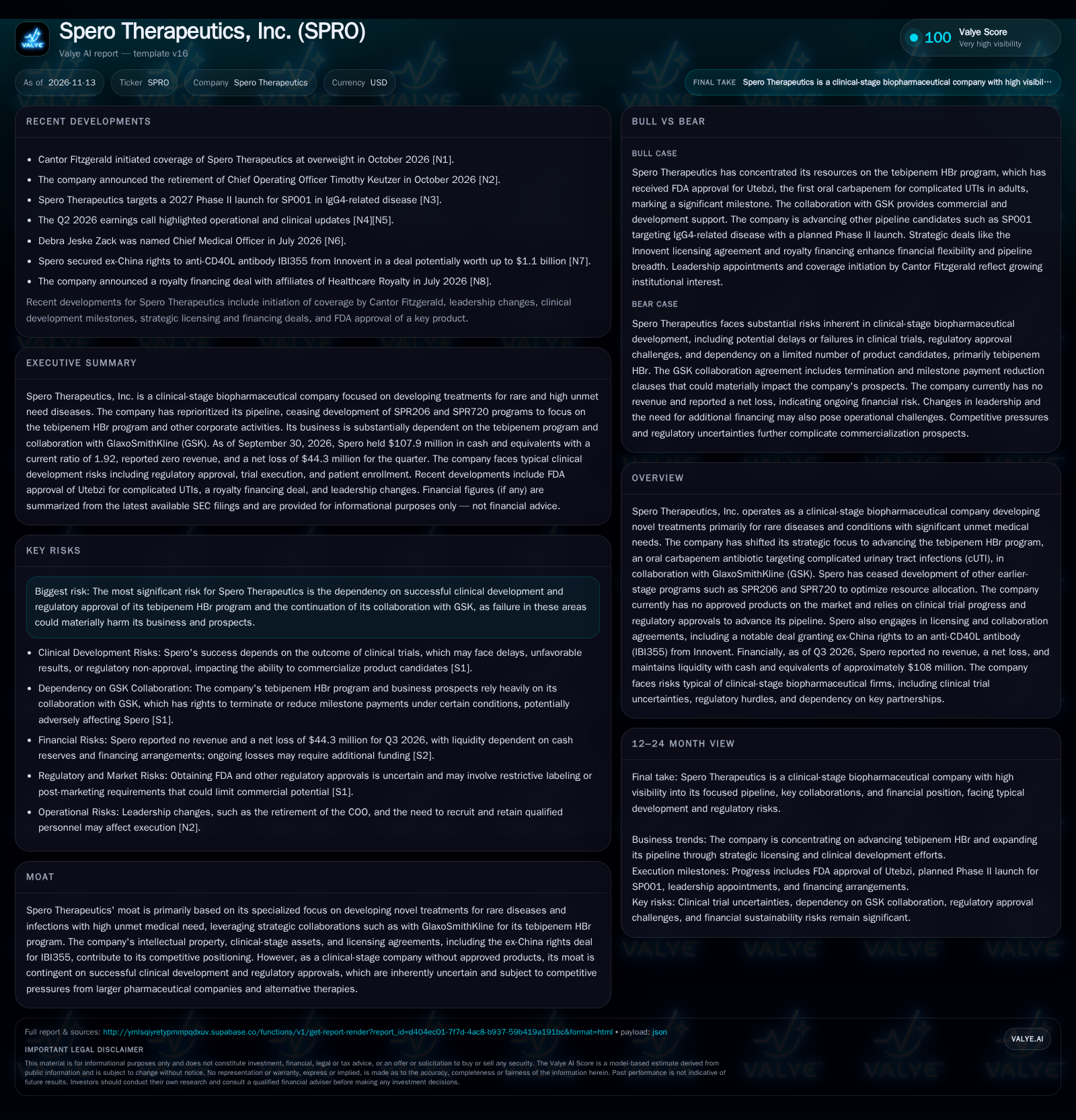
Spero Therapeutics has exited multiple early-stage programs to concentrate on tebipenem HBr, an oral antibiotic for complicated UTIs, now in partnership with GSK. Despite a reported cash position ($107.9M as of Q3 2026) and new licensing and royalty deals, Spero remains a pre-revenue company with ongoing net losses and acute dependency on clinical, regulatory, and partnership outcomes. Recent leadership changes and pipeline additions (SP001, IBI355) offer optionality, but the next phase will be defined by tebipenem’s fate and the stability of its GSK collaboration. [S1] [S2] [N7] [N8]
Spero Therapeutics, Inc. sits at a pivotal crossroads: after exiting its SPR206 and SPR720 programs, the company has doubled down on tebipenem HBr—an oral antibiotic for complicated urinary tract infections—in a partnership with GlaxoSmithKline. This strategic narrowing intensifies both risk and potential reward, as Spero’s prospects are now tightly bound to the clinical and commercial fate of a single asset and the durability of a single key relationship. With no approved products and ongoing operating losses, Spero is leveraging its remaining cash, new licensing agreements, and royalty financing to extend its runway. The company’s future will be determined by its ability to deliver on tebipenem, manage partnership terms, and translate a focused pipeline into regulatory and commercial traction. [S1] [S2] [N7] [N8]
Strategic Developments and Financial Landscape
The past year has seen Spero Therapeutics make decisive pipeline cuts, discontinuing both SPR206 and SPR720 to focus resources on the tebipenem HBr program—now the company’s main value driver and the centerpiece of its collaboration with GlaxoSmithKline (GSK) [S1]. This bet on tebipenem is high-conviction but increases single-asset dependency. Financially, Spero ended Q3 2026 with $107.9 million in cash and equivalents, a current ratio of 1.92, and no revenue for the period, alongside a net loss of $44.3 million [S2]. The lack of revenue underscores the company’s reliance on external funding and partnership support. Notably, Spero has broadened its pipeline through a licensing agreement with Innovent for IBI355 (anti-CD40L antibody, ex-China rights, potential value up to $1.1 billion) [N7] and secured a royalty financing deal with Healthcare Royalty in July 2026 [N8], both moves aimed at shoring up future optionality and potential financial flexibility. Leadership changes—including the appointment of Debra Jeske Zack as Chief Medical Officer and the retirement of COO Timothy Keutzer—signal ongoing organizational adaptation [N6] [N2].
Economics of a Concentrated Pipeline and Capital Needs
Spero’s business model is typical of clinical-stage biotechs: significant front-loaded R&D investment, no product revenue, and a dependency on milestone payments, licensing, and external financing for survival. The economics of tebipenem HBr are potentially attractive if it becomes the first approved oral carbapenem for complicated urinary tract infections (cUTI), a setting where effective oral therapies could reduce hospital stays and intravenous antibiotic use. However, the cost base is dominated by clinical development and regulatory costs—highly fixed until approval inflection points are reached. The GSK partnership could provide non-dilutive funding through milestones and, if commercialized, royalties or profit-sharing; however, the agreement allows GSK to terminate or reduce payments under certain adverse conditions, introducing revenue discontinuity risk [S1].
The royalty financing deal with Healthcare Royalty offers near-term liquidity but will reduce future net cash flows from successful products, creating a trade-off between current runway and long-term margin potential [N8]. The IBI355 licensing deal, while headline-grabbing in potential value, only translates to material economics if the program advances successfully and achieves milestones [N7]. Absent product approval, funding needs will remain acute, with dilution or expensive capital likely if clinical or regulatory timelines slip.
Niche Expertise, Partner Roles, and Competitive Risks
Spero’s competitive stance is anchored in its specialization: targeting unmet needs in infectious disease and rare immunological conditions. Tebipenem HBr’s promise is in potentially providing an oral alternative to IV carbapenems for cUTI, a gap that, if filled, could shift standard-of-care and offer significant prescriber and patient appeal. Yet, this niche is also a target for larger pharmaceutical players and generics, especially if tebipenem’s clinical profile fails to show clear superiority or safety advantages over existing therapies.
The GSK collaboration provides scale and validation but also introduces dependency risk. If GSK reallocates resources or strategic focus, Spero's single-asset reliance could become a liability. Pipeline additions like IBI355 (autoimmune) and SP001 (targeting IgG4-related disease) aim to diversify the risk base, but both are early-stage and face formidable competition from established immunology players. The true competitive moat will only materialize if Spero can secure regulatory approval, demonstrate clinical differentiation, and maintain strong partner alignment.
Potential Outcomes if Tebipenem HBr Gains Approval with Current Partnerships
A favorable scenario unfolds if tebipenem HBr delivers positive pivotal trial results, secures timely FDA approval, and GSK remains committed to commercialization. In this case, Spero could benefit from milestone payments, royalty streams, and the validation needed to raise further capital or attract additional partnerships. The market opportunity for an oral carbapenem in cUTI is substantial, especially if adoption leads to reduced hospitalization rates and payer receptivity.
The upside would be confirmed by: 1) successful completion of key clinical trials for tebipenem; 2) clear communication from GSK affirming continued collaboration and commercial plans; 3) regulatory milestones achieved without major delays; and 4) early evidence of prescriber uptake if approved. Additional pipeline progress (e.g., SP001 advancing to Phase II as targeted for 2027 [N3]) and monetization of the IBI355 asset would further strengthen the case.
Execution Challenges Amid Funding Constraints and Pipeline Advances
The most plausible near-term outcome is a period of focused execution on tebipenem HBr, with Spero managing cash burn while progressing toward key clinical and regulatory milestones. Pipeline programs like SP001 and IBI355 provide optionality, but are unlikely to drive near-term economics. The GSK partnership likely remains in place, but with continued mutual assessment of asset potential and commercial viability.
Evidence supporting this scenario would be steady clinical progress for tebipenem, prudent cost management, timely achievement of pipeline milestones (such as the planned 2027 Phase II launch of SP001 [N3]), and no material deterioration in partnership terms. However, delays in trial enrollment, regulatory feedback, or incremental cash raises could extend timelines and raise dilution risk.
Risks from Reliance on a Single Asset and Partnership Outcomes
The major risk is that tebipenem HBr experiences clinical setbacks, regulatory rejection, or adverse safety signals, forcing Spero to seek further capital with a weakened story and no near-term revenue prospects. If GSK terminates or reduces its commitment—enabled by contract terms—Spero could lose both funding and commercialization leverage, compounding financial pressure [S1].
In this scenario, Spero’s remaining pipeline assets (SP001, IBI355) are too early-stage to offset value loss, and the company may be forced into dilutive financings, strategic asset sales, or a search for new partnerships under less favorable terms. Confirmation would come from negative clinical trial updates, FDA feedback indicating major regulatory hurdles, or GSK signaling reduced engagement or outright termination of the agreement.
Spero’s Key Milestones and Performance Drivers
Progress and outcome of pivotal clinical trials for tebipenem HBr, including enrollment rates, safety signals, and efficacy data.
Any material updates to the GSK collaboration, such as milestone payments, contract amendments, or public statements of commitment or withdrawal.
Regulatory feedback from the FDA or other authorities on tebipenem HBr, especially regarding approvability and potential label restrictions.
Cash burn rate and projected runway, factoring in new financing, milestone receipts, and royalty obligations—if disclosed.
Advancement of SP001 into Phase II for IgG4-related disease by 2027, as targeted [N3].
Progress on the IBI355 program, including any disclosed clinical trial initiations or milestone payments.
Leadership stability and further changes in the management team, which could affect execution.
Disclaimer: This is research-only, informational analysis and not investment advice. It may include AI-generated interpretation and general industry context. Always verify important details using primary sources.

Comments