
NET Power’s Pivot to Gas-Fired Generation: Execution Risk and the Search for Data Center Deals
NET Power Inc. has shelved its flagship carbon capture technology to pursue natural gas power projects targeted at large-load customers—especially data centers—amid permitting headwinds and a critical need for binding offtake agreements.
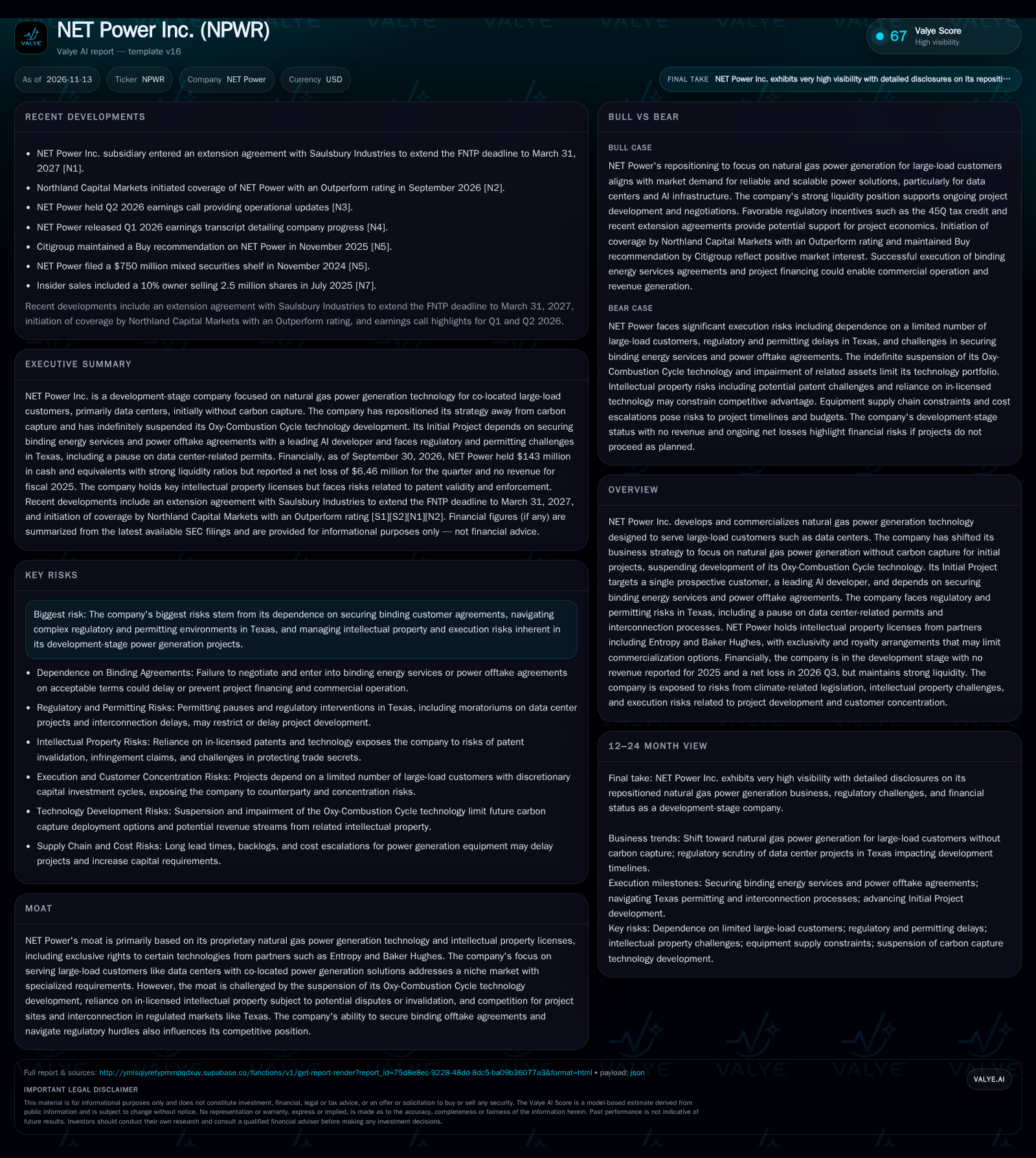
NET Power is now focused on supplying natural gas power to large-load customers like data centers, having suspended its carbon capture technology. Its initial project depends on securing a binding agreement with a major AI developer but faces regulatory and permitting delays in Texas. The company remains pre-revenue, reported a net loss for Q3 2026, and holds $143 million in cash, giving it liquidity but not revenue visibility. Key risks include customer concentration, regulatory obstacles, and heavy reliance on in-licensed technology.[S1] [S2] [N1] [N2]
NET Power Inc. is at a critical inflection point after shelving its once-flagship Oxy-Combustion Cycle carbon capture technology to focus on supplying natural gas-fired power directly to large-load customers such as data centers. While the company holds a substantial cash position and has garnered positive attention from analysts, actual commercial traction remains elusive. Its business now centers on executing a single high-stakes project for a major AI customer, whose commitment is not yet secured. Regulatory pauses and permitting delays in Texas, combined with the risks of customer concentration and reliance on third-party intellectual property, present significant barriers. NET Power’s future will be determined by its ability to convert development-stage promise into binding customer agreements and operational projects.[S1] [S2] [N1] [N2]
Project Delays, Strategic Pivot, and Customer Dependence Define the Present
NET Power’s operational reality is defined by three interlocking facts: its indefinite suspension of the Oxy-Combustion Cycle carbon capture technology, a strategic pivot to natural gas-fired power generation without carbon capture, and a development pipeline anchored by a single prospective project for a major AI developer.[S1] [S2] As of September 30, 2026, the company held $143 million in cash and equivalents but reported no revenue for 2025 and a net loss of $6.46 million for Q3 2026.[S2] Its ability to advance the Initial Project is hampered by regulatory and permitting delays in Texas, including a pause on data center-related permits and interconnection processes. The recent extension of the FNTP (Full Notice to Proceed) deadline to March 31, 2027, underscores both the slow progress and the continued development focus.[N1]
How NET Power’s New Model Could Generate Value—If Execution Follows
NET Power’s economics now hinge on providing reliable, potentially lower-emission natural gas power at scale for large-load customers—most notably data centers. The company’s business model, in its current form, requires securing long-term energy service or power offtake agreements with a small number of customers. If these contracts are achieved, they could provide multi-year revenue visibility and justify the capital-intensive development of new generation assets.
Pricing power may depend on the scarcity value of reliable, locally generated power for data centers in grid-constrained regions. However, without carbon capture, NET Power’s offering competes more directly with conventional gas plants, potentially limiting margins unless it can demonstrate unique efficiency, reliability, or regulatory advantages. Project development will require substantial up-front capital and long lead times, with revenues unlikely until after commercial operation commences. This creates a period of negative operating leverage, with fixed costs dominating until—and unless—binding agreements and project financing are secured.
The company reported cash and liquidity metrics for the period; these figures do not by themselves establish operating runway, investment capacity, financial flexibility, or financing capacity. [S2]
Technology, Licensing, and Regulatory Headwinds Shape NET Power’s Edge—And Its Limits
NET Power’s moat is rooted in its proprietary natural gas generation technology and exclusive intellectual property licenses from partners such as Entropy and Baker Hughes.[S1] This could provide a competitive edge if the technology offers cost, reliability, or efficiency benefits for large-load customers. However, the indefinite suspension of its Oxy-Combustion Cycle technology diminishes its differentiation—especially as the market increasingly values low- or zero-carbon solutions for data center power.
The company’s reliance on in-licensed intellectual property introduces vulnerability: exclusivity and royalty arrangements could constrain flexibility, while patent challenges or disputes could erode its competitive position. Regulatory and permitting challenges are another major counterforce: Texas, the company’s initial market, has imposed permitting pauses for data center-related projects and slowed interconnection approvals, increasing the risk that competitors or substitutes (such as traditional utilities, on-site renewables, or modular nuclear) capture the available demand.
In this environment, NET Power’s ability to secure binding offtake agreements and demonstrate reliable execution will be crucial to building enduring customer relationships and fending off substitute technologies.
Transformative Customer Win Could Unlock Commercialization and Market Confidence
A favorable scenario for NET Power would see the company securing a long-term, binding energy services or power offtake agreement with its targeted AI developer customer. This would catalyze project financing, enable construction to proceed, and potentially establish NET Power as a credible, scalable provider of reliable power for data centers. If regulatory and permitting barriers in Texas are resolved or workarounds are found, project timelines could accelerate.
Confirmation of this upside would likely be signaled by: (1) public disclosure of a binding contract with a large-load customer; (2) movement beyond the FNTP milestone with construction underway; (3) evidence that NET Power’s technology delivers operational or cost advantages over conventional gas or renewable solutions; and (4) additional customer wins or expansion into new geographies. Falsification would be evident if the company fails to secure a binding offtake agreement, if regulatory delays persist beyond the extended FNTP deadline, or if customer interest wanes in favor of alternative power solutions.
Prolonged Development and Execution Strain Without Near-Term Revenue
The most plausible path for NET Power is an extended period of development-stage operations, with continued expenditure on project development, regulatory navigation, and customer negotiations. The company may secure incremental progress, such as non-binding memoranda of understanding or preliminary permitting steps, but is likely to remain pre-revenue through 2027 unless regulatory and customer hurdles are overcome.
Confirmation would come from continued extensions of project milestones (such as FNTP), periodic operational updates, and the absence of material commercial agreements. Falsification would involve either a breakthrough customer contract (moving the company to the upside scenario) or a deterioration in liquidity that precipitates cost-cutting, asset sales, or strategic pivots.
Customer or Regulatory Failure Could Trigger Strategic Retreat or Restructuring
In an adverse scenario, NET Power fails to secure a binding offtake agreement with its targeted AI customer and encounters persistent regulatory and permitting delays in Texas.
This scenario could be confirmed by (1) public disclosure of failed customer negotiations or terminated development agreements; (2) extended regulatory moratoriums with no progress on permitting; (3) negative liquidity trajectories in quarterly filings; and (4) impairment of project assets or further technology write-downs. Falsification would require new customer interest, regulatory breakthroughs, or a significant shift in market or policy support for natural gas-fired generation.
Milestones That Will Determine Whether NET Power’s Pivot Yields Results
Disclosure of a binding energy services or power offtake agreement with a large-load customer—especially the targeted AI developer—would provide critical validation.
Regulatory progress in Texas, including the lifting or easing of data center permitting and interconnection moratoriums, will determine if project timelines can advance.
Updates on the FNTP milestone and any subsequent construction starts or project financing commitments will signal movement from development to execution.
Quarterly cash burn and liquidity levels should be monitored to assess the company’s financial runway and risk of forced strategic pivots.
Evidence of technology differentiation—such as published efficiency, emissions, or reliability data—would help gauge competitive viability.
Any new intellectual property challenges, licensing disputes, or loss of exclusivity with Entropy or Baker Hughes would materially affect the company’s strategic options.
Progress (if any) in diversifying the customer pipeline beyond the initial AI developer would reduce concentration risk.
Disclosures regarding supply chain readiness, equipment procurement, and cost escalation risks would clarify the path to on-time, on-budget project delivery.
Disclaimer: This is research-only, informational analysis and not investment advice. It may include AI-generated interpretation and general industry context. Always verify important details using primary sources.

Comments