
SBC Medical Group: Growth Re-Acceleration, Governance Overhang, and Strategic Refocus in Japanese Aesthetics
SBC Medical Group’s Q2 2026 EBITDA surge and strategic alliances signal renewed core growth in Japan’s competitive aesthetic surgery market, but unresolved Nasdaq governance compliance and board independence shortfalls cast a shadow over future market access and investor confidence.
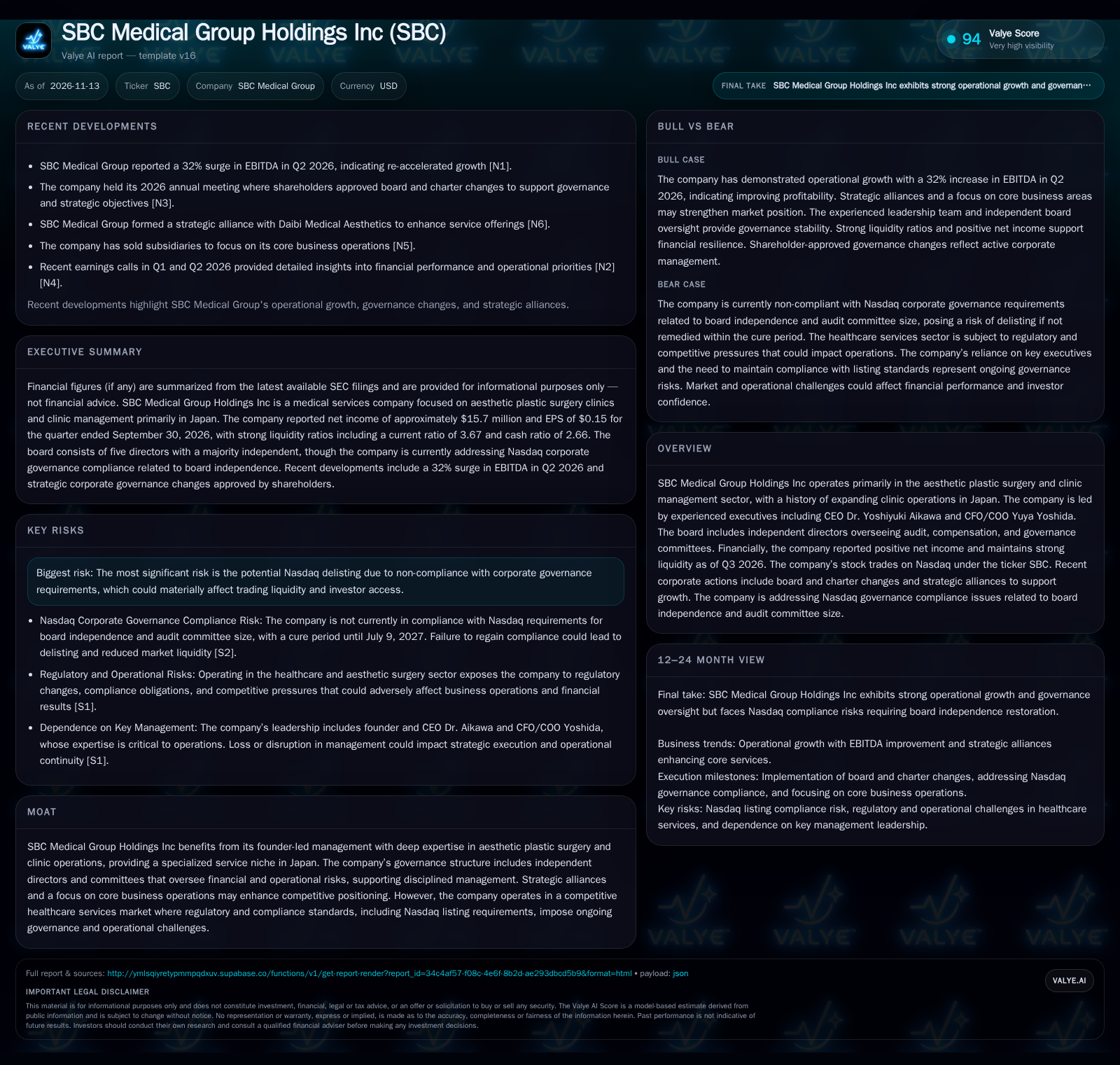
SBC Medical Group Holdings Inc posted a 32% EBITDA jump in Q2 2026 while sharpening its focus on core Japanese aesthetic surgery clinics through divestitures and new strategic alliances. However, ongoing Nasdaq non-compliance over board independence remains unresolved, threatening potential delisting if not cured by July 2027.
SBC Medical Group Holdings Inc, a major operator of aesthetic plastic surgery clinics in Japan, has reignited operational growth with a 32% EBITDA increase in Q2 2026, following strategic moves to streamline its business and expand through alliances. This duality—renewed business strength versus unresolved governance overhang—frames the company’s investment debate as it navigates regulatory, competitive, and operational headwinds.
Growth Momentum and Governance Uncertainty Define the Current Landscape
SBC Medical Group’s most recent quarter delivered a 32% year-over-year surge in EBITDA, underscoring re-accelerating profitability and operational momentum in its core Japanese aesthetic surgery clinics [N1]. This financial improvement coincides with a strategic push: the company has divested certain subsidiaries to sharpen its focus on core clinic operations [N5] and entered a new alliance with Daibi Medical Aesthetics to broaden its service portfolio [N6].
However, this operational progress is tempered by a material governance risk. As of July 2026, SBC Medical Group is non-compliant with Nasdaq’s board independence and audit committee size requirements, with a cure deadline of July 2027 [S2]. While the company is actively seeking additional independent directors, the overhang of possible delisting introduces uncertainty regarding market access and investor sentiment.
On the balance sheet, SBC reported $198.4 million in cash and a current ratio of 3.67 as of September 30, 2026 [S2]. Net income for the quarter was $15.7 million, translating to $0.15 per share [S2].
How Clinic Scale and Service Mix Shape Profitability in Japanese Aesthetics
SBC Medical Group’s revenue engine is built on high-throughput, branded aesthetic plastic surgery clinics—an area where scale, reputation, and service breadth drive patient acquisition and retention. The core economics hinge on procedure volume, case mix (from high-frequency, lower-ticket treatments to complex, higher-margin surgeries), and operating leverage from centralized clinic management.
Fixed costs—such as facility leases, salaried medical staff, and brand marketing—can be significant, but once scale is achieved, incremental procedures may generate high gross margins. Variable costs are mainly consumables, commission, and procedure-specific labor. The company’s recent EBITDA growth suggests either an increase in procedure volumes, improved pricing/mix, or cost efficiencies, but the specific drivers remain undisclosed [N1].
Capital needs for expansion are moderate: opening new clinics typically requires upfront investment in fit-out, equipment, and initial marketing, but ongoing cash requirements are largely tied to working capital and regulatory compliance.
Niche Leadership, but Facing Intense Regional Competition and Regulatory Pressures
SBC Medical Group occupies a specialized niche in Japan’s aesthetic surgery market, where brand trust, clinical outcomes, and service breadth are critical differentiators. The market is fragmented, with competitors ranging from large national clinic groups to boutique practices and international chains targeting affluent Japanese consumers.
The company’s founder-led management and operational experience provide a potential edge in scaling clinics and maintaining quality. Strategic alliances, such as the recent partnership with Daibi Medical Aesthetics, may help broaden its service portfolio and tap new patient segments [N6]. However, these advantages are counterbalanced by regulatory scrutiny, evolving patient preferences, and the constant threat of new entrants or international players leveraging technology or aggressive pricing.
Switching costs for patients are relatively low, as aesthetic procedures are often elective and reputation-driven. Sustained differentiation likely depends on continually upgrading service offerings, demonstrating clinical safety, and leveraging brand equity—while managing regulatory and governance risks that could erode trust or operational continuity.
If Core Clinic Growth and Governance Restoration Align, Market Expansion Could Accelerate
A favorable scenario for SBC Medical Group would see the company resolving its Nasdaq board independence and audit committee compliance issues well before the July 2027 deadline, restoring full access to public equity markets and improving investor confidence. With the governance overhang removed, the company could fully leverage its liquidity and operational momentum to accelerate new clinic openings, expand its service mix, and deepen alliances—such as the partnership with Daibi Medical Aesthetics [N6].
If positive EBITDA trends persist and are driven by rising procedure volumes, premium service uptake, and sustained cost discipline, operating leverage could further enhance profitability. Evidence for this scenario would include: appointment of new independent directors and restoration of compliance (confirmed by Nasdaq notifications), continued double-digit EBITDA growth, new clinic launches or service expansions, and visible increases in patient volumes or average revenue per procedure (if disclosed).
Falsification would come from continued delays in board appointments, persistent governance warnings, or stagnation in core financial metrics—suggesting unresolved structural or market frictions.
Operational Progress Continues, but Governance Overhang Weighs on Valuation
The most plausible path is that SBC Medical Group sustains moderate operational growth—driven by incremental clinic improvements, selective service expansion, and targeted alliances—while working toward governance compliance over the next several quarters.
In this scenario, profitability remains healthy, but the company limits aggressive capital deployment or international expansion until governance risks are fully resolved. Confirmation would come from stable or slightly improving EBITDA, incremental progress toward board independence (e.g., announced director appointments), and continued focus on core Japanese clinic management. Falsification would be indicated by worsening financials, regulatory setbacks, or further Nasdaq warnings.
Prolonged Governance Impasse or Regulatory Shocks Could Erode Core Value
A negative chain of events would involve SBC Medical Group failing to restore Nasdaq compliance by the July 2027 deadline, leading to delisting and a sharp reduction in market liquidity and institutional investor access. This could depress the company’s share price, raise its cost of capital, and limit strategic flexibility for future growth initiatives.
Additional risks include adverse regulatory changes affecting elective procedures, reputational damage from clinical incidents, or the departure of key executives—particularly founder and CEO Dr. Aikawa. If competitive pressures intensify or the company fails to maintain service quality, patient volumes and margins could decline.
Downside evidence would include missed governance deadlines, negative regulatory actions, declining EBITDA, or unexpected leadership departures. Conversely, partial mitigation could come from private capital access or successful transition to alternative trading venues, but these would not fully offset lost visibility and market confidence.
Milestones and Metrics That Will Define SBC Medical Group’s Next Chapter
Appointment and onboarding of additional independent directors to restore Nasdaq governance compliance—confirmation via SEC or company filings.
Nasdaq notifications regarding status of compliance with board independence and audit committee requirements—evidence of progress or further warnings.
Sustained double-digit EBITDA growth in coming quarters, and whether margin improvement is driven by volume, pricing, or cost control (if disclosed).
New clinic openings, service line expansions, or other organic growth initiatives—especially those enabled by strategic alliances.
Trends in patient volumes, procedure mix, and average revenue per procedure—a useful metric if disclosed in future filings or earnings calls.
Visibility into the impact of subsidiary divestitures on core profitability and operational focus.
Any changes in regulatory environment for aesthetic surgery in Japan and how the company adapts its compliance and business practices.
Retention of key executives, particularly founder/CEO Dr. Aikawa, and succession planning disclosures.
Disclaimer: This is research-only, informational analysis and not investment advice. It may include AI-generated interpretation and general industry context. Always verify important details using primary sources.

Comments