
Milestone Pharmaceuticals: Etripamil’s Market Launch, Cost Controls, and the Delisting Overhang
The company’s ability to scale CARDAMYST® (etripamil) prescriptions, manage cost reductions, and deliver pivotal AFib-RVR trial results will shape its financial and strategic trajectory.
Milestone Pharmaceuticals has launched CARDAMYST® (etripamil) nasal spray for PSVT in the U.S., achieved initial commercial traction, and secured China approval with milestone payments. Success now hinges on execution in commercialization, cost management, and pivotal trial delivery for expanded indications.
Milestone Pharmaceuticals stands at a critical juncture after launching CARDAMYST®, the first FDA-approved self-administered nasal spray for PSVT. Early commercial uptake and global regulatory wins demonstrate clinical and commercial momentum. Yet, persistent net losses, a recent CFO resignation, structural cost cuts, and the specter of Nasdaq delisting due to share price non-compliance create a high-stakes environment. The company’s ability to translate early adoption into sustainable revenue, navigate cost reductions without impairing execution, and deliver pivotal trial results for expanded indications will determine whether Milestone can transition from a development-stage risk to a durable commercial enterprise.
Milestone’s Commercial Debut and Cost Realignment in the Shadow of Delisting Risk
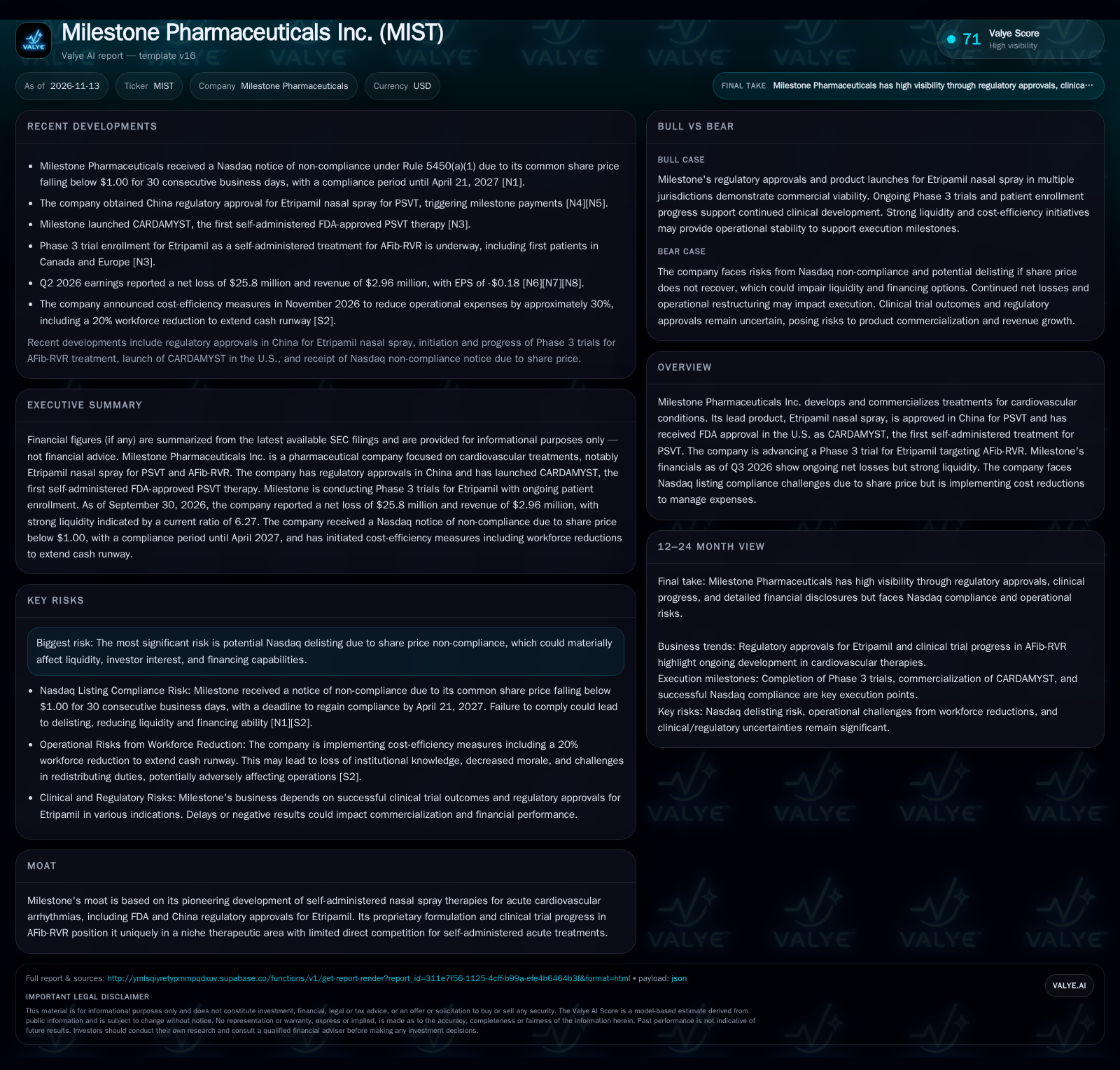
Milestone Pharmaceuticals has begun commercializing CARDAMYST® (etripamil) nasal spray for paroxysmal supraventricular tachycardia (PSVT) in the U.S., with over 1,600 unique prescribers initiating therapy and approximately 3,400 prescriptions filled as of the end of Q3 2026. The product has also secured regulatory approval in China, triggering milestone payments, and expanded formulary coverage in the U.S. to 67% of commercial lives, reflecting initial traction in both physician adoption and payer acceptance [S2] [N4] [N5].
Despite these advances, Milestone reported a net loss of $25.8 million and revenue of $2.96 million for Q2 2026, underlining the challenge of translating clinical innovation into commercial profitability. [S2]
A critical near-term overhang is the Nasdaq notice of non-compliance: Milestone’s share price has traded below $1.00 for 30 consecutive business days, starting a compliance clock that puts its listing at risk if not resolved by April 2027. Delisting could restrict access to capital and dampen institutional investor interest, compounding operational risks from restructuring and continued net losses [N1] [S2].
How Etripamil Commercialization Could Reshape Milestone’s Financial Model
Milestone’s core economics hinge on the successful commercialization of CARDAMYST® (etripamil) for PSVT and, prospectively, for atrial fibrillation with rapid ventricular rate (AFib-RVR) pending trial results. The U.S. launch marks a transition from a purely R&D-driven cost structure towards a blended model of product revenue, cost of goods sold, and commercial-scale SG&A. Early prescription volumes (3,400 scripts) suggest an initial revenue ramp, but the company remains far from breakeven, as evidenced by a $25.8 million quarterly net loss on $2.96 million in Q2 revenue [S2] [N6] [N7] [N8].
Pharmaceutical launches typically require substantial upfront investment in sales, marketing, and payer engagement to drive adoption and secure reimbursement. If CARDAMYST® establishes durable demand and achieves broader coverage, revenue leverage could increase as fixed commercial costs are absorbed over a growing prescription base.
However, persistent net losses and the risk of delisting could raise the cost of future capital or limit financing options. The key economic inflection will be whether prescription growth and potential additional indications (such as AFib-RVR) can accelerate top-line expansion faster than burn, ultimately driving operating leverage.
Evaluating Milestone’s Place in the Cardiovascular Therapeutics Landscape
Milestone’s competitive advantage rests on CARDAMYST® being the first and only FDA-approved self-administered nasal spray for PSVT, addressing an unmet need for rapid, on-demand treatment outside of hospital settings [S2]. This form factor and indication specificity differentiate it from traditional intravenous treatments or oral maintenance therapies. However, the company faces competition from established antiarrhythmic drugs, in-hospital interventions, and potential future entrants developing novel therapies for acute arrhythmias.
Barriers to entry in cardiovascular therapeutics are high due to regulatory, clinical, and payer hurdles, but switching costs for prescribers and patients may be moderate if alternatives demonstrate superior efficacy, safety, or convenience. The company’s ability to secure broad payer coverage (67% of U.S. commercial lives as of Q3 2026) is a positive early signal, but sustained uptake will depend on real-world outcomes, prescriber education, and patient experience.
If the ongoing AFib-RVR Phase 3 trial succeeds, Milestone could unlock a larger addressable market, further differentiating its product portfolio. However, the risk of generic competition, alternative delivery technologies, or paradigm shifts in arrhythmia management remains a long-term consideration.
Prescription Growth and AFib-RVR Success Could Drive a Commercial Inflection
The most favorable scenario for Milestone hinges on rapid prescription growth for CARDAMYST®, driven by expanded physician adoption, patient awareness, and payer coverage. If the company can demonstrate compelling real-world outcomes and safety, this could reinforce prescriber confidence and accelerate uptake. Broader formulary wins—especially with remaining major insurers—would further expand the addressable market and reduce out-of-pocket barriers for patients.
Success in the pivotal AFib-RVR Phase 3 trial would be transformative, potentially enabling label expansion into a large, high-need indication and opening new revenue streams. Regulatory approvals in additional geographies (beyond China and the U.S.) could provide milestone payments and royalty streams via partnerships.
Evidence supporting this scenario would include a steepening trajectory in prescription volumes, positive feedback from prescribers and patients, significant new payer contracts, and clear clinical trial progress or topline results in AFib-RVR. A sustained share price recovery above $1.00 would also mitigate delisting risk and restore financing flexibility.
Commercialization Advances, But Execution and Market Penetration Remain Measured
The most plausible trajectory for Milestone is a slow but steady build in CARDAMYST® prescription volumes as awareness and payer coverage improve.
Prescription growth remains positive but gradual, and additional milestone or partnership payments (e.g., in China) provide incremental financial support.
Confirmation of this scenario would be sequential growth in U.S. prescriptions, incremental improvements in payer coverage, successful completion of planned cost reductions, and clear progress in the AFib-RVR trial. The share price may remain volatile and at risk of delisting, but the company avoids operational disruptions or severe liquidity constraints.
Delisting, Slow Uptake, and Operational Strain Threaten Strategic Options
In the adverse case, CARDAMYST® prescription growth stalls due to limited physician adoption, payer pushback, or unfavorable real-world outcomes. The commercial team, already reduced by cost cuts, may struggle to drive market penetration, while workforce reductions lead to loss of institutional knowledge and execution bottlenecks.
Failure to regain Nasdaq compliance results in delisting, reducing liquidity for shareholders and restricting access to equity financing. This could force further cost cuts or require dilutive financing on unfavorable terms, especially if net losses persist. If the pivotal AFib-RVR trial encounters delays or negative results, the company’s ability to expand its addressable market and justify ongoing R&D investment would be severely impaired.
Evidence for this scenario would include flat or declining prescription volumes, negative prescriber or patient feedback, additional workforce or operational disruptions, delayed or negative clinical trial updates, and a sustained share price below the $1.00 threshold triggering delisting.
Milestones That Will Define Milestone’s Transition from Launch to Sustainable Growth
Quarterly trends in CARDAMYST® prescription volumes and unique prescribers, as these will reflect real-world adoption and commercial execution.
Updates on U.S. payer coverage expansion—especially with major commercial plans and Medicare Part D, if disclosed.
Progress milestones and interim data releases from the AFib-RVR Phase 3 trial (ReVeRA-301), including enrollment rates, protocol adherence, and topline readout timing.
Impact and completion status of the announced 30% operational expense reduction and 20% workforce cut, including any changes in commercial or R&D capacity.
Share price performance relative to the $1.00 Nasdaq compliance threshold, and any corporate actions or communications regarding plans to regain compliance.
Incremental revenue from China and other ex-U.S. partnerships, including milestone payments and royalty streams, if disclosed.
Stability of the management team following the CFO transition, and any further leadership turnover or strategic realignment.
Cash burn trajectory and updated guidance on runway adequacy through key clinical and commercial milestones.
Disclaimer: This is research-only, informational analysis and not investment advice. It may include AI-generated interpretation and general industry context. Always verify important details using primary sources.

Comments