
First Choice Healthcare Solutions: Strategic Clinic Pivot Meets Acute Liquidity Stress and M&A Uncertainty
First Choice Healthcare Solutions is abandoning its legacy orthopedic business to build a national network of functional health and wellness clinics, integrating primary care, anti-aging, and compounding pharmacy services.
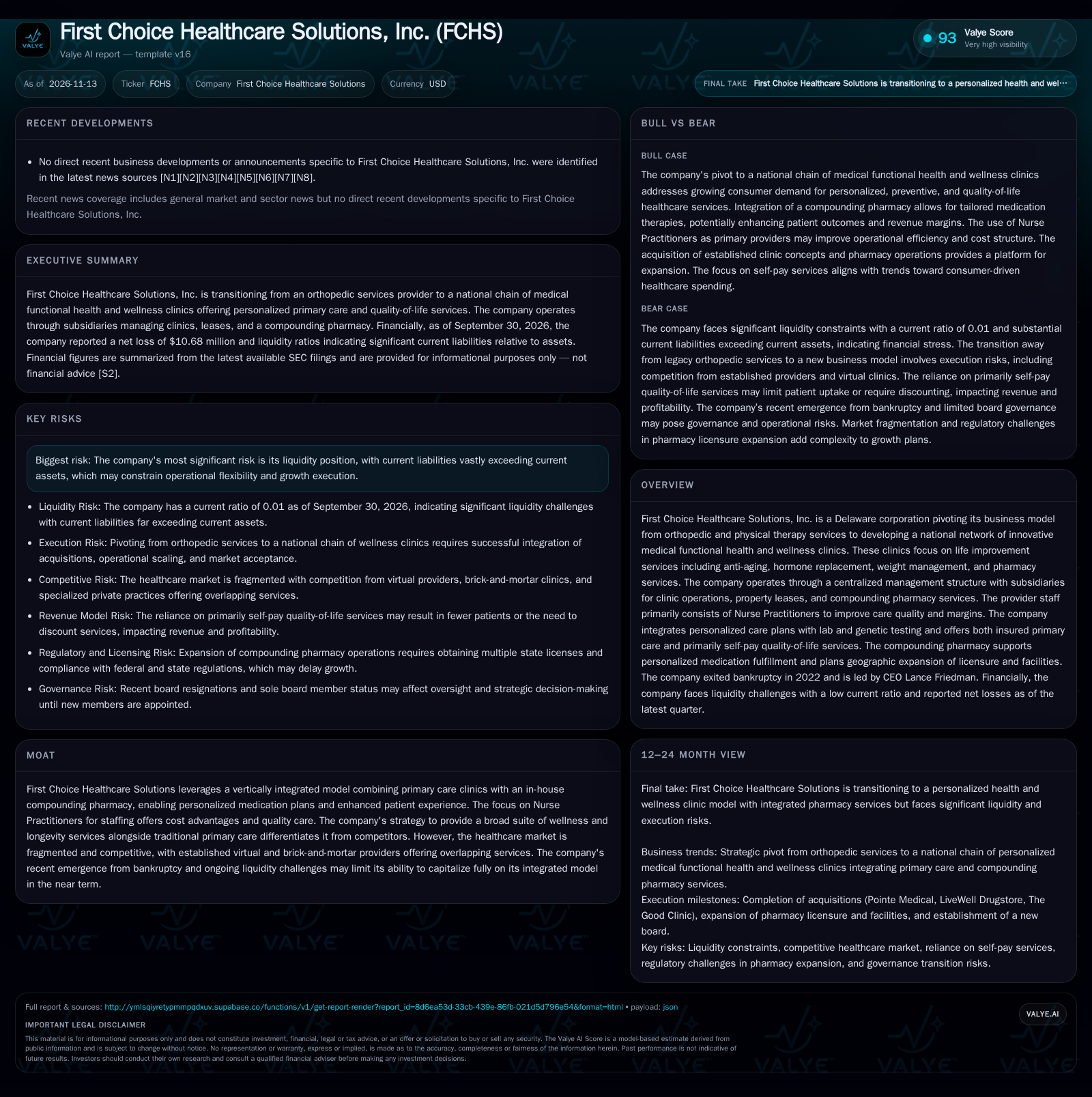
First Choice Healthcare Solutions is abandoning its legacy orthopedic business to build a national network of functional health and wellness clinics, integrating primary care, anti-aging, and compounding pharmacy services. While its new model targets the self-pay wellness trend and leverages acquisitions for scale, the company is under acute liquidity pressure, reporting a current ratio of 0.01 and a net loss of $10.7 million as of September 2026. A pending business combination and major clinic acquisition could reset its balance sheet and growth prospects, but both deals remain unconsummated and contingent on external financing. Execution, funding, and market acceptance risks dominate the investment case.
First Choice Healthcare Solutions is in the midst of a high-stakes transformation: abandoning its former orthopedic and physical therapy business to construct a national chain of functional health and wellness clinics. The new model combines primary care with in-demand services such as anti-aging, weight management, and custom pharmacy solutions, aiming to capture the growing consumer shift toward personalized, out-of-pocket health spending. Investors must weigh the potential for a vertically integrated, high-margin clinic network against the reality of severe short-term financial strain and unproven execution.
Radical Business Model Pivot Amid Severe Liquidity Headwinds
First Choice Healthcare Solutions is executing a decisive exit from its legacy orthopedic and physical therapy operations, aiming instead to build a national chain of functional health and wellness clinics. The new model integrates primary care, anti-aging, hormone therapy, weight management, and a compounding pharmacy, with a focus on both insured and self-pay services [S1].
Net loss for the period was $10.7 million, with negative EPS of -$0.32, underscoring operational and financial stress [S2].
A pending business combination with Westin Acquisition Corp. (to form Wellgevity 360, Inc.) values First Choice at up to $650 million in equity, with $10 million in preferred investment also contingent on closing. Simultaneously, a major acquisition (Pointe Medical Services and related entities) requires $7 million in cash at closing, but both deals remain unconsummated and subject to financing and regulatory hurdles [S2].
Economics of an Integrated Wellness Clinic and Pharmacy Platform
First Choice’s new business model is designed to capture multiple revenue streams: reimbursed primary care, self-pay quality-of-life services (such as anti-aging, hormone therapy, and cosmetic medicine), and in-house compounding pharmacy sales [S1]. The mix of insured and self-pay services is intended to blend the predictability of traditional healthcare reimbursement with the higher margins and consumer demand associated with elective wellness offerings.
Self-pay services—if priced and marketed effectively—can offer superior contribution margins, as they typically bypass insurance pricing constraints and attract discretionary spending. The use of Nurse Practitioners as primary providers may reduce labor costs and improve clinic-level operating leverage, assuming sufficient patient throughput.
The compounding pharmacy (LiveWell Drugstore) has the potential to drive additional margin via personalized medication fulfillment, centralized distribution to clinics, and expanded licensure. However, upfront investments in regulatory compliance, licensing, and physical infrastructure are capital-intensive, and the company’s current liquidity position may limit its ability to realize these ambitions at scale.
Fixed costs (leases, staffing, compliance) and acquisition-related debt create operating leverage, meaning profitability would require rapid ramp-up in patient volumes, retention, and ancillary pharmacy sales. The lack of current, representative revenue data makes it difficult to assess whether the new model can scale to cover these fixed costs before liquidity constraints trigger further restructuring.
Can Vertical Integration Differentiate in a Fragmented Health and Wellness Market?
First Choice is targeting a market crowded with virtual care providers, established brick-and-mortar clinics, and specialized practices offering subsets of its services—ranging from primary care to boutique wellness and biohacking [S1]. The vertically integrated model, combining in-house pharmacy with personalized care, may offer convenience and bespoke patient experience as differentiators.
However, switching frictions in healthcare are relatively low for self-pay wellness services, where patients can easily shop among clinics, telehealth startups, and national chains. The company’s use of Nurse Practitioners could support operational efficiency, but does not guarantee patient loyalty or pricing power unless paired with strong outcomes, branding, or network effects.
The compounding pharmacy offers a potential moat if it can achieve scale, multi-state licensure, and deliver unique medication regimens not easily sourced elsewhere. Yet, pharmacy expansion is heavily regulated and subject to state-by-state barriers, and national competitors with greater capital are pursuing similar integration strategies.
Without established patient panels, proven retention, or proprietary clinical protocols, First Choice’s competitive edge remains theoretical. Execution on the integration of clinics and pharmacy, coupled with patient acquisition and retention at sustainable economics, will be the true test.
If Capital Flows and Clinic-Pharmacy Synergies Deliver, Margin Expansion Could Follow
The most favorable scenario hinges on both the business combination with Westin and the Pointe Medical acquisition closing, delivering a significant capital infusion and expanded clinic footprint. With new funding, First Choice could accelerate the rollout of its integrated clinics, invest in pharmacy licensure and logistics, and implement administrative improvements to support scaling.
If patient acquisition costs are managed and the self-pay wellness suite gains traction—driven by personalized care plans, lab/genetic testing, and convenient medication fulfillment—the company could see rapid revenue growth and margin expansion. Centralized pharmacy operations may further boost contribution margins by capturing more of the value chain.
Confirmation would come from successfully closing the merger and acquisition, reporting sequential growth in same-clinic patient volumes, and demonstrating positive gross margins from both clinics and pharmacy operations. Early evidence of strong patient retention and pharmacy cross-selling would further validate the thesis.
Execution Delays and Funding Gaps Prolong Turnaround, Forcing Cost Controls and Slow Growth
The most plausible near-term outcome is a protracted period of financial stress and execution risk. If the business combination or acquisition is delayed or fails to close, First Choice may be forced to slow expansion plans, negotiate with creditors, and prioritize cost containment over growth.
Clinic rollout would proceed cautiously, with limited marketing spend and geographic expansion constrained by available cash. The compounding pharmacy might achieve incremental licensure expansion, but lack the resources for rapid scaling or technological upgrades.
Progress would be measured by incremental improvements in liquidity or working capital, modest growth in patient volumes at existing clinics, and early pharmacy revenue contributions. Failure to close the pending deals or secure alternative financing would be a strong signal that the base scenario is playing out.
Acute Liquidity Crisis Forces Restructuring or Dissolution
In this scenario, the company would likely halt further clinic expansion, shutter or divest underperforming assets, and focus on short-term cash preservation. The pharmacy business, if unable to achieve scale or licensure expansion, could become a stranded asset.
Confirmation would come from missed payments, acceleration of debt, workforce reductions, or public statements regarding going concern doubts or restructuring efforts. Inability to secure bridge financing or alternative capital would further validate the downside case.
Proving the Model: What Will Determine If First Choice’s Pivot Succeeds
Closure of the business combination with Westin Acquisition Corp. and the associated $10 million preferred investment—timing, terms, and any amendments to closing conditions.
Successful completion of the Pointe Medical Services and pharmacy acquisition, including meeting the $7 million cash closing requirement and integrating acquired operations.
Disclosure of current and forward 12-month clinic-level patient volumes, retention rates, and payer mix—especially the proportion of self-pay vs. insured services.
Gross margin profiles for both the clinic and compounding pharmacy operations, if disclosed, and evidence of operating leverage as new clinics scale.
Expansion of pharmacy licensure beyond Florida, Georgia, and Mississippi, with updates on regulatory approvals and new state entries.
New board appointments and governance improvements following the CEO’s sole board tenure, as a test of oversight and strategic depth.
Working capital trends and any new financing, bridge loans, or equity raises to address the acute liquidity shortfall.
Disclaimer: This is research-only, informational analysis and not investment advice. It may include AI-generated interpretation and general industry context. Always verify important details using primary sources.

Comments