
Regional Health Properties: Integrated Healthcare Platform, Turnaround Ambitions, and Liquidity Tensions
Regional Health Properties has repositioned itself as an integrated owner-operator in skilled nursing, senior housing, and pharmacy services, leveraging recent acquisitions and a diversified approach to value creation.
Regional Health Properties now operates as a vertically integrated healthcare platform, combining facility ownership, direct operations, and pharmacy services following the SunLink merger. The company targets underperforming assets in Southeastern U.S. markets, aiming to drive value through operational improvement.
Regional Health Properties, Inc. is pursuing a high-touch, integrated healthcare model after years as a passive real estate landlord, now directly operating skilled nursing and senior housing communities and expanding into pharmacy services. This transformation—accelerated by the 2025 SunLink merger—positions the company to drive value through operational improvement and turnaround of underperforming assets in demographically favorable Southeastern U.S. markets.
Recent Integration, Liquidity Strains, and Operating Losses: The Current State
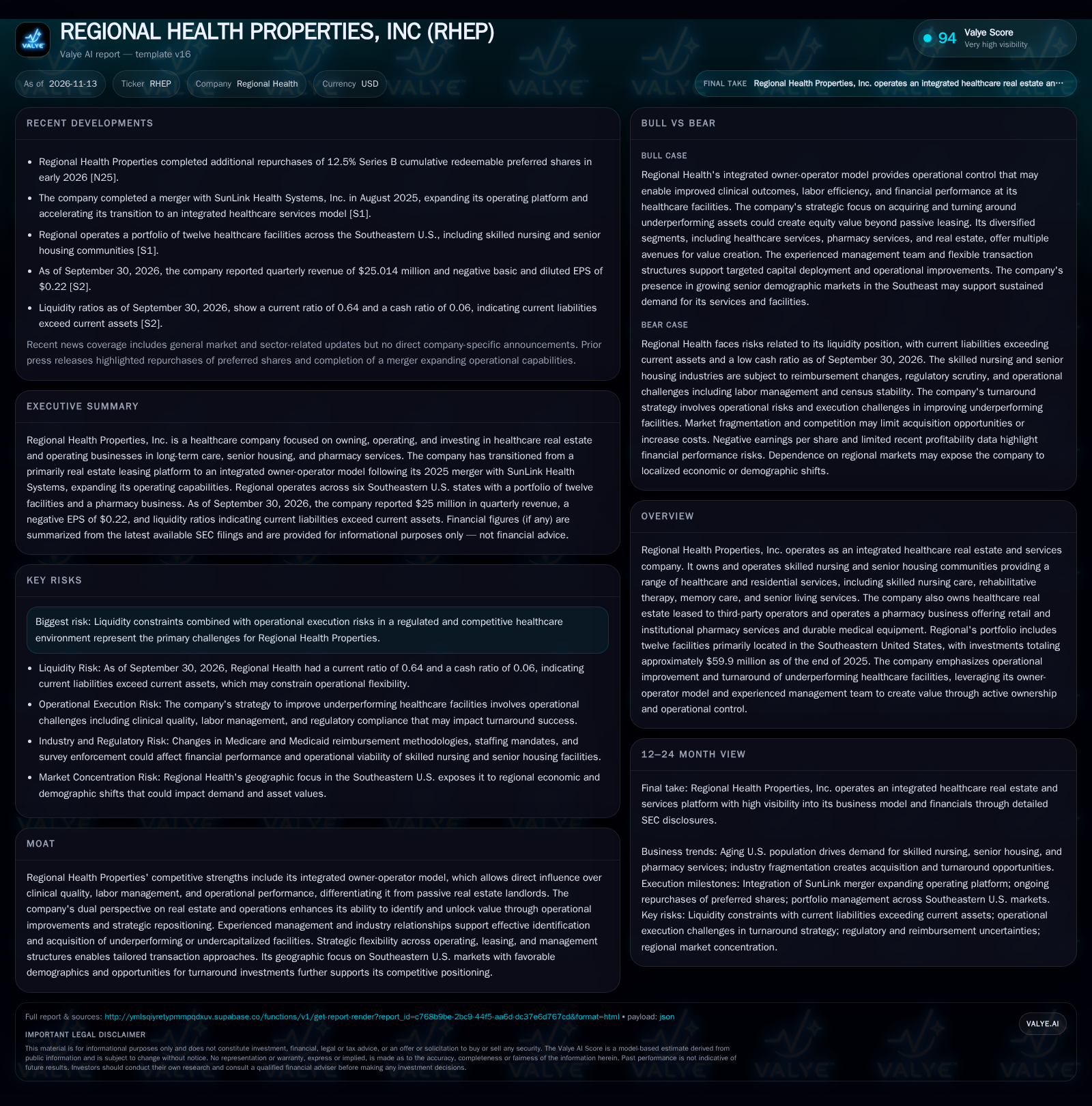
Regional Health Properties has evolved into an integrated healthcare owner-operator, now running skilled nursing and senior housing facilities alongside a pharmacy business acquired via the SunLink Health Systems merger in August 2025. The company’s portfolio as of year-end 2025 included twelve facilities totaling 1,126 beds/units across five Southeastern states, and a real estate investment base of approximately $59.9 million [S1].
Financially, the company reported $25.014 million in revenue for the quarter ended September 30, 2026, but basic and diluted EPS remained negative at -$0.22. Liquidity is a clear concern: current assets of $17.978 million compare to current liabilities of $27.992 million, resulting in a current ratio of 0.64 and a cash ratio of 0.06 [S2]. The company reported cash and liquidity metrics for the period; these figures do not by themselves establish operating runway, investment capacity, financial flexibility, or financing capacity.
The company’s strategy remains focused on acquiring, operating, and turning around underperforming healthcare assets, leveraging its vertically integrated structure to improve facility-level performance [S1].
How the Owner-Operator Model Could Create or Destroy Value
Regional Health’s business model blends real estate economics with operating company risk. In its Healthcare Services segment, the company generates revenue from direct operation of skilled nursing and senior housing communities—a model highly sensitive to occupancy (census), payer mix (Medicare, Medicaid, private pay), labor costs, and clinical quality. The Pharmacy Services segment—added via the SunLink merger—offers retail and institutional pharmacy and durable medical equipment, potentially offering higher-margin ancillary revenue streams but also requiring scale and integration to move the needle on consolidated performance [S1].
The Real Estate segment provides more stable, albeit typically lower-yield, income via triple-net leases to third-party operators. However, as the company shifts toward direct operations, the mix of fixed (real estate) versus variable (labor, supplies, clinical costs) expenses tilts toward higher operational leverage—and higher risk. Turnaround of underperforming assets may deliver outsized returns if census and reimbursement rates improve, but underperformance can quickly erode cash in this capital- and labor-intensive sector.
Capital needs are inherently high: upgrading facilities, absorbing acquisition costs, and covering working capital requirements for operations all demand access to liquidity and/or credit. In the absence of robust free cash flow, the company’s ability to reinvest or weather shocks depends on external financing, asset sales, or creative transaction structuring.
Differentiation Through Integration—But Competitive and Regulatory Headwinds Persist
Regional Health’s integrated owner-operator structure allows direct control over clinical quality, labor management, and census development, potentially differentiating it from passive healthcare REITs and pure-play facility operators [S1]. This dual perspective may help the company identify value creation opportunities—such as operational improvements or asset repositioning—that pure landlords or operators might miss.
However, the skilled nursing and senior housing industries remain highly fragmented, with competition from regional chains, national operators, and private equity-backed consolidators. Barriers to entry are moderate, but operational complexity and regulatory scrutiny are high. The pharmacy segment, while potentially synergistic, faces entrenched regional chains and large institutional pharmacy providers.
Regulatory risk is ever-present: changes in Medicare and Medicaid reimbursement, staffing mandates, and enforcement priorities can dramatically affect facility economics, while labor shortages and wage inflation further challenge operators. Regional Health’s geographic concentration in the Southeast may provide demographic tailwinds, but also exposes it to localized economic or reimbursement shifts.
If the Turnaround Playbook Works: Pathways to Margin Expansion and Asset Value Creation
The company’s upside rests on its ability to execute operational improvements at acquired or underperforming facilities, driving higher occupancy, better payer mix, and improved cost control. If management can leverage its owner-operator structure to enhance clinical quality, stabilize labor, and boost census, facility margins could expand and asset values rise. The pharmacy business could further add accretive, recurring revenue if cross-selling to facility residents and regional healthcare providers succeeds.
Evidence of this scenario would include sustained growth in census/occupancy rates, improvement in facility-level EBITDA, and positive cash flow from operations. Successful integration of SunLink assets and pharmacy services—demonstrated through margin expansion and revenue growth—would further validate the strategy. Asset recycling or refinancing at favorable terms could also unlock value.
Falsification would come from persistent negative facility-level margins, inability to increase occupancy, or evidence that pharmacy integration is not generating incremental revenue or operational synergies.
Integrated Model Delivers Incremental Gains Amid Ongoing Headwinds
The most plausible path is gradual improvement in facility operations and pharmacy integration, offset by ongoing industry pressures and liquidity constraints. Regional Health may achieve modest census gains and some cost efficiencies, but labor inflation, reimbursement volatility, and working capital stress could limit margin expansion. The real estate segment continues to provide a stable, if unspectacular, income base, while pharmacy services contribute incremental but not transformative revenue.
Under this scenario, reported losses may narrow but not fully reverse in the near term, with external financing or asset sales required to meet obligations and fund growth. Management’s ability to identify, acquire, and turn around additional underperforming facilities will be constrained by access to capital and the competitive landscape.
Confirmation would come from stable to modestly improving revenue, incremental margin gains, and evidence of successful facility turnarounds. Falsification would be reflected in deteriorating liquidity, stalled census recovery, or further widening of operating losses.
Liquidity Stress, Execution Missteps, and Adverse Regulation Amplify Downside Risk
If operational improvements stall and census remains weak, the company’s low current and cash ratios could force asset sales, dilutive financing, or even restructuring. Persistent negative operating cash flow could erode the ability to invest in needed facility upgrades or meet debt and lease obligations. Regulatory changes—such as reimbursement cuts or new staffing mandates—could further stress margins and accelerate losses.
A failure to integrate the SunLink assets or pharmacy business, or unanticipated adverse events (e.g., regulatory penalties, lawsuits, or local market disruptions), could compound downside risk. In this scenario, the company may be forced to divest assets at unfavorable prices or cede operational control to creditors or third-party managers.
Downside confirmation would include further deterioration in liquidity metrics, negative cash flow, asset impairments, or public disclosure of covenant breaches or going concern uncertainty.
Operational and Financial Milestones That Will Define Regional Health’s Trajectory
Quarterly census/occupancy rates for owned and operated skilled nursing and senior housing facilities, if disclosed, to assess the effectiveness of turnaround efforts.
Facility-level EBITDA or operating margin trends, which would provide insight into the impact of operational improvements and cost controls.
Integration progress and revenue contribution from the pharmacy business, including cross-sell rates to facility residents and external customers.
Changes in the current and cash ratios, or explicit liquidity management disclosures, to monitor the company’s ability to meet near-term obligations.
Acquisition or divestiture activity, particularly the terms and rationale for new facility or real estate transactions.
Updates on regulatory or reimbursement changes in key Southeastern markets, and management commentary on anticipated impacts.
Disclosure of any external financing arrangements, covenant compliance, or going concern language that would signal emerging financial stress.
Disclaimer: This is research-only, informational analysis and not investment advice. It may include AI-generated interpretation and general industry context. Always verify important details using primary sources.

Comments