
Contango ORE: JV Leverage, Exploration Ambitions, and the Realities of Gold Sector Dependency
Contango ORE’s 30% stake in the Peak Gold JV, managed by Kinross, provides access to operational cash flows, but ongoing net losses, minority status, and capital needs underscore the company’s exposure to gold price volatility and external funding risks.
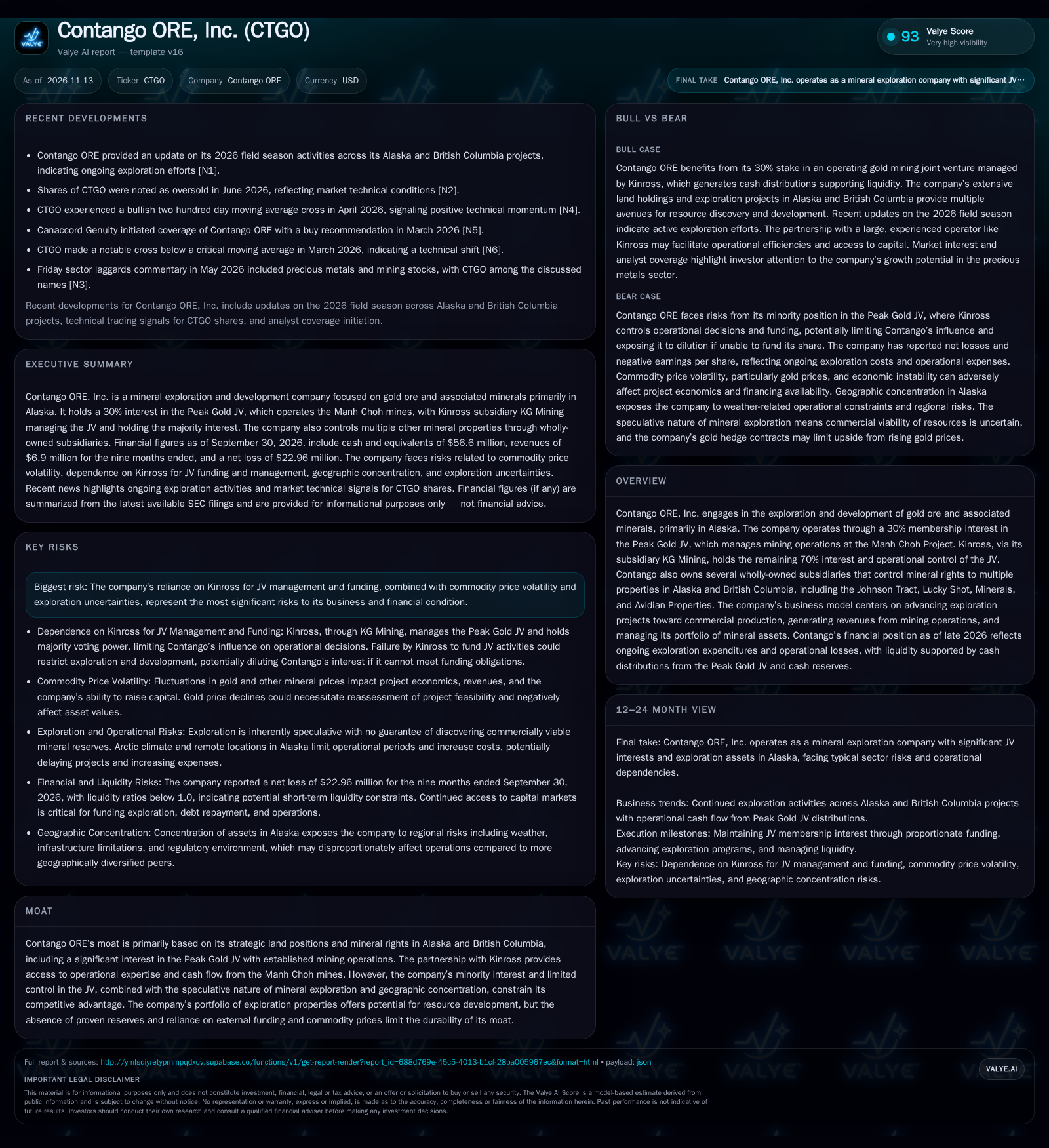
Contango ORE’s business is anchored by a minority stake in an operating Alaskan gold JV with Kinross, which has generated substantial cash distributions but leaves the company dependent on external management and funding. The company’s fortunes are closely tied to gold prices, JV governance, and the commercial viability of its exploration assets. [S2] [N1]
Contango ORE’s investment thesis is defined by its hybrid profile: a minority stake in the producing Peak Gold JV—providing tangible cash returns but little operational control—and an expansive, high-risk exploration portfolio in Alaska and British Columbia. This structure offers both leverage to gold prices and exposure to the uncertainties of early-stage mining. Future value creation depends on sustaining JV distributions, successfully advancing exploration assets, and navigating the constraints of minority ownership and external funding reliance. [S2] [N1]
Cash Distributions, Losses, and JV Dependence Define 2026 Realities
As of September 30, 2026, Contango ORE reported $56.6 million in cash and equivalents against $90.7 million in current liabilities, yielding a current ratio of 0.67 and a cash ratio of 0.62. Over the first nine months of 2026, the company generated $6.9 million in revenue but posted a net loss of $22.96 million (EPS: -$0.66). [S2]
The company reported cash and liquidity metrics for the period; these figures do not by themselves establish operating runway, investment capacity, financial flexibility, or financing capacity. However, the structure of the JV leaves operational control and majority voting power with Kinross, limiting Contango’s influence over mine management and capital allocation. [S2]
Ongoing exploration activities were reported across Alaskan and British Columbia properties during the 2026 field season, indicating that the company continues to invest in resource expansion and optionality. [N1]
How Contango ORE’s Model Turns Exploration and JV Leverage into Revenue—And Why Fixed Costs Remain High
Contango ORE’s economics are shaped by two distinct engines: its 30% non-operating stake in the Peak Gold JV and direct ownership of early-stage exploration assets. The JV provides a potential annuity-like stream of cash distributions, but these are not wholly under Contango’s control; distributions depend on JV profitability, reinvestment decisions, and Kinross’s operational priorities. The company’s ability to maintain its interest in the JV is conditional on its capacity to fund its proportionate share of JV expenses—failure to do so could result in dilution. [S2]
On the exploration side, the company incurs substantial fixed costs related to drilling, permitting, and site development, without guaranteed near-term returns. These costs, coupled with the arctic and remote nature of its Alaskan operations, create high operating leverage: successful resource delineation or price increases can dramatically improve value, but setbacks or price declines exacerbate losses. The company’s net loss in the latest period highlights this dynamic. [S2]
Contango has entered into gold hedge contracts, which cap upside from gold price rallies and may require cash outflows if gold prices remain elevated—adding another layer of complexity to its revenue and cash flow profile. [S2]
Strategic Land Holdings and the Kinross JV: Competitive Edge or Constraint?
Contango ORE’s competitive standing is anchored in its strategic mineral rights across Alaska and British Columbia and its 30% stake in the Peak Gold JV. The JV arrangement with Kinross offers operational scale and expertise typically unavailable to junior miners, reducing execution risk at Manh Choh relative to standalone developments. However, minority status in the JV means Contango’s influence is limited, especially regarding capital allocation, operational tempo, and strategic direction. [S2]
In the broader landscape, Contango competes with other exploration-driven juniors for capital, talent, and attention, but its JV connection to a major operator provides a potential credibility advantage. The company’s land package offers resource optionality, yet until commercial viability is proven, these assets remain speculative. Geographic concentration in Alaska exposes Contango to weather, infrastructure, and regulatory risks not faced by more diversified peers.
The primary substitutes are other gold juniors with direct operational control or those developing projects in less challenging geographies. The market’s willingness to fund future exploration and development will depend on both sector sentiment and demonstrated progress in resource expansion and de-risking.
Exploration Success and Sustained JV Cash Flows Could Unlock Significant Value
A favorable scenario would see the Peak Gold JV maintaining high operational performance, leading to continued or even increased cash distributions to Contango. If gold prices remain robust and the company’s hedging strategy does not excessively cap upside, these distributions could fund ongoing exploration and reduce dilution risk. [S2]
Simultaneously, successful exploration at one or more of Contango’s wholly-owned properties (e.g., Johnson Tract or Lucky Shot) could yield new discoveries or resource expansions, attracting either a strategic partner or acquisition interest. Advancing a project to a development decision could materially re-rate the company’s valuation.
Confirmation of this scenario would come from: (1) additional resource announcements or economic studies demonstrating commercial viability at new sites; (2) sustained or growing cash flows from the JV; (3) news of new JVs, asset sales, or farm-outs on favorable terms; and (4) sector-wide strength in gold prices supporting positive sentiment and access to capital.
Navigating the Capital Cycle: Modest Progress and Continued Reliance on JV Support
The most plausible near-term trajectory is one of continued operational dependence on the Peak Gold JV for liquidity, with the company maintaining its minority interest by funding its share of JV expenses. Exploration across the broader portfolio likely continues at a measured pace, constrained by available cash and market conditions. [S2] [N1]
Absent a major discovery or dramatic move in gold prices, Contango is likely to report ongoing net losses, as exploration and corporate overhead remain high relative to revenues. The company’s ability to access external funding (via equity or debt) will be critical to sustaining operations and advancing its project pipeline.
Evidence supporting this scenario would include: (1) stable or modestly declining cash balances reflecting steady exploration spend; (2) continued, but not escalating, JV distributions; (3) regular field season updates without transformative discoveries; and (4) market commentary focusing on technical share price signals and liquidity management.
Dilution and Liquidity Strain if JV Distributions Falter or Funding Gaps Emerge
Adverse outcomes could materialize if the Peak Gold JV underperforms, gold prices fall, or Kinross prioritizes reinvestment over distributions. [S2]
Exploration setbacks, regulatory delays, or cost overruns at the company’s wholly-owned projects would further erode potential financial flexibility. The company’s gold hedge contracts could also require cash payments if gold prices remain above hedge thresholds, exacerbating liquidity stress. [S2]
Confirmation would come from: (1) sharp declines in reported cash balances; (2) announcements of equity raises or asset sales at distressed valuations; (3) JV disclosures indicating dilution or reduced interest; and (4) negative sector sentiment reducing access to new capital.
Milestones and Market Developments That Will Shape Contango’s Next Chapter
The company’s ability to maintain or increase its 30% JV interest—especially in the face of future capital calls—will signal financial resilience or risk of dilution. [S2]
Progress on exploration milestones at wholly-owned properties (e.g., resource estimates, drill results, permitting advances) would materially affect optionality and valuation. [N1]
Any changes in gold price hedging arrangements, including realized gains/losses or required cash outflows, could materially impact cash flow stability. [S2]
A useful metric would be the pace and magnitude of exploration spend, as well as any new JVs, farm-outs, or asset sales that alter the company’s risk/reward profile.
Updates regarding regulatory, environmental, or permitting developments in Alaska and British Columbia, as these can accelerate or delay project timelines.
Announcements of external financing (equity, debt, or JV/farm-in) and the terms secured, which would clarify market perceptions of risk and future dilution potential.
If disclosed, trends in JV operating costs and capital expenditure requirements, which influence Contango’s future funding needs and exposure to dilution.
Disclaimer: This is research-only, informational analysis and not investment advice. It may include AI-generated interpretation and general industry context. Always verify important details using primary sources.

Comments