
QXO’s High-Stakes Transformation: Scaling Distribution, Integrating Acquisitions, and Chasing $50 Billion Ambitions
QXO, Inc. has rapidly converted from a niche tech provider into North America’s largest publicly traded distributor of roofing and complementary building products, following its transformative Beacon Roofing Supply acquisition. With a vast branch footprint, a technology-forward strategy, and aggressive acquisition plans, QXO aims to consolidate a fragmented industry—but must prove it can integrate, scale, and deliver margin expansion against sector cyclicality and operational risks.
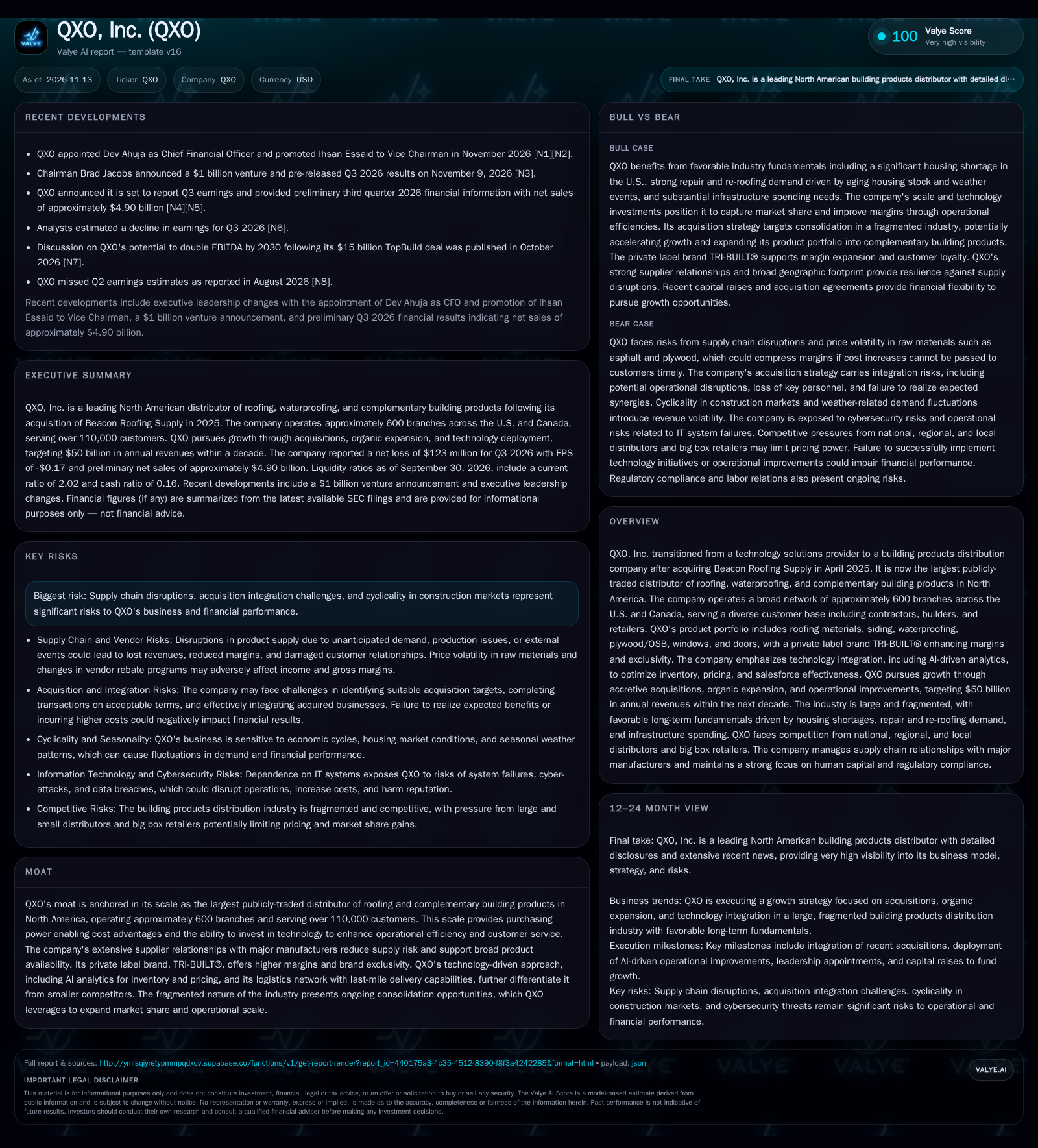
QXO, Inc. now leads North American building products distribution after acquiring Beacon Roofing Supply, operating 600 branches and targeting $50 billion in revenues within a decade. Its strategy depends on accretive acquisitions, tech-driven operational gains, and private-label margin expansion. Current challenges include a Q3 2026 net loss, pending $2.25B Kodiak deal, and integrating rapid growth amid cyclical and supply chain pressures. Execution on technology, acquisition integration, and margin improvement will determine if QXO can realize its consolidation ambitions. [S2] [N1] [N3] [N5]
QXO, Inc. has undergone a dramatic transformation, shifting from its legacy as SilverSun Technologies to a dominant force in North American building products distribution after acquiring Beacon Roofing Supply in 2025. Now operating 600 branches and serving over 110,000 customers, QXO’s ambitions are bold: to consolidate a vast, fragmented industry and reach $50 billion in annual revenues within a decade. The company’s playbook—combining aggressive M&A, tech-driven operational improvements, and private-label margin strategy—faces immediate tests. With a Q3 net loss, heavy acquisition pipeline, and sector-wide risks from cyclical demand and supply chain shocks, QXO’s next phase will hinge on its ability to integrate, scale, and extract value from its rapidly expanding footprint. [S2] [N1] [N3] [N5]
QXO’s Recent Moves: Beacon Integration, Expansion Plans, and Financial Snapshot
QXO, Inc. emerged as the largest publicly traded distributor of roofing, waterproofing, and complementary building products in North America following its acquisition of Beacon Roofing Supply in April 2025. This transformative deal expanded QXO’s footprint to approximately 600 branches and over 110,000 customers across the U.S. and Canada. As of September 30, 2026, the company reported $4.90 billion in preliminary Q3 net sales, but with a net loss of $123 million for the quarter. The company’s capital structure has evolved rapidly, with $749.4 million raised from a January 2026 equity offering and $3 billion in Series C Preferred Stock commitments to fund further acquisitions—including a $2.25 billion definitive agreement to acquire Kodiak Building Partners, expected to close in Q2 2026. These developments underscore QXO’s aggressive push for scale, but also highlight the challenge of integrating new assets while managing near-term profitability pressures. [S2] [N1] [N3] [N5]
How QXO’s Distribution Model Could Create Value—And Where Margin Leverage May Come From
QXO’s business model is anchored in high-volume, low-margin distribution economics, typical of building products wholesalers. Revenue is generated through the sale of roofing, siding, waterproofing, and complementary materials to a diversified customer base—professional contractors, builders, owners, and retailers. The company’s scale provides purchasing power, enabling it to negotiate favorable terms with suppliers and potentially secure volume rebates. Gross margins are generally thin in this sector, but QXO aims to augment them through its private label TRI-BUILT® brand, which offers higher margins and brand exclusivity.
The economics of distribution scale favor fixed-cost leverage: as branch density increases, logistics, procurement, and administrative costs can be spread over a larger revenue base. QXO’s technology investments—particularly in AI-driven pricing, inventory management, and lead generation—are designed to improve asset turns, reduce stockouts, and support dynamic pricing, each of which could incrementally enhance margin.
The company’s capital needs are significant, given its acquisition-driven strategy. Recent equity and preferred stock raises, plus ongoing integration costs, signal continued appetite for external funding. The company reported cash and liquidity metrics for the period; these figures do not by themselves establish operating runway, investment capacity, financial flexibility, or financing capacity. Operating leverage will depend on QXO’s ability to integrate acquisitions efficiently, optimize branch performance, and improve gross-to-operating margin conversion as it scales. [S2]
Scale, Private Label, and Technology: QXO’s Defenses Against Intense Distribution Competition
QXO operates in a vast, fragmented $800 billion building products distribution market, facing competition from national and regional distributors as well as big box retailers. Its largest peers include other multi-branch distributors and vertically integrated building material suppliers. QXO’s core competitive advantages stem from its scale—enabling purchasing power and supplier clout—and its ability to invest in technology that smaller rivals may struggle to match.
The company’s TRI-BUILT® private label brand is a critical tool for margin defense and customer stickiness, offering differentiated products unavailable from competitors. Deep supplier relationships with manufacturers like Owens Corning and GAF provide reliable product access and potential rebate advantages. QXO’s tech-forward approach—applying AI to pricing, inventory, and salesforce optimization—could deliver incremental efficiency and customer service gains, supporting branch-level economics.
However, competitive counterforces remain strong. Large national and regional distributors can match scale in some markets, while local distributors often compete on relationships and service. Big box retailers leverage broad assortments and direct-to-consumer reach. Technology is a moving target; while QXO’s investments may yield a near-term edge, rivals can adopt similar tools, limiting durable differentiation. Ultimately, pricing discipline, supply chain resilience, and integration execution will determine whether QXO’s scale translates into sustained competitive advantage.
If Integration Succeeds and Technology Delivers, Margin Expansion and Market Share Gains Are Plausible
In a favorable scenario, QXO successfully integrates the Beacon and pending Kodiak acquisitions, realizing procurement synergies, cost rationalization, and branch productivity improvements. Technology investments yield measurable gains in inventory turns, pricing accuracy, and salesforce productivity, translating into higher operating margins despite the industry’s low gross margin baseline. The TRI-BUILT® private label brand continues to grow as a share of sales, lifting blended margin and strengthening customer loyalty.
QXO’s scale and capital access enable it to remain a consolidator in a fragmented market, acquiring regional and local distributors at attractive multiples and expanding its footprint efficiently. The company’s diversified customer base insulates it from single-customer risk, while strong supplier relationships safeguard product access during supply chain shocks. Confirmation of this scenario would include sustained revenue growth above industry averages, margin expansion despite raw material inflation, and successful, on-time integration of major acquisitions. Evidence would also include rising share of private label sales, improved asset turns, and positive free cash flow after integration spending.
Sustained Growth with Integration Hurdles and Margin Pressure: The Most Likely Outcome
The most plausible outcome is that QXO delivers continued top-line growth through both organic expansion and ongoing acquisitions, but faces typical integration friction. Synergy realization is incremental, with branch integration and technology adoption proceeding at an uneven pace across the network. Gross margins remain under pressure from raw material price volatility and competitive pricing, while operating expense rationalization lags headline revenue gains.
QXO manages to maintain supplier relationships and branch-level service, but competitive pricing and supply chain disruptions periodically compress margins. The company’s technology initiatives deliver moderate efficiency improvements, but not enough to fully offset external cost pressures or guarantee a step-change in profitability. The result is a business that grows its revenue base and network reach but takes longer than planned to achieve meaningful operating leverage or margin expansion.
Evidence supporting this scenario would include steady but not accelerating margin improvement, periodic integration charges or disruption, and continued reliance on external capital for major acquisitions. Lagging indicators would be persistent net losses or cash flow shortfalls, particularly during periods of construction market softness or adverse weather impacts.
Complexity Overload: Integration Failures, Margin Compression, and Cyclical Shocks
In a negative scenario, QXO’s rapid acquisition pace leads to integration bottlenecks, with branch-level disruption, loss of key personnel, and inconsistent technology adoption across the network. Synergy targets are missed, and expected cost savings are offset by duplicated functions and operational inefficiencies. Supply chain shocks or vendor rebate changes further erode gross margin, while inflation in raw materials is not fully passed through to customers due to competitive pressures.
Cyclical downturns in construction or severe weather events hit demand, exposing QXO’s operating leverage and fixed-cost base. The company’s reliance on external capital—evidenced by low cash ratios and recurring equity/preferred raises—becomes a vulnerability if market conditions tighten or integration disappoints. Underperformance leads to negative free cash flow, credit rating pressure, or the need to pause acquisitions, undermining the growth narrative.
Falsifying this scenario would require clear evidence of smooth post-acquisition integration, robust margin resilience during external shocks, and consistent delivery of free cash flow despite rapid expansion. Watchpoints would include branch-level retention, private label sales growth, and technology adoption metrics (if disclosed).
Milestones That Will Test QXO’s Consolidation Ambitions and Margin Thesis
Progress and cost discipline on Kodiak Building Partners integration—including timeline, synergy capture, and branch retention.
Share of revenue from private label TRI-BUILT® products; growth here would support the margin improvement thesis.
Gross and operating margin trends, especially during periods of commodity inflation or construction market softness.
Free cash flow generation after integration and acquisition costs; positive FCF would validate operational leverage.
Branch-level productivity and customer retention rates (if disclosed), testing network integration and service consistency.
Evidence of realized cost synergies and operating expense reduction following major acquisitions.
Technology adoption rates for AI-driven pricing, inventory, and lead generation; tangible operational improvements would support the tech-driven efficiency narrative.
Trends in supplier rebate income and procurement savings, as indicators of scale-driven purchasing advantage.
Disclaimer: This is research-only, informational analysis and not investment advice. It may include AI-generated interpretation and general industry context. Always verify important details using primary sources.

Comments