
Immunic’s Make-or-Break Year: Phase 3 Readouts, Capital Position, and the Stakes of Late-Stage MS Drug Development
With pivotal Phase 3 data for vidofludimus calcium in relapsing MS due in December 2026 and a fresh $132 million cash reserve, Immunic stands on the threshold of its first commercial opportunity—but faces the binary realities of late-stage biotech: success could transform its economics and position, while failure would force a strategic reset.
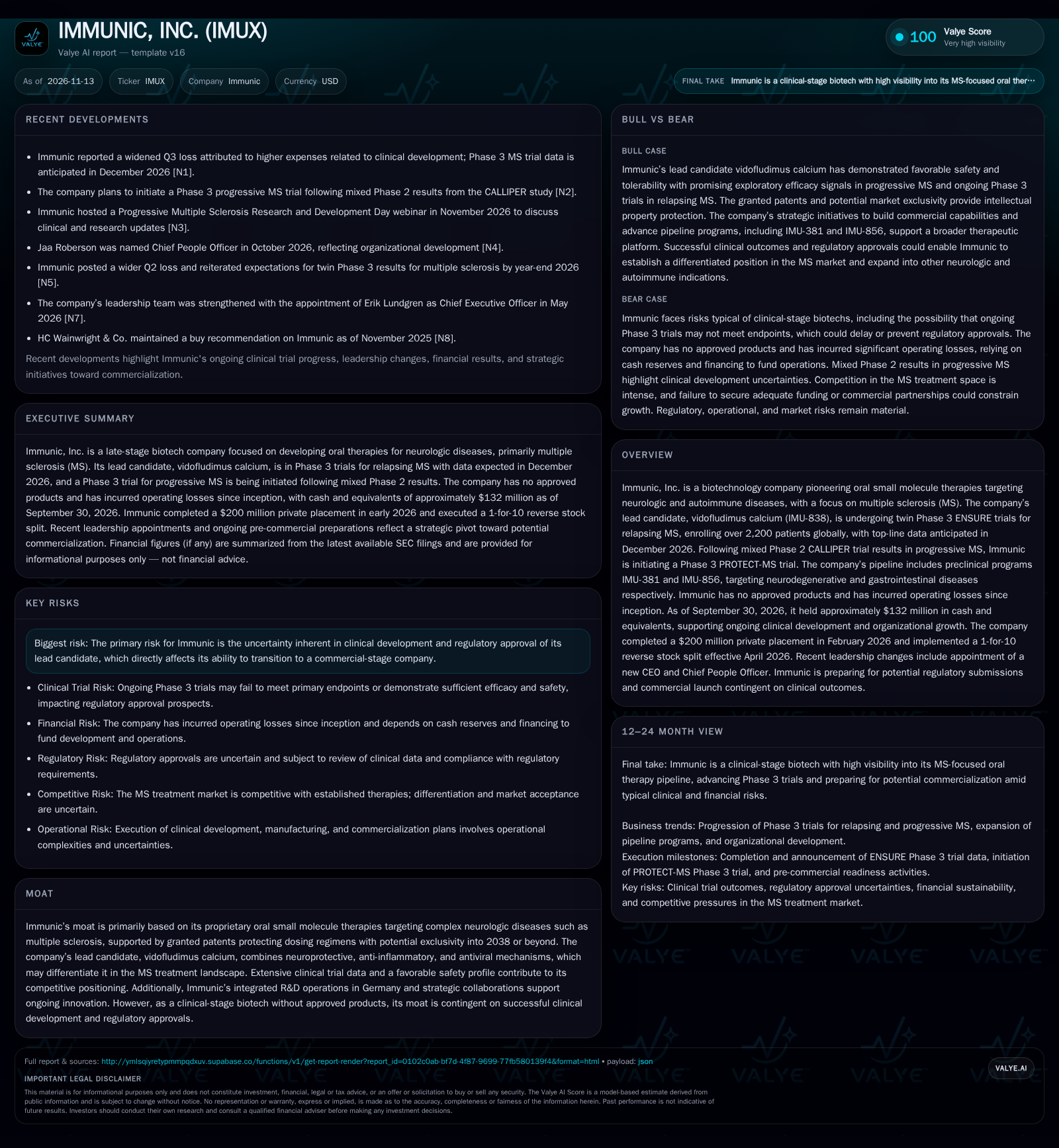
Immunic, Inc. is a late-stage biotech advancing oral therapies for multiple sclerosis, with lead candidate vidofludimus calcium in pivotal Phase 3 trials and data expected December 2026. The company holds $132 million in cash after a major private placement, but has no approved products and a $717.6 million accumulated deficit. Its outcome now hinges on imminent trial results and the path to regulatory approval or partnership.
Immunic, Inc. faces a pivotal moment as it approaches the December 2026 release of Phase 3 trial data for its lead MS candidate, vidofludimus calcium. With no products on the market and an accumulated deficit of over $700 million, Immunic’s future now hinges on clinical outcomes that will determine whether it can transition from a development-stage biotech to a commercial player.
Immunic’s Clinical and Financial Position Ahead of Pivotal Data
Immunic is in the late stages of clinical development, with its lead asset vidofludimus calcium (IMU-838) undergoing twin Phase 3 ENSURE trials in relapsing multiple sclerosis (MS), enrolling over 2,200 patients globally. Top-line data from these trials are expected in December 2026, representing the most consequential inflection point in the company’s history [S2].
The company has not generated any revenue from product sales and continues to operate at a loss, with an accumulated deficit of $717.6 million as of September 30, 2026 [S2]. As of the same date, Immunic reported $132 million in cash and equivalents—a figure bolstered by a $200 million private placement earlier in 2026 [S2]. The company reported cash and liquidity metrics for the period; these figures do not by themselves establish operating runway, investment capacity, financial flexibility, or financing capacity.
Following mixed results in the Phase 2 CALLIPER trial for progressive MS, Immunic is initiating a Phase 3 PROTECT-MS trial, underscoring both the scientific challenge and the potential for pipeline breadth if efficacy can be demonstrated in progressive forms of the disease [S2] [N2].
The Economics of Oral MS Therapies: Potential for Scale, but High Fixed Costs
Immunic’s business model is built around the development and eventual commercialization of proprietary oral small molecule therapies, with an initial focus on multiple sclerosis. The economics of this model are binary at the current stage: if vidofludimus calcium demonstrates efficacy and safety in Phase 3 and achieves regulatory approval, Immunic could unlock a large, established market with a product that offers the convenience of oral dosing and the potential for a differentiated safety/tolerability profile.
Pricing for new MS therapies is typically high, reflecting both the chronic nature of treatment and the competitive landscape. However, Immunic would likely face significant commercial investment requirements—namely, building or partnering for sales infrastructure, market access, and post-marketing commitments. Fixed costs are substantial due to ongoing R&D, regulatory, and potential launch activities, while variable costs (manufacturing oral small molecules) are generally lower than for biologics.
Operating leverage could be high if the lead asset is approved and achieves significant uptake, as incremental sales would be expected to deliver strong gross margins. Conversely, failure in the current trials would mean continued high fixed costs with no path to revenue, necessitating urgent cost containment or strategic alternatives.
Defining Differentiation in a Crowded MS Market
The MS treatment landscape is intensely competitive, with numerous approved oral, injectable, and infused therapies from major pharmaceutical companies. Immunic’s potential edge lies in vidofludimus calcium’s oral formulation, multi-modal mechanism (combining anti-inflammatory, neuroprotective, and antiviral properties), and a safety/tolerability profile that has been similar to placebo across multiple trials with over 3,500 participants exposed [S2].
However, the threshold for commercial success is high: existing MS drugs have established efficacy and safety records, and many are protected by their own strong patent estates and commercial franchises. For Immunic to carve out a share, it will need not only to demonstrate clear clinical advantages or comparable efficacy with improved safety or convenience, but also to convince payers and neurologists of the value proposition.
Patent protection for dosing regimens extends potential market exclusivity in the US and Europe into 2038, and possibly to 2043 with supplementary protection certificates [S1]. This could provide a window for return on investment if the product is approved and adopted, but does not guarantee pricing power or rapid uptake in a market where payer pressure and formulary access are increasingly critical.
How a Positive Phase 3 Readout Could Transform Immunic
If vidofludimus calcium meets or exceeds primary endpoints in the ENSURE Phase 3 trials, Immunic would have a compelling case for regulatory submission in relapsing MS. Favorable data, particularly if accompanied by a safety/tolerability advantage or unique efficacy signals, could drive partnership interest from larger pharma companies seeking to expand or refresh their MS portfolios.
The economics of a successful launch could be significant: with established MS drug pricing, even modest penetration could yield substantial revenue and operating leverage. Immunic’s strong patent position would support exclusivity, and its existing cash could fund initial regulatory and pre-commercial activities. A positive readout would also raise the value of pipeline assets (such as IMU-381 and IMU-856), potentially enabling out-licensing or partnerships.
Confirmation would come from: robust, statistically significant efficacy and safety data in December 2026; clear regulatory engagement and guidance on submission; and announcements of commercial partnerships, licensing deals, or preparations for launch. Falsification would occur if the data fail to show differentiation, or if regulatory or payer feedback is negative despite positive top-line results.
What If Immunic’s Phase 3 Data Are Mixed but Manageable?
The most plausible scenario is that vidofludimus calcium delivers Phase 3 results that are positive but not best-in-class: efficacy meets the threshold for regulatory submission, but safety or differentiation versus existing therapies is incremental rather than dramatic. In this case, Immunic may face a slower commercial ramp, with payers and prescribers requiring additional evidence or real-world experience before widespread adoption.
This outcome would likely prompt Immunic to pursue a commercial partnership rather than a full solo launch, both to manage capital outlays and to leverage a partner’s established infrastructure.
Evidence supporting this scenario would include: regulatory acceptance of the submission based on available data, announcement of a regional or global partnership, and further clarity on payer and prescriber attitudes. Falsification would be signaled by delays in regulatory timelines, inability to secure partnerships, or negative market feedback on the product’s clinical profile.
When Clinical Setbacks Force Rethinking the Strategy
If the Phase 3 ENSURE trials fail to meet their primary endpoints or reveal unexpected safety concerns, Immunic’s lead asset would likely be unviable for approval in relapsing MS. This would not only eliminate near-term commercial prospects, but also impair the company’s ability to raise additional capital or attract partners. The pipeline assets (IMU-381, IMU-856) are at earlier stages and unlikely to support the current cost structure or valuation in the short term.
Such an outcome would require urgent cost-cutting, potential workforce reductions, and a strategic pivot—possibly toward out-licensing earlier-stage assets or seeking a merger or acquisition. The company’s cash would provide only a temporary buffer as it re-evaluates options.
This scenario would be confirmed by: negative or inconclusive Phase 3 data; public statements on restructuring or pipeline reprioritization; and a halt or delay in ongoing or planned trials. Falsification would occur if, despite a negative headline result, further analyses or subgroup data allow for a regulatory path forward or support for other indications.
What Will Determine Immunic’s Transition from Science to Business?
Top-line efficacy and safety results from the ENSURE Phase 3 trials for vidofludimus calcium in relapsing MS, expected December 2026, are the single most material milestone [S2].
Regulatory feedback on the completeness and sufficiency of Phase 3 data for submission in major markets (US, EU) would help test the timeline to potential approval.
Announcements regarding commercial partnerships, licensing deals, or plans to build a salesforce would clarify the company’s intended go-to-market strategy.
Cash burn rate and updated guidance on runway, especially in the context of post-readout activities, will be critical for evaluating financial sustainability if disclosed.
Progress and clarity on the design, enrollment, and early signals from the PROTECT-MS trial in progressive MS will indicate pipeline optionality.
Patent litigation outcomes or challenges, if any arise, would be important to monitor given the value of exclusivity into 2038 or beyond.
Strategic alternatives or transactions involving IMU-381 or IMU-856, including out-licensing or divestiture, would serve as a test of the company’s ability to monetize its broader platform.
Disclaimer: This is research-only, informational analysis and not investment advice. It may include AI-generated interpretation and general industry context. Always verify important details using primary sources.

Comments