
Amanat Acquisition Corp.: Merger Execution, SPAC Lifecycle, and the Stakes of the Corxel US Deal
Amanat Acquisition Corp. has completed its IPO and announced a business combination with Corxel US, progressing through the classic SPAC lifecycle. With reported liquidity position but no operating revenues, the company’s trajectory now hinges on the successful closure and integration of its Corxel US merger.
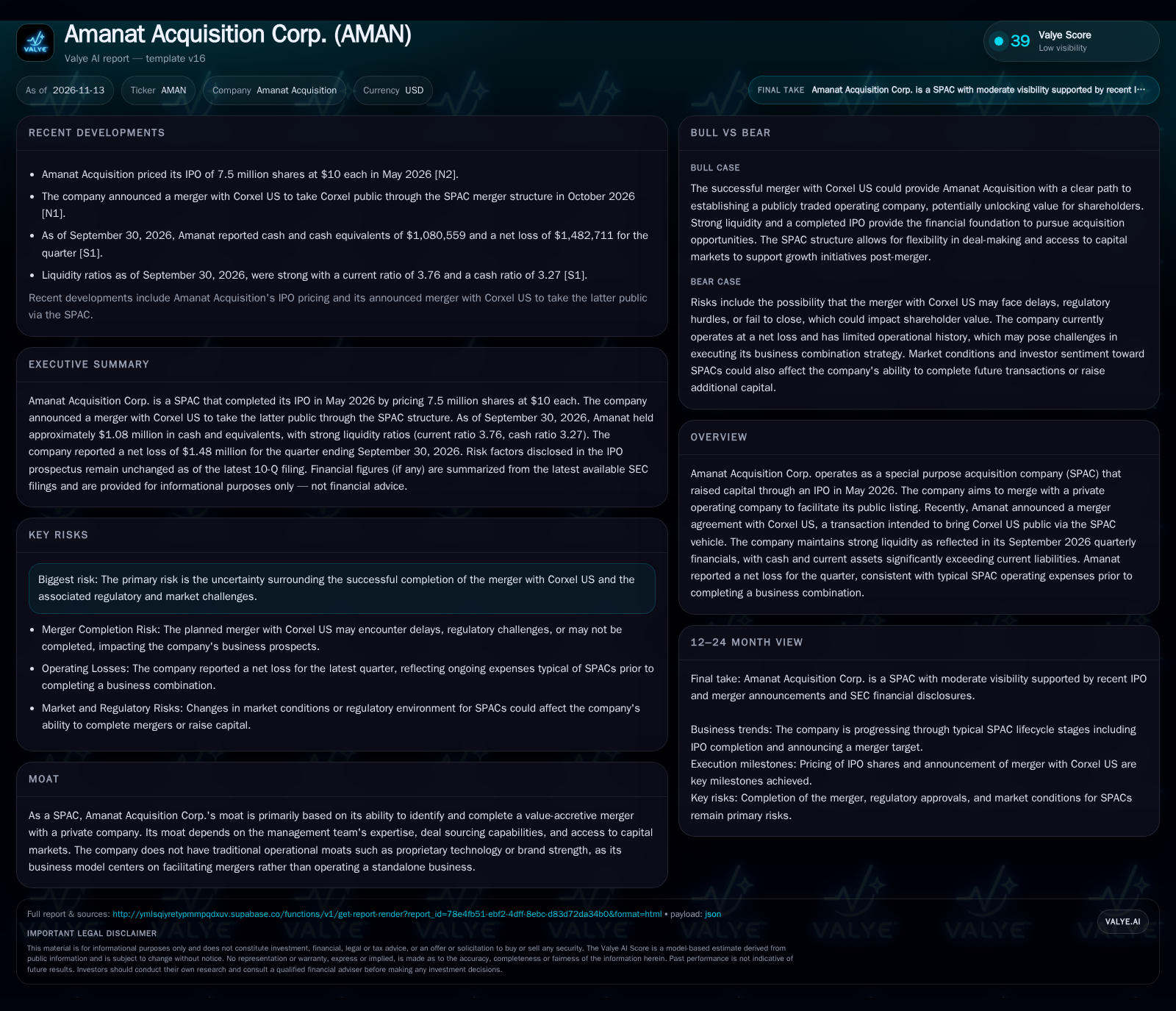
Amanat Acquisition Corp. is a newly listed SPAC that raised $75 million in its May 2026 IPO and announced a merger with Corxel US in October 2026. The company’s financials as of September 30, 2026, reflect reported liquidity position and pre-combination losses typical of SPACs. The main uncertainty now is whether the Corxel US deal closes as planned and delivers value to shareholders, against a backdrop of unchanged risk disclosures and no operational revenues yet.[S1] [N1] [N2]
Amanat Acquisition Corp. embodies the SPAC lifecycle: raising capital through a $75 million IPO, operating with minimal expenses but no revenues, and seeking to unlock value via a high-stakes merger. The company’s October 2026 agreement to merge with Corxel US is now its defining event, but execution risk remains high.
IPO Proceeds, Announced Merger, and the Pre-Revenue SPAC Phase
Amanat Acquisition Corp. completed its IPO in May 2026, issuing 7.5 million shares at $10 each, raising $75 million in gross proceeds.[N2] [S1] This capital was earmarked for identifying and completing a business combination within the 24-month window typical for SPACs. In October 2026, Amanat announced a merger agreement with Corxel US, aiming to bring Corxel public via the SPAC structure.[N1] [S1] As of September 30, 2026, Amanat reported cash and cash equivalents of $1,080,559 and a current ratio of 3.76, with a net loss of $1,482,711 for the quarter.[S1] These figures reflect ongoing formation and deal pursuit costs, with no operating revenues—a standard SPAC dynamic prior to a business combination.
The merger with Corxel US is expected to close in the first half of 2027, pending shareholder and regulatory approvals, and risk factors disclosed at IPO remain unchanged.[S1] Amanat’s value proposition now pivots entirely on its ability to consummate this transaction, as failure to do so within the 24-month window could force liquidation and return of capital to shareholders.
The pre-revenue phase of a SPAC like Amanat Acquisition Corp. inherently involves a delicate balance between capital preservation and deal execution urgency. The cash burn rate prior to merger closure is a critical factor, as excessive expenditures can erode the trust account and reduce the capital available for the business combination. Moreover, the timing of the merger announcement relative to the IPO date influences investor confidence; earlier announcements can signal strong deal sourcing capabilities but may also compress due diligence periods, increasing execution risk. Careful management of these dynamics is essential to maintain shareholder support and regulatory goodwill during this formative stage.
How SPAC Economics Shape Incentives and Outcomes
SPACs like Amanat Acquisition do not generate revenues or profits prior to a business combination; their economic model is to raise capital, identify a target, and facilitate its public listing. The sponsor typically invests in private placement shares and receives a 'promote'—founder shares convertible into a significant post-merger stake—if a deal closes. Fixed costs include underwriting fees, legal expenses, and ongoing reporting obligations, resulting in predictable operating losses until a merger is completed.[S1]
Upon closing a merger, the economics shift: the combined entity may access the public equity markets for additional capital, and the sponsor’s promote becomes valuable if the merged company trades above the SPAC’s original trust value. The capital structure post-merger may include redemptions that shrink the public float, PIPE investments for additional funding, and warrants or earn-outs tied to performance. If the Corxel US deal succeeds, Amanat’s shareholders could benefit from upside in the newly public company; if the deal fails or redemptions are high, value creation is limited or negative.
The sponsor’s promote structure creates aligned but potentially conflicting incentives that shape deal outcomes. While sponsors benefit from a significant equity stake post-merger, this upside is contingent on the combined entity’s market valuation exceeding the trust value plus dilution effects. This can incentivize sponsors to pursue deals with aggressive growth projections or complex earn-out structures, which carry execution risk. Additionally, the redemption rights of public shareholders introduce variability in the capital structure, potentially forcing sponsors to seek PIPE investors or renegotiate terms to ensure adequate capitalization. Understanding these incentive mechanisms is vital to assess the sustainability of value creation post-merger.
SPAC Competition: Deal Sourcing, Sponsor Reputation, and Market Sentiment
Amanat Acquisition’s competitive edge as a SPAC hinges on its ability to source and close a compelling merger before the 24-month deadline. Unlike operating companies, SPACs do not compete on products or technology but on their access to capital, sponsor credibility, and deal execution track record. The broader SPAC landscape is crowded, with many blank check companies seeking deals, making attractive targets scarce and inflating valuations.
The sponsor team’s network, reputation, and ability to negotiate favorable terms with Corxel US are critical. Market sentiment toward SPACs has fluctuated, with regulatory scrutiny and post-merger underperformance leading to greater investor skepticism. Amanat must demonstrate that the Corxel US transaction offers a compelling growth story and fair economics, or risk high redemption rates and limited aftermarket support.
In a saturated SPAC market, differentiation often hinges on the sponsor’s ability to leverage proprietary deal flow and sector expertise. Amanat’s competitive positioning depends not only on its network but also on the perceived quality and strategic fit of Corxel US within its targeted investment thesis. Furthermore, evolving regulatory landscapes can disproportionately impact SPACs with less transparent or complex deal structures, increasing scrutiny and lengthening approval timelines. Market sentiment toward SPACs is also cyclical; a resurgence in investor appetite can lower redemption rates and facilitate smoother capital raises, while skepticism can amplify volatility and constrain post-merger financing options.
Merger Completion Unlocks Value if Corxel US Delivers Growth
The most favorable scenario for Amanat is a timely closing of the Corxel US merger, followed by strong operating performance and market reception for the newly public company. This would require smooth regulatory and shareholder approvals, limited redemptions, and clear communication of Corxel’s growth prospects. If Corxel US demonstrates robust revenue growth, profitability, or a differentiated business model, post-merger share prices could exceed the SPAC trust value, benefiting both public shareholders and the sponsor.
Confirmation of this scenario would come from: regulatory filings showing minimal closing hurdles, PIPE or institutional investor participation, and positive investor sentiment in the run-up to the merger vote. Early trading performance post-merger, low redemption rates, and initiation of analyst coverage would further validate the upside case.
Navigating the Standard SPAC Playbook: Deal Closes with Moderate Redemptions
The most plausible outcome is that Amanat and Corxel US complete the merger within the anticipated timeline, but encounter moderate to high shareholder redemptions and a cautious market response. This reflects the current environment for SPACs, where many deals close but face significant capital outflows and post-listing volatility. The merged entity would become public, but may need to secure PIPE financing or adjust transaction terms to maintain adequate capitalization.
Evidence supporting this scenario would include steady progress through regulatory milestones, proxy statements outlining redemption mechanics, and market-neutral commentary from the sponsor and Corxel management. The main risks would be dilution, limited free float, and the challenge of building sustained investor interest post-merger.
Deal Failure or Regulatory Delays Trigger SPAC Liquidation Risk
A negative outcome for Amanat would be failure to close the Corxel US merger due to regulatory, shareholder, or market obstacles. This could stem from regulatory pushback, material adverse changes at Corxel, or a shift in market sentiment that drives overwhelming redemptions. If Amanat cannot consummate a business combination within 24 months of the IPO, it must liquidate and return trust proceeds to shareholders, with sponsors losing their promote and sunk costs.[S1]
Confirmation of downside risk would be signaled by missed regulatory deadlines, withdrawal or renegotiation of the merger agreement, negative proxy feedback, or a collapse in PIPE or institutional support. High redemption intent in advance of the merger vote would also foreshadow a failed deal or a weak post-merger public float.
Milestones and Metrics That Will Determine Amanat’s Outcome
Progress toward regulatory and shareholder approvals for the Corxel US merger, including HSR Act clearance and proxy statement filings.
Redemption rates at the merger vote; a useful metric would be the percentage of public shares redeemed versus retained in the combined entity.
PIPE financing or other committed capital raised to support the post-merger balance sheet, if disclosed.
Any revisions to the merger terms or transaction structure in response to market or regulatory feedback.
Quarterly updates on Amanat’s trust account balance and cash burn prior to deal closure.
Changes in risk factor disclosures in subsequent SEC filings, especially regarding deal completion or regulatory scrutiny.
Clarity on Corxel US’s business model, financial projections, and post-merger strategy as disclosed in proxy materials or investor presentations.
Market sentiment indicators, such as analyst initiation or trading volume, following the merger’s announcement and leading into the vote.
Disclaimer: This is research-only, informational analysis and not investment advice. It may include AI-generated interpretation and general industry context. Always verify important details using primary sources.

Comments