
Quetta Acquisition Corp: Extension-Driven Survival, Deal Urgency, and the Realities of SPAC Economics
The company’s future now hinges on successfully closing a deal before its extension deadlines expire, testing both its management’s cross-border dealmaking skills and the resilience of the SPAC model amid shifting capital markets.
Quetta Acquisition Corp remains a pre-revenue SPAC with severe liquidity pressure, no operating cash flow, and an extended but finite deadline to close a business combination—now focused on SMART KREATE GROUP LIMITED. Its ability to generate value for shareholders depends on executing a deal before its trust funds are depleted and extension options run out. The company’s fate will be determined by deal execution speed, capital market receptivity, and the viability of the target.
Quetta Acquisition Corp’s journey reflects both the promise and peril of the modern SPAC. After a terminated merger and with a new target in sight, the company is racing against both time and a rapidly deteriorating liquidity position. The trust account remains untouched except for modest extension deposits, but the operational balance sheet is nearly depleted. With the clock reset only one month at a time and the next extension hinging on small but recurring capital infusions, Quetta’s future is now a high-stakes test of its team’s ability to execute a cross-border deal under pressure, and of the broader SPAC mechanism’s resilience in a more skeptical capital market.
Deal Deadlines, Liquidity Crunch, and the Urgency of Execution
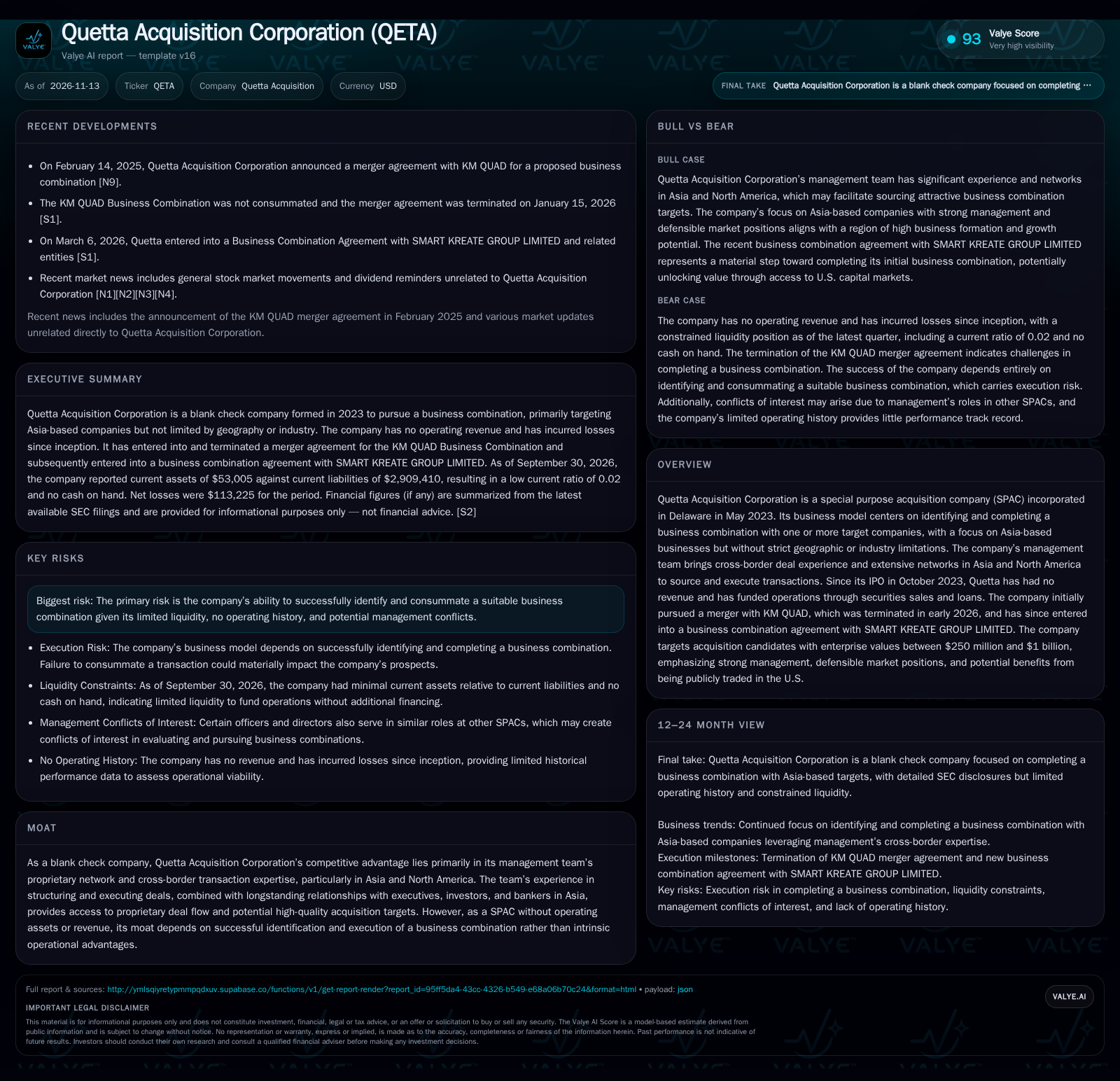
Quetta Acquisition Corp’s most material current facts are its failed initial merger (KM QUAD, terminated January 2026), the subsequent signing of a new business combination agreement with SMART KREATE GROUP LIMITED in March 2026, and its acute working capital deficit as of September 30, 2026. The company reported current assets of just $53,005 against current liabilities of $2,909,410, with a current ratio of 0.02 and no cash on hand [S2]. Trust account funds, which stood at $20.2 million, remain restricted for use only upon deal consummation. Shareholders have approved monthly extensions of the SPAC’s life through October 2027, but each extension requires a $5,000 deposit into the trust and does not address the underlying operational cash shortfall [S2]. These facts matter because Quetta’s ongoing viability now depends on closing a deal before funds and patience run out, with the risk of forced liquidation looming if execution falters.
SPAC Economics: Trust Account Mechanics, Fee Drag, and the Capital Squeeze
Quetta’s business model is typical of SPACs: raise capital via an IPO, place proceeds in a restricted trust, and seek to merge with a private company, thereby taking it public. Until a deal is closed, the SPAC generates only minimal interest income. All operating expenses—legal, accounting, deal diligence, and extension deposits—must be funded by the sponsors or through bridge loans, as the trust account cannot be tapped for ongoing costs. This structure creates a sharp contrast between the headline trust balance and the sponsor’s actual financial exposure.
With no operating revenue and persistent net losses, Quetta’s economics are defined by negative operating leverage: fixed public company costs and deal expenses accumulate with each month of delay, while no cash flows are generated. Deferred underwriting fees, professional costs, and sponsor advances add to the drag. Upon deal consummation, the merged entity could access the trust funds, but redemptions by public shareholders and deal-related costs often erode the headline proceeds. If a business combination fails, the trust is returned to shareholders (net of redemptions and expenses), and the SPAC dissolves.
The capital needs are thus twofold: bridging the operational gap until a deal closes, and ensuring the target company, once merged, is adequately capitalized to execute its growth plans. The recurring need for extension deposits and the lack of operating cash intensify the pressure to close a deal swiftly.
Access to Proprietary Deal Flow vs. Crowded SPAC Field and Target Scarcity
Quetta’s potential advantage lies in its management team’s cross-border transaction experience and networks across Asia and North America, which may provide access to proprietary deal flow in underpenetrated markets [S1]. The stated acquisition criteria target Asia-domiciled, globally operating companies with enterprise values between $250 million and $1 billion—a segment that could attract premium valuations if the right target is found.
However, the competitive landscape for SPACs has become increasingly challenging. There is a glut of SPAC capital chasing a finite pool of attractive targets, especially as market sentiment has cooled toward speculative growth stories and post-merger performance has often disappointed. Competing SPACs, direct listings, and traditional IPOs all vie for the same high-quality private firms. Furthermore, regulatory scrutiny and investor skepticism have increased, raising the bar for both deal quality and disclosure.
If Quetta’s team can leverage its regional expertise to identify and close a differentiated transaction, it could stand out. But the broader SPAC market’s structural headwinds, combined with the ticking clock and limited cash, create a formidable competitive gauntlet.
Successful Cross-Border Merger Unlocks Trust Value and Growth Platform
The favorable scenario for Quetta is the timely and successful consummation of its merger with SMART KREATE GROUP LIMITED. This would unlock the $20.2 million in the trust account (subject to redemptions), deliver a public listing for the target, and potentially position the combined entity for growth in Asian and global markets. If the target has a credible growth plan, proven management, and can withstand public market scrutiny, the deal could generate upside for both sponsors and shareholders.
Confirmation of this scenario would require evidence of regulatory and shareholder approvals, limited public shareholder redemptions (preserving trust proceeds), and positive market reception to the target’s business model. Early post-merger performance—such as revenue growth, margin expansion, or new customer wins—would further validate the value creation thesis. Key falsifiers would be high redemption rates, inability to close the deal, or negative post-merger trading performance.
Extension-Driven Deal Drag and the Reality of Sponsor Dilution
The most plausible outcome is a protracted deal process where Quetta continues to burn sponsor capital to buy monthly extensions, stretching negotiations and regulatory approvals with SMART KREATE GROUP LIMITED into 2027. This scenario is characterized by escalating professional fees, mounting sponsor advances, and increasing risk of shareholder fatigue and redemptions.
The economics for public shareholders may deteriorate with each extension, as the net trust value per share erodes due to ongoing costs and redemptions. Sponsor dilution becomes a greater risk if further bridge financing or concessions are required to close the deal. Confirmation would come from continued extension deposits, slow regulatory progress, and incremental deal updates without closure. Evidence that could falsify this scenario would be a rapid, successful closing or, conversely, a formal deal termination.
Failure to Close: Liquidation, Sponsor Losses, and Shareholder Return of Trust
The adverse scenario is that Quetta fails to consummate a business combination within the allowed extension period, either due to regulatory, financial, or execution obstacles with SMART KREATE GROUP LIMITED or another target. In this case, the company would be forced to liquidate and return the trust proceeds to public shareholders, net of any permitted expenses and redemptions.
This outcome would crystallize losses for the sponsor (who funded operational costs and extensions), provide little or no upside to public shareholders (beyond trust value), and likely result in negative reputational and financial consequences for the management team. Confirmation would be a formal liquidation notice, accelerated sponsor withdrawals, or a complete breakdown in deal negotiations. Falsification would require a credible signed and closing-ready merger agreement well before the extension period expires.
Milestones That Will Determine If Quetta’s SPAC Model Delivers Shareholder Value
Progress toward closing the business combination with SMART KREATE GROUP LIMITED, including regulatory filings and shareholder meeting dates.
The rate and size of public shareholder redemptions as the merger vote approaches—if disclosed, this will directly affect net trust proceeds available post-merger.
Monthly extension deposits into the trust account and any changes to the extension structure or deadlines.
Updates on sponsor loans, advances, or additional fundraising needed to sustain operations and fund extensions—if disclosed, this would clarify dilution risk.
Any material changes to the business combination agreement, such as revised terms, valuation adjustments, or target financial disclosures.
Management turnover or changes in sponsor composition, which could affect deal execution and market confidence.
External market conditions affecting SPAC redemptions, PIPE funding appetite, or regulatory scrutiny of Asia-based listings.
Disclaimer: This is research-only, informational analysis and not investment advice. It may include AI-generated interpretation and general industry context. Always verify important details using primary sources.

Comments