
Rank One Computing: Vision AI Expansion Amid Integration, Litigation, and Global Security Shifts
Rank One Computing’s proprietary Vision AI platform is gaining traction in biometrics and digital forensics, leveraging efficiency and U.S. pedigree to win share from legacy competitors. The company now faces the dual challenge of integrating its ZTC acquisition—amid lost contracts—and defending against a potentially material lawsuit, even as international demand and regulatory scrutiny reshape the identity technology landscape.
The company's edge lies in its efficient, U.S.-developed Vision AI, serving security-sensitive sectors and expanding abroad. Future performance will hinge on contract wins, successful integration, and navigating regulatory and legal headwinds. [S2]
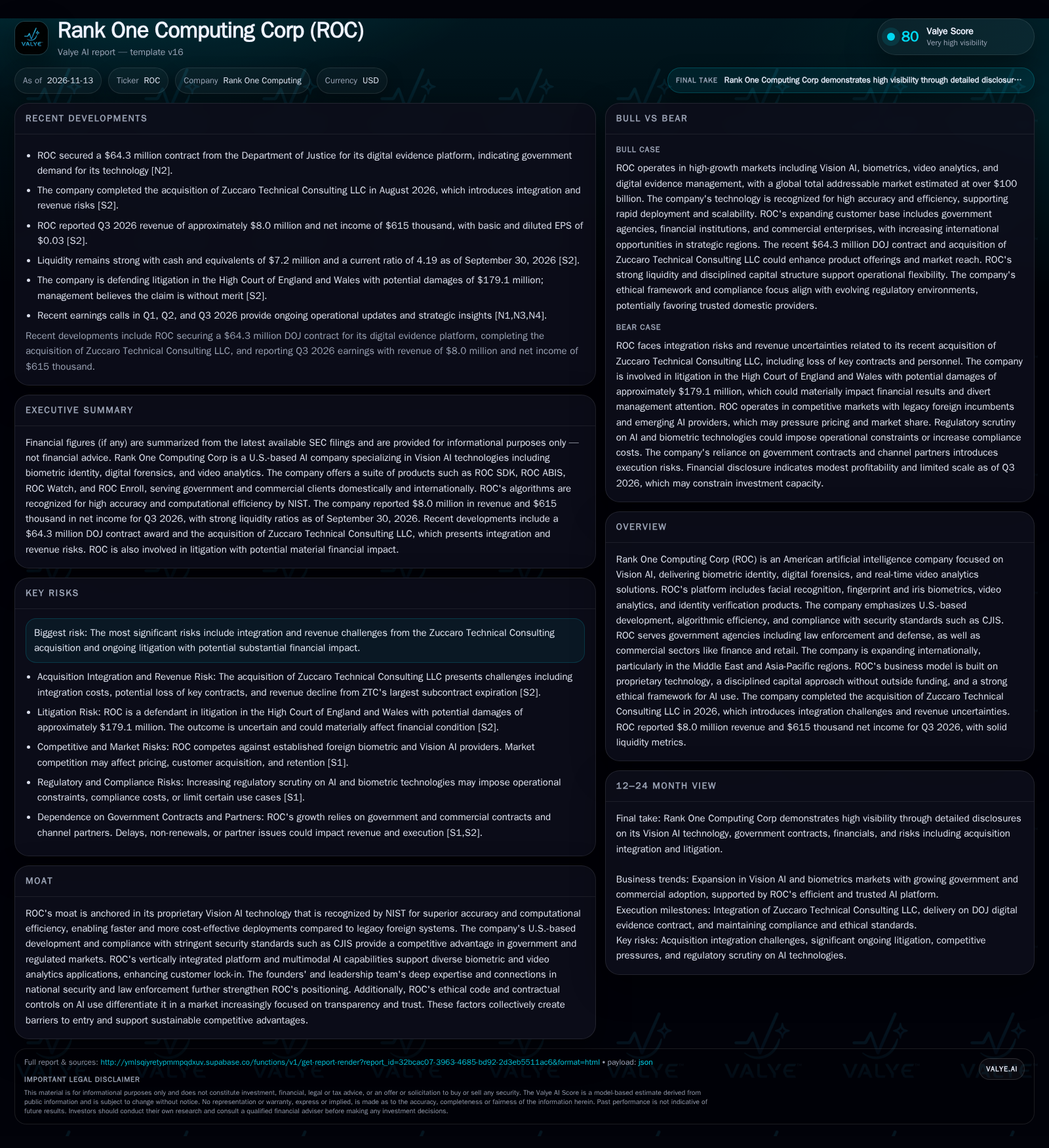
Rank One Computing Corp (ROC) has carved out a niche in the competitive Vision AI and biometrics sector by combining U.S.-developed, highly efficient algorithms with a platform spanning facial recognition, multimodal biometrics, and real-time video analytics. Recent financial results confirm commercial momentum and prudent balance sheet management, but the company’s future is complicated by two major uncertainties: integrating the newly acquired Zuccaro Technical Consulting (ZTC) after a key contract loss, and the looming risk of substantial damages from ongoing litigation in the UK. As ROC pushes into international markets and navigates regulatory headwinds, its ability to translate technical differentiation into sustained, scalable growth will be tested.
Acquisition Fallout and Legal Exposure Shape ROC’s Near-Term Landscape
ROC reported Q3 2026 revenue of approximately $8.0 million and net income of $615,000, with basic and diluted EPS of $0.03. As of September 30, 2026, the company’s cash and equivalents stood at $7.2 million, with a current ratio of 4.19 and a cash ratio of 1.55, indicating a reported liquidity position. [S2]
In August 2026, ROC completed the acquisition of Zuccaro Technical Consulting LLC (ZTC). However, ZTC’s largest subcontract expired in May 2026 and has not been renewed, reducing revenue from the acquired business and complicating integration. [S2]
ROC is currently defending litigation in the High Court of England and Wales, with potential damages of approximately $179.1 million. Management maintains that the claim is without merit and is defending vigorously, but the scale of the claim introduces meaningful financial risk. [S2]
The company’s core technology—NIST-ranked for accuracy and efficiency—continues to underpin contracts with government agencies, finance, public safety, and retail, with international expansion accelerating, particularly in the Middle East and Asia-Pacific. [S1]
Economic Model: High-Value Software, Integration Revenue, and Capital Discipline
ROC’s primary revenue streams likely derive from licensing its Vision AI software suite (ROC SDK, ABIS, Watch, Enroll), enterprise deployments, and related support or integration services. The company’s algorithms are recognized for high computational efficiency, which may allow ROC to deliver competitive pricing or higher margins by reducing customer infrastructure costs and speeding time-to-value. [S1]
Contracts with government and regulated enterprise customers often feature lengthy sales cycles and bespoke integration, which could create lumpy revenue recognition and a mix of upfront and recurring revenue. ROC’s ability to support both air-gapped and cloud-native deployments allows it to serve a broad range of security-sensitive customers, which may command premium pricing but also require ongoing compliance investment.
The ZTC acquisition could have been aimed at expanding ROC’s services or integration capabilities, but the expiration of ZTC’s largest subcontract prior to deal close removes a key revenue anchor and increases the risk of negative operating leverage if integration costs are not offset by new business. [S2]
ROC’s reported net income and prudent liquidity metrics suggest a disciplined approach to capital and operating expenses. However, the company’s relatively modest scale (quarterly revenue of $8.0 million) means that any large adverse event—such as litigation damages or a failed integration—could quickly absorb available resources. [S2]
Where ROC Stands: Domestic Trust, Algorithmic Efficiency, and the Challenge from Incumbents
ROC’s most distinctive edge is its U.S.-based development and NIST-validated algorithmic performance. In an era of rising geopolitical suspicion—especially toward Chinese and Russian providers—ROC is positioned to win contracts where national security, supply chain transparency, and regulatory compliance are paramount. [S1]
Legacy foreign incumbents, as well as established Western ABIS and biometric vendors, typically offer deeply embedded solutions but are often criticized for vendor lock-in and slow innovation. ROC’s efficiency claims and plug-and-play architecture may help it displace these incumbents, particularly in greenfield deployments or where incumbent service quality is lacking.
Emerging AI-native providers may compete aggressively on price and features, but ROC’s focus on computational efficiency and compliance (including ongoing CJIS and related certifications) could set a higher bar for government and regulated enterprise buyers.
Customer lock-in could be reinforced by ROC’s vertically integrated platform and multimodal capabilities, but the commoditization of basic biometric modalities means that long-term differentiation will depend on maintaining best-in-class efficiency, compliance, and trust.
How ROC Could Outperform: Contract Wins, Global Expansion, and Successful Integration
The most favorable scenario sees ROC leveraging its NIST-ranked technology and U.S. provenance to win large government and enterprise contracts—domestically and internationally—particularly as customers seek alternatives to foreign and legacy incumbents. Expansion in the Middle East and Asia-Pacific could provide meaningful growth if ROC successfully navigates local regulatory environments and adapts to regional procurement cycles. [S1]
If the ZTC acquisition is integrated efficiently and new contracts are secured to offset lost revenue, ROC could scale its services business, deepen customer relationships, and reduce integration drag. Cross-selling between ROC and ZTC’s legacy customer bases may unlock incremental revenue streams.
A favorable litigation outcome—either through dismissal or manageable settlement—would remove a major overhang, preserve capital, and free management to focus on growth.
Confirmation of this scenario would come from: (1) new or expanded contract wins in key international markets, (2) integration cost control and positive contribution from the ZTC business, (3) continued net income margin expansion, and (4) resolution of the UK litigation with no material cash outflow.
Sustaining Momentum: Efficiency Gains Offset by Integration and Legal Headwinds
The most plausible near-term outcome for ROC is steady commercial progress—winning select new contracts and maintaining a core government and enterprise customer base—while managing integration costs and legal uncertainty. Revenue growth may be modest as the company absorbs the loss of ZTC’s largest subcontract and faces lumpy contract cycles typical of public-sector and regulated enterprise markets. [S2]
Margins may remain positive but pressured by temporary integration expenses and continued investment in compliance and product development. Cash and liquidity are likely to be sufficient for operations barring an adverse litigation outcome or further major setbacks.
Evidence confirming this scenario would include stable or slightly rising quarterly revenue, manageable integration costs disclosed in future filings, and no escalation in the scale of litigation reserves or settlements.
What Could Go Wrong: Litigation Loss, Failed Integration, and Erosion of Differentiation
The principal downside risk is an adverse litigation outcome in the UK, which could result in damages ($179.1 million) that far exceed ROC’s cash and scale, potentially threatening solvency or forcing emergency financing. [S2]
If integration of ZTC fails—through loss of additional contracts, cost overruns, or cultural misalignment—ROC could face negative operating leverage, margin compression, and potential impairment charges.
Competitive threats could accelerate if legacy incumbents improve their offerings or if new AI-native entrants achieve regulatory acceptance and undercut ROC on price or features. Regulatory shifts that impose new compliance burdens, or public backlash against biometric technologies, could also slow adoption or increase costs.
Evidence for this scenario would include a material increase in litigation reserves or a settlement announcement, reporting of ZTC-related impairments or restructuring charges, declining revenue or margins, and loss of key contracts to competitors.
Signals That Will Reveal ROC’s Ability to Scale and Withstand Shocks
Progress or setbacks in the UK litigation—updates to reserves, settlements, or court rulings—would directly impact ROC’s financial outlook.
New contract wins, especially in the Middle East and Asia-Pacific, would validate international expansion and the perceived value of ROC’s technology.
Disclosure of integration costs, synergies, or impairments related to ZTC in future filings would clarify the acquisition’s net impact.
Trends in recurring revenue versus one-time project sales, if disclosed, would help assess the durability of ROC’s business model.
Any changes in customer concentration or the mix of government versus commercial revenue would indicate shifts in risk exposure.
Updates on regulatory certifications (e.g., CJIS) or new compliance regimes would signal ROC’s ability to maintain its competitive advantage.
Gross and net margin trends over subsequent quarters would provide insight into operating leverage and the impact of integration.
Disclaimer: This is research-only, informational analysis and not investment advice. It may include AI-generated interpretation and general industry context. Always verify important details using primary sources.

Comments