
Marine Petroleum Trust: Royalty Pass-Through Dynamics in a Volatile Energy Market
Marine Petroleum Trust exemplifies the pure royalty trust model: no management, no operating business, and a direct pipeline from petroleum asset revenues to unit holder dividends. Its recent stable distributions highlight the appeal of pass-through income, but also expose unit holders to commodity price swings, structural inflexibility, and limited transparency. The trust’s future cash flows depend almost entirely on oil and gas market conditions and regulatory stability, rather than operational execution or strategic reinvestment.
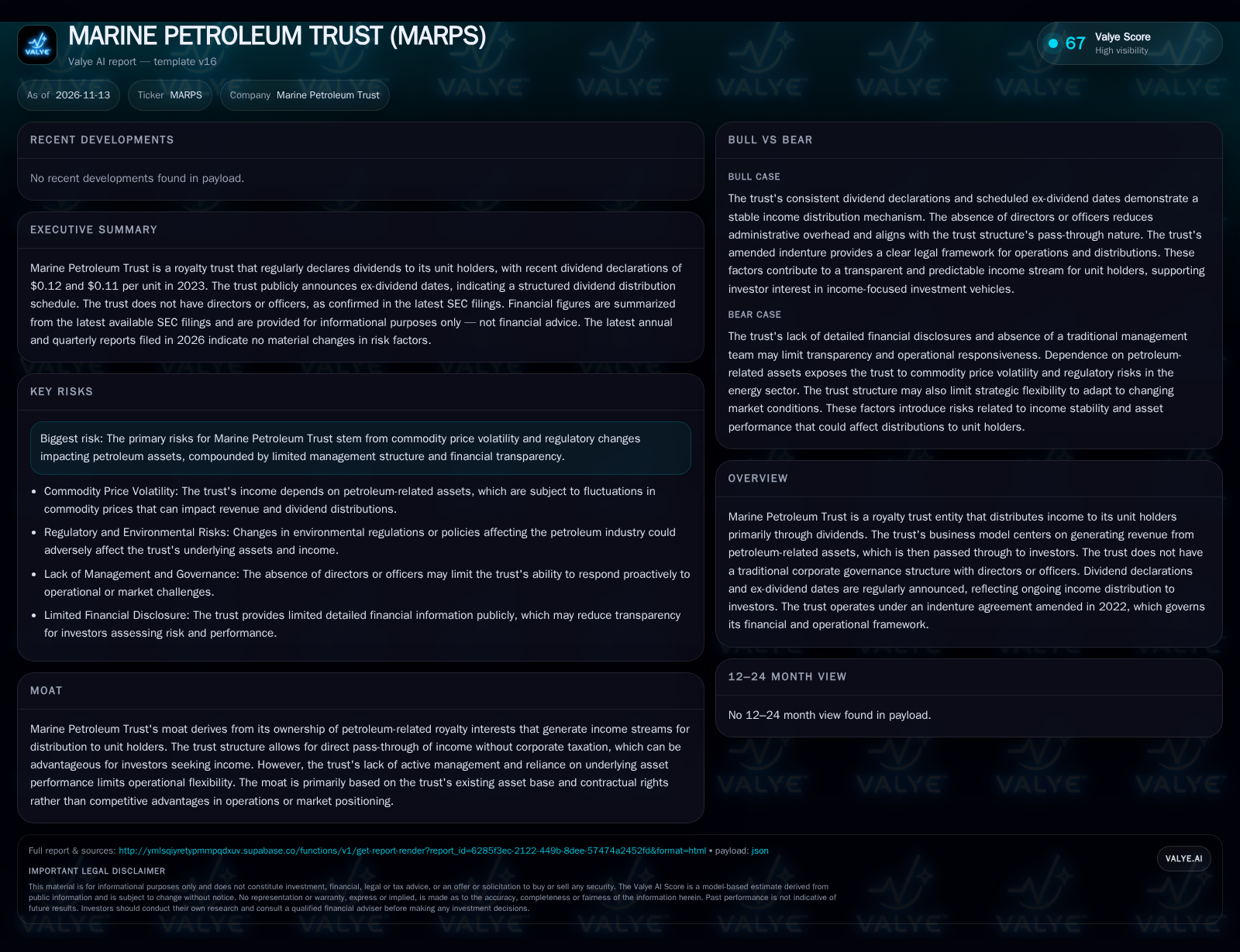
Marine Petroleum Trust continues to deliver regular dividends from petroleum royalty interests, operating without management or active governance. While this structure minimizes overhead and ensures direct pass-through of income, it also exposes unit holders to commodity price volatility, regulatory risk, and a lack of operational adaptability. The trust’s amended indenture anchors its legal and distribution framework, but future payouts remain highly sensitive to external energy market conditions and the productive life of its underlying assets. [S1] [S2] [N3] [N4]
Marine Petroleum Trust stands out as a legacy royalty trust, passing through all available income from its petroleum asset base directly to unit holders. With no directors, officers, or operating business, the trust’s only real levers are dictated by its indenture and the performance of its oil and gas royalties. Regular dividend declarations in 2023 reinforce its role as an income vehicle, but highlight a fundamental vulnerability: payouts are ultimately driven by the underlying asset base and prevailing commodity prices, rather than any management action or strategic shift. For investors, this means stable income when energy markets are favorable, but little protection or adaptability when conditions deteriorate. [S1] [S2] [N3] [N4]
Dividend Stability and Structural Simplicity Define the Present
The cited source reports dividend-related activity; that disclosure alone does not establish dividend-policy continuity, management confidence, or a material constraint on capital flexibility. These facts matter because they illustrate the trust’s pure pass-through structure: all available income from its petroleum royalty assets is distributed to unit holders, with minimal retained earnings or overhead. The legal framework is anchored by an amended indenture as of September 2022, and the latest 10-K and 10-Q filings report no material changes to risk factors or operational structure. This combination of regular distributions, legal continuity, and structural simplicity is central to the trust’s investment profile. [S1] [S2] [N3] [N4]
How Royalty Trust Economics Translate to Investor Outcomes
Marine Petroleum Trust’s economics are governed by the royalty trust model: it holds interests in petroleum properties and pays out virtually all net income to unit holders. There is no active operating business, no reinvestment mandate, and no significant fixed cost base. Revenue is a function of production volumes and prices achieved on the underlying oil and gas assets—both factors outside the trust’s control. There are essentially no variable costs tied to revenue, aside from minimal administrative and legal expenses. Because the trust does not retain earnings for growth or diversification, every dollar of distributable income is effectively a direct function of royalty receipts. Operating leverage is limited; there is no scope to scale or optimize. Capital needs are minimal, but so is the ability to respond to asset declines or market shocks. The trust’s income (and therefore its distributions) will diminish over time as underlying reserves deplete or if realized prices fall.
Given the trust’s lack of operational control, its financial performance is highly sensitive to external market dynamics and the physical characteristics of the petroleum assets. For instance, fluctuations in global oil supply-demand balances, geopolitical events, or technological shifts in energy production can materially affect commodity prices and thus the trust’s revenue. Additionally, the natural decline rates of oil and gas wells impose a structural limit on production volumes, which cannot be offset by reinvestment or enhanced recovery techniques within the trust’s framework. This creates a predictable but inexorable erosion of distributable income over time unless commodity prices rise sufficiently to compensate for volume declines.
Asset Base and Legal Structure: Limited Moat, Expiring Advantage
Marine Petroleum Trust’s competitive position is rooted in its legacy asset base and the contractual rights established by its indenture. Unlike operators or actively managed royalty companies, the trust cannot acquire new assets, optimize production, or diversify its exposure. Its closest peers are other royalty trusts or pass-through vehicles tied to depleting resource pools. The main advantage is the direct, tax-advantaged pass-through of income, which can appeal to income-focused investors. However, this advantage is counterbalanced by exposure to commodity price cycles, regulatory changes, and the natural decline of the underlying assets. There are no network effects, switching costs, or technological moats. Substitute investments—such as other income-generating securities or actively managed energy funds—may offer more diversification or growth potential, especially as the trust’s asset base matures.
Favorable Oil Markets and Asset Longevity Could Sustain High Distributions
The most constructive scenario for Marine Petroleum Trust is a period of sustained high oil and gas prices, combined with production stability or slower-than-expected decline from the underlying assets. In this case, royalty receipts could remain robust, supporting continued or even increased per-unit distributions. Evidence that would confirm this scenario includes sequential or year-over-year growth in declared dividends, stable or rising royalty income in SEC filings, and a lack of adverse commentary regarding asset depletion. If external energy market conditions remain supportive and regulatory risks are muted, the trust could outperform expectations as an income vehicle. However, this scenario is highly contingent on external macro factors and the productive longevity of the trust’s asset portfolio.
Payouts Likely Track Commodity Cycles Amid Asset Depletion
The most realistic scenario is that Marine Petroleum Trust’s distributions fluctuate with oil and gas price cycles while gradually declining as the underlying reserves are depleted. Periods of high commodity prices may temporarily boost payouts, but the overall trajectory is downward due to the finite nature of the assets. Confirming this scenario would be a pattern of stable-to-declining dividends over multiple years, with little change in the trust’s structure or operations as documented in future 10-Ks or 10-Qs. Falsifying evidence would be a sustained increase in distributions without corresponding commodity price increases, or unexpected new asset inflows (which are structurally unlikely given the trust’s indenture).
Regulatory Shocks or Commodity Price Collapse Threaten Distribution Viability
A negative scenario for Marine Petroleum Trust would involve a sharp and sustained drop in oil and gas prices, or the imposition of adverse regulatory or environmental policies that reduce the value or productivity of its underlying assets. In this context, royalty receipts would fall, potentially leading to sharply reduced or even suspended distributions. A rapid acceleration in reserve depletion or unexpected legal/operational expenses could further erode distributable income. Evidence confirming this scenario would include abrupt dividend cuts, explicit risk factor updates in SEC filings, or disclosures of asset impairments or regulatory actions affecting the trust’s income streams.
Testing the Marine Petroleum Trust Thesis: Payouts, Asset Trends, and External Shocks
Track the quarterly and annual dividend declarations for changes in payout levels, direction, or frequency. [N3] [N4]
Monitor SEC filings for new disclosures on asset depletion rates or changes in the estimated productive life of the trust’s royalty interests. [S1] [S2]
Watch for any amendments or updates to the trust’s indenture that could alter distribution mechanics or asset coverage. [S2]
Evaluate external oil and gas price trends, as these directly influence the trust’s revenue and distribution potential.
Review risk factor sections in future filings for emerging regulatory, legal, or environmental threats to the trust’s assets. [S1] [S2]
If disclosed, analyze the underlying production volumes and realized commodity prices to assess sustainability of current payout levels.
Observe for any signals of extraordinary administrative or legal expenses that could materially reduce distributable income.
Disclaimer: This is research-only, informational analysis and not investment advice. It may include AI-generated interpretation and general industry context. Always verify important details using primary sources.

Comments