
MetaVia Inc.: Clinical Momentum in Liver-Cardiometabolic Therapies Collides with Severe Funding Uncertainty
MetaVia’s dual lead programs for liver-driven metabolic disease show promising early clinical data and patent durability, but the company’s ability to capitalize on these assets is acutely constrained by short cash runway, persistent operating losses, and unresolved financing needs.
MetaVia Inc. is advancing two novel drug candidates for liver-focused cardiometabolic diseases, with positive early clinical data and broad patent coverage. The commercial future hinges on both clinical progress and the company’s capacity to secure capital or partnerships to bridge to pivotal trials and, ultimately, regulatory submission and commercialization. [S2] [N1]
MetaVia Inc. is at a critical juncture: its lead candidates for liver-focused cardiometabolic diseases are progressing through early-stage clinical trials, with DA-1726 showing encouraging biomarker results and both pipeline assets protected by long-duration patents. The coming year will test whether MetaVia can convert scientific momentum into a sustainable business platform—or whether financial constraints will force a retrenchment or asset sale before pivotal trials can be completed.
Recent Clinical Progress and Financial Strains Define MetaVia’s Near-Term Outlook
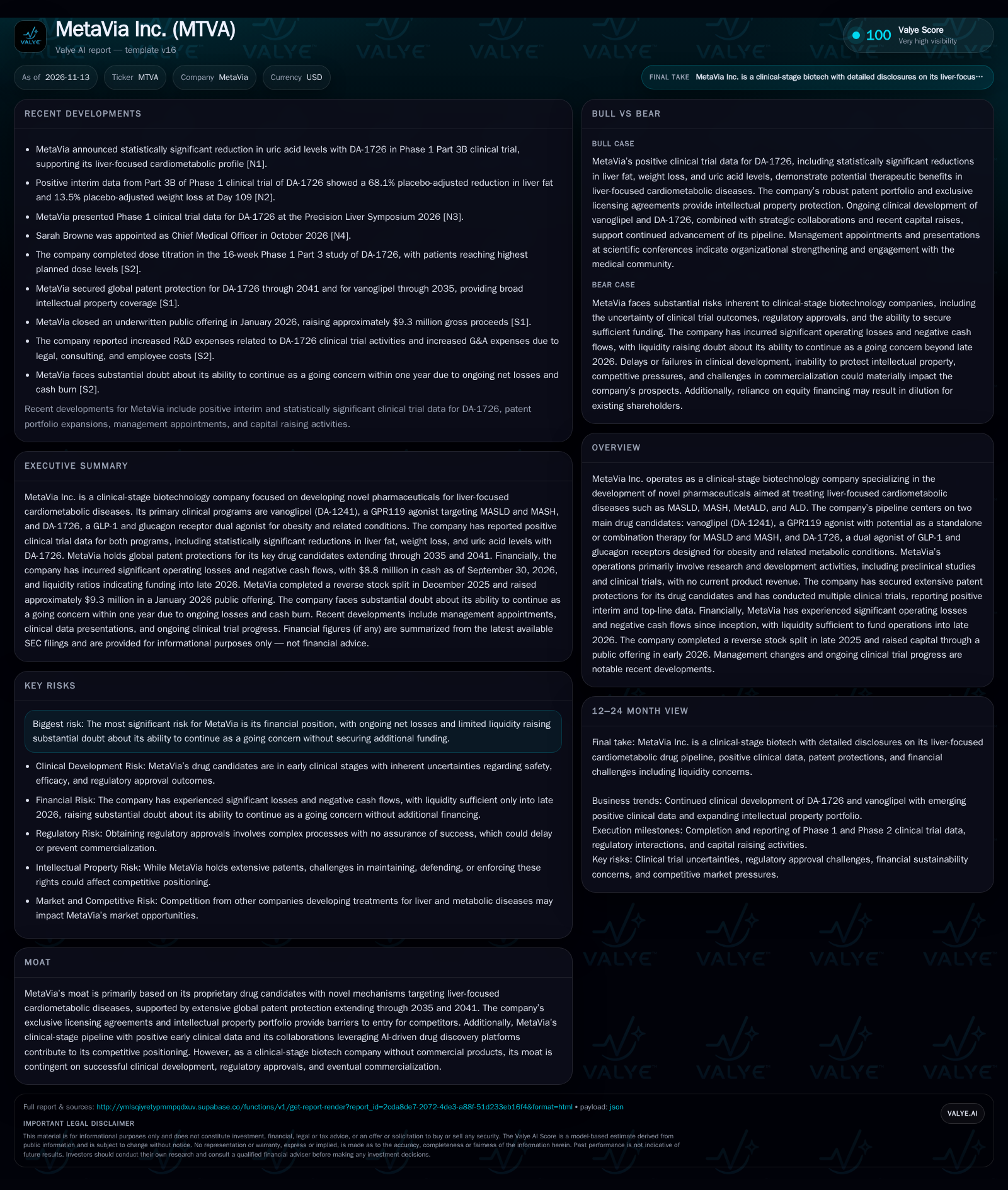
MetaVia’s DA-1726, a dual GLP-1/glucagon receptor agonist, achieved a statistically significant reduction in uric acid levels in a Phase 1 clinical trial, reinforcing its potential as a differentiated therapy for liver-driven metabolic and cardiometabolic conditions. The company completed the highest planned dose escalation in this early-stage study and shared results at recognized scientific forums, signaling credible R&D momentum. [N1] [S2] [N3]
On the financial front, MetaVia reported a net loss of $13.8 million for the first nine months of 2026, with cash and equivalents totaling $8.8 million at September 30, 2026. This liquidity is forecast to last only into late 2026, and management has explicitly acknowledged 'substantial doubt' about the company’s ability to continue as a going concern without new funding. A $9.3 million capital raise in January 2026 provided a temporary cushion, but did not resolve the underlying structural funding gap. [S2] [S1]
Intellectual property coverage remains a relative strength: patents for DA-1726 extend through 2041 and for vanoglipel through 2035, covering novel peptide structures, dual-incretin design, manufacturing, and therapeutic uses. These protections create a window for potential commercial exclusivity—if the pipeline progresses to market. [S1]
How MetaVia’s Model Could Convert Science into Cash—If Development Succeeds
MetaVia’s economic model is typical of clinical-stage biotech: high up-front R&D spend, no current product revenue, and a business plan dependent on successful clinical development, regulatory approval, and eventual commercialization or out-licensing. The company’s primary value drivers are its two lead programs: vanoglipel (a GPR119 agonist with application in MASLD/MASH) and DA-1726 (a dual GLP-1/glucagon agonist for obesity and related liver conditions).
Revenue, if achieved, would likely be driven by a mix of proprietary drug sales (pending regulatory approval) or milestone and royalty payments from out-licensing partnerships. The economics of GLP-1-based and metabolic disease drugs have historically allowed for premium pricing in the event of differentiated efficacy or safety, but these markets are also highly competitive and subject to payer pressure. Volume would depend on the breadth of approved indications, prescriber adoption, and payer reimbursement—factors that hinge on robust Phase 2/3 data.
Operating leverage could emerge if one or both candidates advance to late-stage trials or commercialization, as fixed infrastructure costs may be spread over higher revenue bases. However, capital needs are substantial: each new clinical phase requires incremental funding, especially for pivotal studies and pre-commercial buildout. With no recurring revenue, MetaVia is reliant on external capital—via equity, debt, or partnerships—to fund ongoing operations and R&D. [S2]
There is also potential for asset monetization: MetaVia has four legacy programs not currently being advanced, which could be out-licensed or divested to provide non-dilutive capital. If realized, such transactions could help bridge the funding gap, but their value and timing are uncertain.
Patent Coverage, Differentiated Mechanisms, and the Challenge of Entrenched Rivals
MetaVia’s competitive position is anchored by its proprietary drug candidates and broad patent estate, which—if the clinical programs succeed—could provide a multi-year head start against generic and biosimilar competition. DA-1726’s dual agonist mechanism aims to address both liver and metabolic endpoints, potentially offering differentiation in a space where single-pathway GLP-1 therapies have already achieved commercial success.
However, the company operates in a crowded field. Large pharmaceutical companies and well-funded biotechs are developing or marketing GLP-1 agonists and NASH/MASH therapies, many with more advanced clinical programs or established commercial infrastructure. Incumbents benefit from scale, distribution networks, and payer relationships that MetaVia would need to build or access through partnerships.
Switching frictions in metabolic disease treatments are moderate: while prescribers may be receptive to novel mechanisms, adoption depends on clear clinical superiority, safety, tolerability, and payer willingness to reimburse. Intellectual property does create a barrier, but only if MetaVia’s candidates show compelling clinical advantages and can reach the market before competitors leapfrog with next-generation or combination therapies.
Should MetaVia be unable to fund late-stage trials internally, its bargaining power in partnership negotiations may be weakened, potentially forcing it to accept less favorable terms or risk losing out to larger players with overlapping programs.
What If MetaVia Converts Clinical Momentum into a Valuable Platform?
In the most favorable scenario, MetaVia’s lead assets (especially DA-1726) continue to deliver strong clinical data, including robust efficacy and safety in larger, longer-duration trials. This would increase the likelihood of regulatory approval, especially if the dual-mechanism approach yields clear advantages over single-pathway competitors in hard-to-treat patient populations.
Positive data would likely attract the interest of larger pharmaceutical companies seeking to augment their metabolic/liver portfolios, enabling MetaVia to negotiate partnership or out-licensing deals with substantial upfront payments, milestones, and royalties. Non-dilutive capital from such deals could bridge the company to pivotal trials and, eventually, commercialization. The company’s broad patent protection and differentiated mechanism would further support premium deal terms.
Confirmation of this scenario would come from: (1) successful completion and positive readouts from Phase 2 trials; (2) public disclosure of significant partnership, licensing, or co-development agreements; (3) additional capital raises at favorable terms; and (4) regulatory designations (e.g., Fast Track or Breakthrough Therapy) that signal agency confidence in the program.
Clinical Progress Continues, but Funding Remains a Persistent Threat
The most plausible outcome is that MetaVia advances its lead programs through ongoing Phase 1/2 studies, generating additional safety and efficacy data and presenting at scientific meetings.
Dilution for existing shareholders may increase, especially if funding is secured under distressed conditions. The company may also seek to monetize legacy assets, but the proceeds and timing are uncertain. Without a transformative partnership or non-dilutive financing, MetaVia may need to slow R&D or prioritize one program over the other to conserve resources.
Evidence for this scenario would include: (1) continued reporting of incremental clinical results; (2) new, but modest, capital raises; (3) cost containment measures; and (4) lack of major partnership announcements. Any delays in clinical progress or regulatory setbacks would further strain the funding situation.
When Science Alone Isn’t Enough: The Risk of Forced Retrenchment or Asset Fire Sale
In the adverse scenario, MetaVia’s clinical data fail to show sufficient efficacy or safety to attract partners or new investors. The company’s cash position deteriorates before it can secure additional funding, forcing a halt or slowdown of clinical activities.
Without new capital, MetaVia may be compelled to out-license or divest its core assets at distressed valuations, or face the risk of bankruptcy and liquidation. Even if clinical results are promising, a weak funding environment or loss of investor confidence could force similar outcomes.
Confirmation of this scenario would be: (1) announcement of halted or delayed clinical trials due to lack of funding; (2) distressed asset sales or licensing deals with minimal upfront payments; (3) management or board turnover; and (4) explicit regulatory filings or disclosures of imminent insolvency.
Milestones That Will Determine Whether MetaVia Can Bridge Science and Sustainability
Progression to, and successful completion of, Phase 2 trials for DA-1726 and vanoglipel, including efficacy and safety endpoints that differentiate from standard-of-care or competitors.
Disclosure of partnership, co-development, or out-licensing agreements that provide non-dilutive capital or strategic resources.
Cash runway and burn rate updates—specifically, whether MetaVia can extend liquidity beyond late 2026 without severely dilutive financing.
Any regulatory designations (e.g., Fast Track, Breakthrough Therapy) that could accelerate approval timelines or increase asset value.
Outcomes of efforts to monetize or divest legacy pipeline assets—if disclosed, size and timing of proceeds would help test the thesis.
Changes in R&D or G&A expense trajectory, signaling either cost containment or incremental investment in pipeline advancement.
Management turnover, especially in clinical, financial, or business development leadership roles.
Disclaimer: This is research-only, informational analysis and not investment advice. It may include AI-generated interpretation and general industry context. Always verify important details using primary sources.

Comments