
Royale Energy: Operating Under Constraints Amid Limited Transparency and Tight Liquidity
Royale Energy, Inc. faces a challenging financial position with current liabilities far exceeding current assets, minimal revenue, and ongoing net losses. With sparse public disclosures and little visibility into its core business model, the company’s future hinges on its ability to manage short-term obligations, maintain operational continuity, and clarify its strategic direction.
Royale Energy’s latest filings reveal a net loss, low revenue, and a current ratio well below 1, signaling significant short-term liquidity pressure. The company provides minimal public information about its operations or industry focus, limiting external visibility. The main levers for improvement may be cost containment, liability management, and establishing a clearer commercial roadmap.
Royale Energy, Inc. stands at a crossroads defined less by operational milestones than by its acute financial constraints and lack of public transparency. With current liabilities more than double its current assets and a continued net loss, the company’s ability to operate as a going concern in the near term is in question. The absence of detailed business model disclosures or recent company-specific news further complicates any assessment of Royale’s strategic prospects, leaving investors and stakeholders reliant on sparse SEC filings and general market context for insights into future viability.
Latest Financials and Disclosure Gaps Shape Immediate Outlook
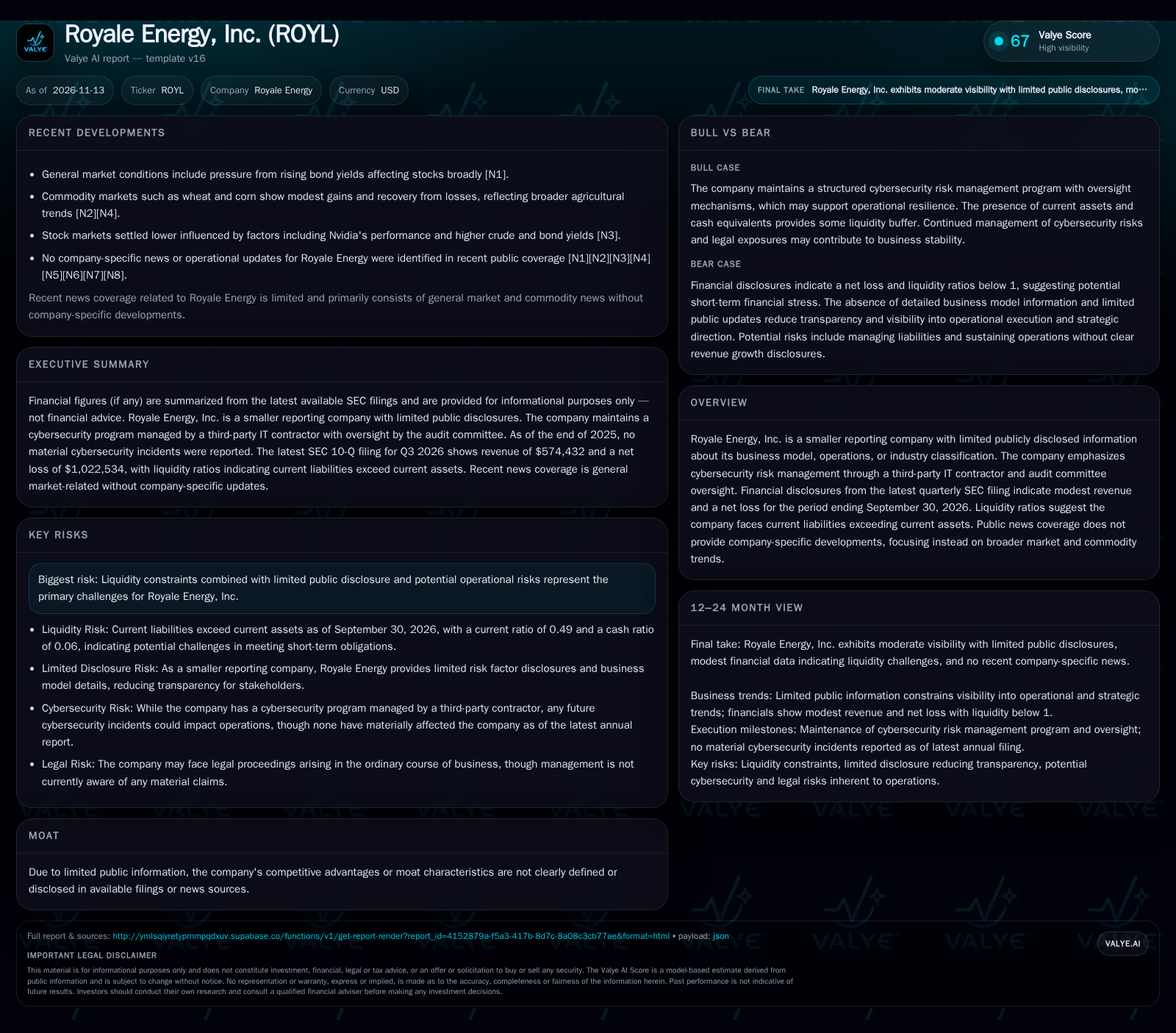
Royale Energy’s most recent SEC 10-Q filing shows revenue of $574,432 and a net loss of $1,022,534 for the period ending September 30, 2026. Cash and cash equivalents stood at $1,455,707, while current assets totaled $12,876,736 against current liabilities of $26,124,834. This results in a current ratio of 0.49 and a cash ratio of 0.06, highlighting a pronounced short-term liquidity gap [S2].
The company remains classified as a smaller reporting company, which allows for limited risk factor and business-model disclosure under SEC rules [S1]. No material cybersecurity or legal incidents have been reported, and public news coverage offers no substantive company-specific developments [S1] [S2]. These factors combine to create a situation where the company’s operational and financial risks are difficult to fully assess using publicly available data.
Revenue Model Unknowns and the Economics of Survival
With minimal revenue and an ongoing net loss, Royale Energy’s underlying business model remains opaque, complicating any analysis of its economics. The company’s small revenue base suggests either a niche or declining business, or a non-core asset portfolio. The high current liabilities relative to assets may stem from legacy obligations, short-term borrowings, or accrued expenses, but the lack of detailed disclosure precludes precise attribution [S2].
If Royale operates in the energy sector as its name implies, typical models include oil and gas production, royalty interests, or energy services. These businesses are generally capital intensive, with cash flow sensitive to commodity prices and production volumes. In such models, fixed costs can be significant, and operating leverage cuts both ways—amplifying losses when revenue is weak.
The absence of capital-raising disclosures or asset sales in recent public filings suggests either limited access to such options or ongoing negotiations not yet disclosed.
Competitive Dynamics Obscured by Limited Public Insight
Royale Energy’s competitive position is difficult to ascertain due to the lack of industry specifics or operational detail. If active in upstream oil and gas, the company would face competition from both small independents and larger integrated energy firms. Barriers to entry in such sectors include capital requirements, access to acreage, and operational expertise, while commodity price volatility can rapidly reshape the competitive landscape.
Without disclosures on asset base, production volumes, or customer mix, it is not possible to determine whether Royale has any sustainable cost advantage, differentiated asset quality, or niche positioning. In the absence of visible scale or integration, smaller energy companies often struggle to maintain profitability during downturns and can be acquisition targets or forced sellers in times of distress.
Cybersecurity oversight, while prudent, does not confer a clear competitive edge unless tied to digital asset management or critical infrastructure—none of which is established in current filings. Thus, the principal competitive risks may be structural rather than operational, with Royale’s limited transparency compounding the uncertainty.
Restructuring or Asset Monetization Could Reset the Narrative
The most plausible upside for Royale Energy would come from successfully restructuring its liabilities, securing bridge financing, or monetizing non-core assets to relieve near-term liquidity pressure. If the company were able to renegotiate payables, convert debt to equity, or sell a material asset, it could restore working capital and buy time to stabilize operations.
A secondary upside pathway could involve a rebound in commodity prices or the discovery of a high-value asset, which—if applicable—would boost revenue and improve cash flow. However, there is no evidence of such developments in current filings [S2].
Confirmation of an upside scenario would come from SEC disclosures of a new financing agreement, asset sale, or material reduction in current liabilities. Additional signals could include disclosure of new revenue streams, strategic partnerships, or a detailed business model roadmap. The absence of such filings would tend to falsify the near-term upside thesis.
Operational Stasis with Persistent Financial Strain
The most likely scenario given current facts is that Royale Energy continues to operate under severe liquidity constraints, attempting to meet obligations through incremental measures such as cost-cutting, negotiating payment terms, or seeking modest external funding. Revenue may remain flat or decline further if operational activity is curtailed by lack of working capital.
Without a clear business model disclosure or evidence of new commercial initiatives, the company’s trajectory could be characterized by ongoing net losses and mounting pressure from creditors. If Royale can maintain core operations and avoid default or forced asset sales, it may muddle through, but the structural imbalance between current assets and liabilities makes this an unsustainable status quo absent intervention.
Evidence confirming this scenario would include continued reporting of net losses, flat or declining revenue, and persistent negative working capital in future filings. Signs of stabilization—such as improved liquidity ratios, new funding, or asset sales—would challenge the base case.
Liquidity Crunch Leading to Distress or Forced Liquidation
The adverse scenario is that Royale Energy’s liquidity position deteriorates to the point where it cannot meet its short-term obligations, leading to technical default, creditor actions, or forced asset dispositions. In the absence of new funding or liability management, the company could face bankruptcy or restructuring proceedings.
If Royale is unable to access capital markets or monetize assets quickly, operational disruptions could follow, eroding whatever franchise or asset value remains. For smaller reporting companies, such situations can unfold rapidly, with little public warning due to minimal disclosure requirements.
Downside confirmation would include SEC filings disclosing covenant breaches, going concern warnings, missed payments, or formal restructuring actions. A sharp drop in cash balances, further declines in the current ratio, or the emergence of material legal claims would also validate this scenario.
Signals That Could Reshape the Royale Energy Thesis
New SEC disclosures of asset sales, debt restructuring, or fresh financing would provide direct evidence of management’s ability to address liquidity constraints.
Updated revenue figures and any commentary on business segment performance—if disclosed—would help clarify the sustainability of ongoing operations.
Future filings indicating a material change in current liabilities or working capital structure would test whether the company is making tangible progress toward solvency.
Disclosure of a detailed business model, industry focus, or operational plan would allow for a more rigorous assessment of underlying economics and strategy.
Announcements of new commercial partnerships, customer wins, or strategic transactions could signal a shift from survival mode to growth or repositioning.
Any emergence of material legal claims, regulatory actions, or cybersecurity incidents would represent additional downside risks.
A useful metric would be disclosure of production volumes, realized commodity prices, or operating margins—if relevant to the company’s actual business activities.
Disclaimer: This is research-only, informational analysis and not investment advice. It may include AI-generated interpretation and general industry context. Always verify important details using primary sources.

Comments