
Customer Concentration and Regulatory Exposure Define Integrated BioPharma’s Strategic Leverage and Fragility
Integrated BioPharma’s reliance on a narrow contract manufacturing customer base and exposure to regulatory volatility create both stability and acute risk. The company’s operating model, capital structure, and margin sensitivity highlight the importance of supply chain management, compliance agility, and customer retention for future performance.
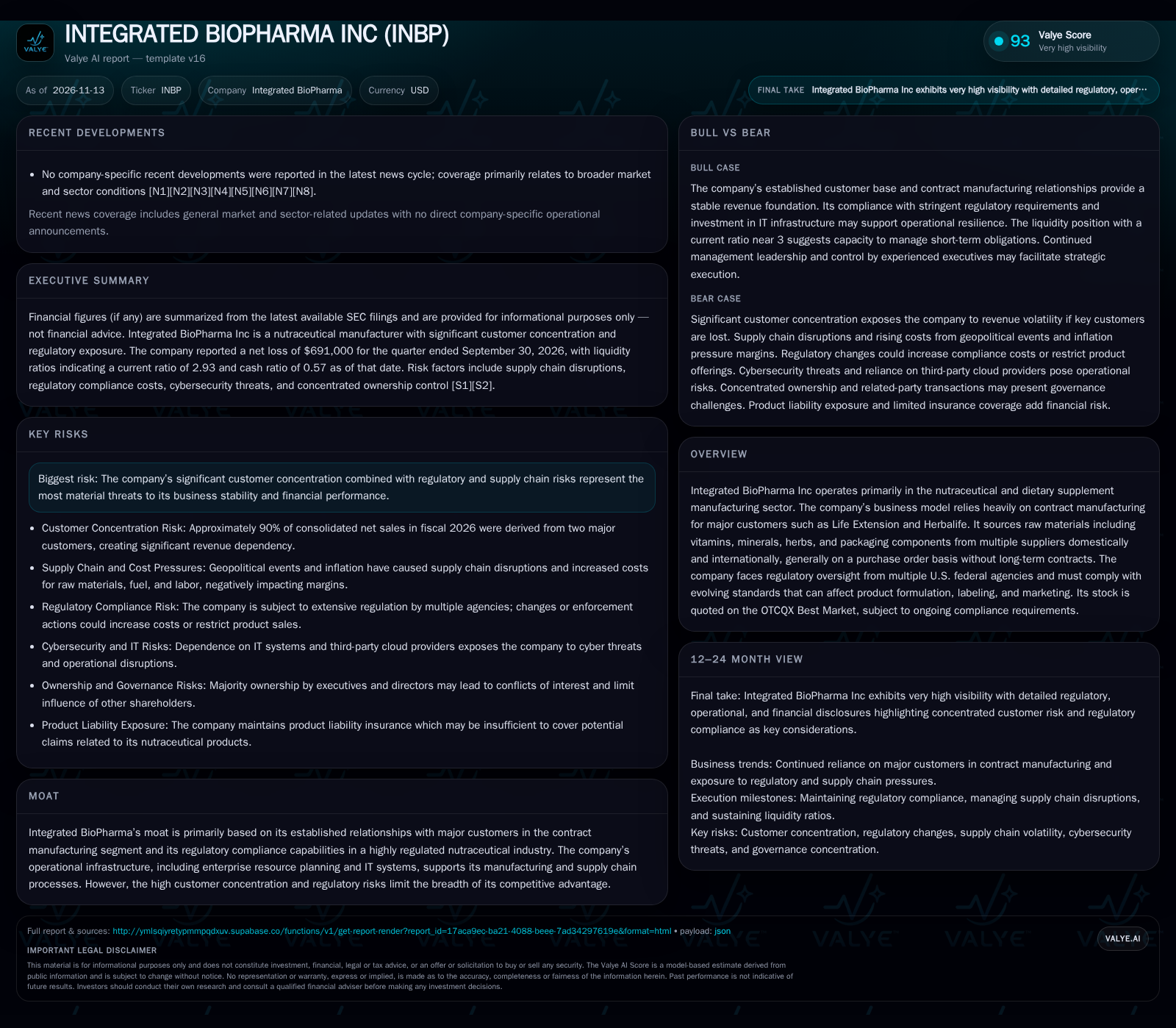
Integrated BioPharma Inc generates nearly all of its revenue from two major contract manufacturing customers, exposing it to significant revenue volatility should these relationships weaken. The company reported a net loss in the latest quarter, with a reported current ratio but modest cash coverage. Regulatory compliance, supply chain pressures, and concentrated ownership further shape both its opportunities and vulnerabilities. The core challenge: sustaining margins and revenue visibility amid high customer dependency and external shocks. [S1] [S2]
Integrated BioPharma Inc stands at a strategic crossroads defined by extreme customer concentration, tightening regulatory demands, and margin pressure from global supply chain volatility. While its core contract manufacturing relationships with industry giants like Life Extension and Herbalife provide revenue stability, they also create a single point of failure. As the nutraceutical sector faces ongoing disruption from evolving compliance, cost inflation, and digital threats, Integrated BioPharma’s ability to diversify customers, manage complexity, and adapt its cost base will determine whether it can convert operational scale into durable value.
Recent Financial Performance and Customer Dependency Shape Risk Profile
Integrated BioPharma’s latest quarter ended September 30, 2026, saw a net loss of $691,000, highlighting ongoing profitability challenges. The company reports a current ratio of 2.93—indicative of near-term liquidity—yet a cash ratio of just 0.57 suggests that much of its current assets are tied up outside immediate cash. Critically, approximately 90% of consolidated net sales in fiscal 2026 came from just two customers in its contract manufacturing segment, underscoring acute revenue concentration risk. This concentrated model amplifies exposure to any contract renegotiation, customer shift, or market loss. [S1] [S2]
These facts matter because they establish both the company’s dependence on a few key relationships for ongoing business viability and the potential volatility in financial outcomes should those relationships be disrupted. At the same time, margin pressure from rising input and labor costs, as well as regulatory compliance expenses, compound the challenge of sustaining profitability.
How the Contract Manufacturing Model Drives Margin Structure and Capital Needs
Integrated BioPharma’s core business is contract manufacturing of nutraceuticals and dietary supplements for large branded customers. Revenue is primarily a function of manufacturing volume and contract pricing, with the company acting as an outsourced production partner. While this model can deliver stable recurring orders when customer relationships are strong, it often yields thin gross margins due to competitive pressure, customer bargaining power, and pass-through of input cost fluctuations.
The company’s cost base is heavily influenced by raw material prices (vitamins, minerals, herbal extracts), labor, energy, and packaging. With most raw materials sourced on a purchase order basis rather than long-term supply contracts, Integrated BioPharma is exposed to commodity price swings and supply interruptions—factors amplified by global geopolitical events. Operating leverage exists but is limited by the need to flex production up or down with customer demand and the absence of proprietary brands or products.
Capital expenditure requirements are moderate, focused on maintaining GMP-compliant facilities and IT systems. However, regulatory compliance, product liability insurance, and IT/cybersecurity investments add to fixed costs.
Customer Stickiness, Regulatory Compliance, and the Limits of Differentiation
The company’s chief competitive asset is its entrenched relationship with major contract customers—most notably Life Extension and Herbalife. These partnerships are built on regulatory compliance, manufacturing reliability, and the ability to deliver at scale within a highly regulated environment. However, the lack of long-term supply contracts or exclusivity means switching costs for customers may be relatively low if competitors offer better pricing, reliability, or innovation.
Integrated BioPharma’s regulatory compliance infrastructure and IT/ERP systems create some operational barriers to entry, but these are not unique in the nutraceutical manufacturing landscape. Larger contract manufacturers or vertically integrated supplement brands could offer similar or greater capabilities, potentially compressing margins further. The company also faces competitive risk from international manufacturers that may benefit from lower labor or input costs, particularly in a commoditized segment of the value chain.
Diversification and Margin Recovery Could Unlock Durable Value
If Integrated BioPharma successfully diversifies its customer base—either by onboarding additional contract manufacturing clients or expanding value-added services—it could reduce revenue volatility and improve pricing power. Margin recovery could also occur if supply chain pressures ease, input costs stabilize, or the company negotiates more favorable terms with suppliers and customers.
Regulatory agility—proactively anticipating and adapting to evolving standards—could allow Integrated BioPharma to introduce new products or formulations ahead of competitors, capturing incremental share. Confirmation of this scenario would include disclosed new customer contracts, reduced revenue concentration (less than 70% from the top two customers), improved gross margin trends, and evidence of successful product launches or service expansions.
Conversely, if the customer mix remains static or new business is not secured, the upside case would be weakened.
Persistent Customer Concentration and Margin Squeeze Remain Central Challenges
The most plausible scenario is continued reliance on the existing two major customers, with incremental fluctuations in order volumes tied to their own market performance and inventory cycles. Gross margins remain pressured by input cost volatility and competitive pricing, while regulatory compliance costs are a steady drain on operating income.
In this scenario, Integrated BioPharma maintains operational continuity and meets near-term obligations, but struggles to generate consistent profitability or meaningful free cash flow. Earnings remain volatile and sensitive to supply chain shocks or regulatory changes. Confirmation would come from continued high revenue concentration, stable but thin margins, and no significant expansion of the customer base or product mix.
Major Customer Loss or Regulatory Shock Could Trigger Steep Decline
The principal risk is the loss or scaling back of business from either Life Extension or Herbalife, which could immediately remove the majority of revenue and overwhelm the company’s ability to cover fixed costs. A regulatory enforcement action, product recall, or material supply chain disruption could also lead to sharp revenue declines, margin compression, and liquidity stress.
In this scenario, Integrated BioPharma could be forced to restructure, seek emergency financing, or even face existential risk if unable to replace lost volumes or absorb compliance costs. Evidence of a downside trajectory would include disclosed customer departures or order reductions, regulatory actions or investigations, sustained net losses, and deteriorating liquidity ratios.
Measures That Will Reveal Whether Integrated BioPharma Can Overcome Its Structural Risks
Customer concentration: Monitor the percentage of revenue derived from the top two customers—any reduction below 80% would signal diversification progress.
Gross margin trends: Track reported gross margins for signs of recovery or further compression amid changing input and labor costs.
New contract wins or customer announcements: Disclosures of new manufacturing relationships would test the company’s ability to broaden its revenue base.
Regulatory developments: Monitor FDA, FTC, or other agency actions, as well as changes in labeling or product standards that could affect costs or product offerings.
Supply chain stability: Any disclosure of raw material shortages, price spikes, or sourcing disruptions would be material to margin outlook.
Cybersecurity and IT incidents: Track for reported breaches or system outages, which could disrupt operations or erode customer trust.
Related-party transaction transparency: Watch for expanded disclosures or changes in governance practices that could affect minority shareholder rights or risk profile.
Disclaimer: This is research-only, informational analysis and not investment advice. It may include AI-generated interpretation and general industry context. Always verify important details using primary sources.

Comments