
Cross Timbers Royalty Trust: Navigating Declining Production and Commodity Price Volatility in a Pure-Passive Structure
Cross Timbers Royalty Trust’s 2025 net profits income fell 13% year-over-year on lower oil prices and declining production, highlighting the challenge of offsetting natural declines and commodity swings within its royalty trust model. With no operational control and distributions tied directly to net proceeds from XTO Energy-operated assets, CRT’s future cash flows hinge on external market forces and the stewardship of its upstream operator.
Cross Timbers Royalty Trust’s distributable income declined in 2025 due to lower oil prices and a roughly 10% drop in oil and gas production volumes, only partially offset by higher gas prices and lower costs. The trust structure shields CRT from direct operating risks, but it remains exposed to natural production decline and commodity price volatility, with limited ability to influence outcomes. Sustained distributions will require either commodity price recovery or a moderation in production decline rates, as the trust’s economics are tightly coupled to its underlying asset base and market conditions. [S1]
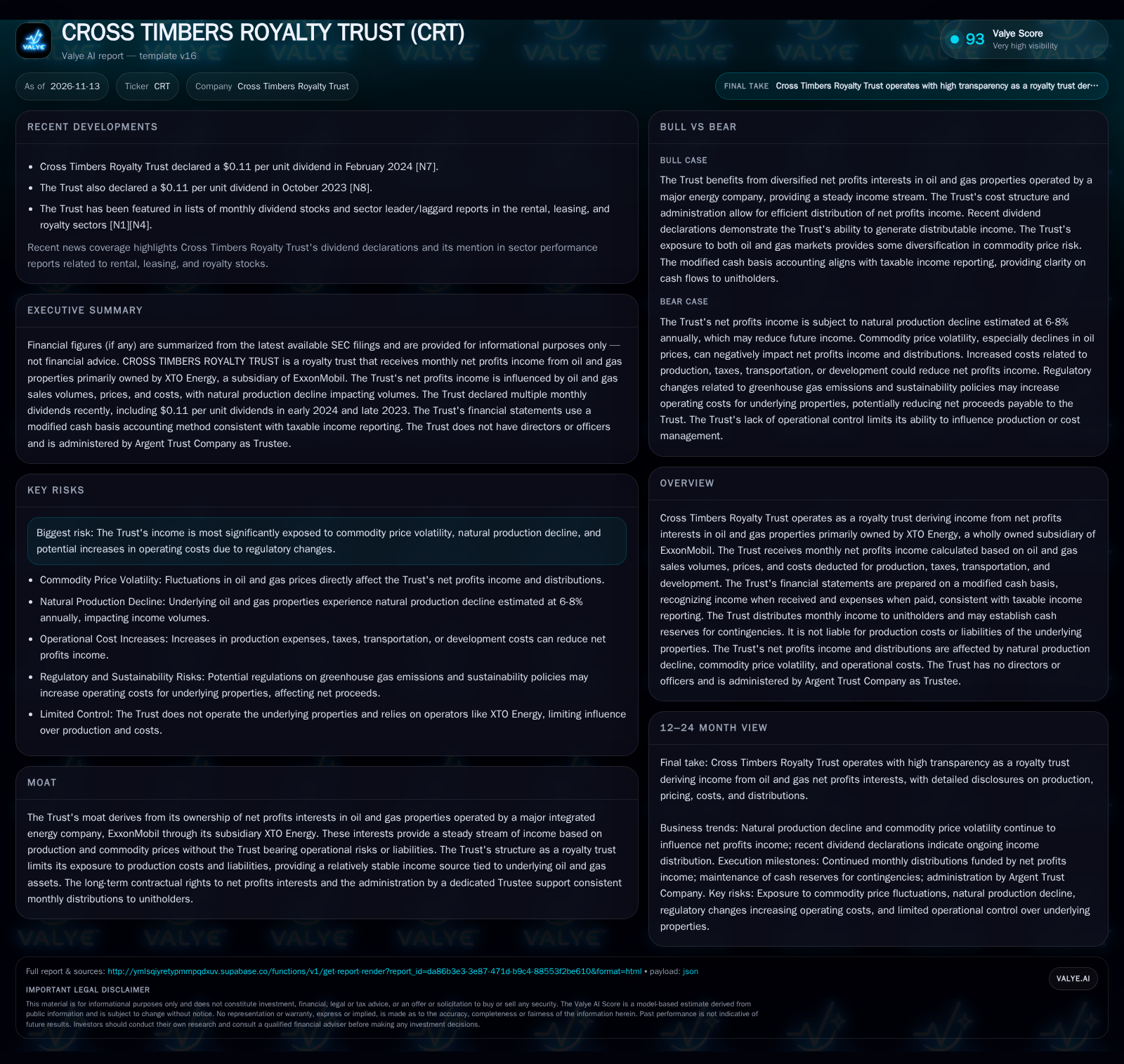
Cross Timbers Royalty Trust (CRT) epitomizes the pure-passive royalty trust model: it collects net profits interests from oil and gas properties operated by XTO Energy, a subsidiary of ExxonMobil, and passes through virtually all income to unitholders after minor administrative expenses. In 2025, CRT’s net profits income dropped by 13% to $5.74 million, driven by a combination of lower oil prices and a 10% decline in both oil and gas sales volumes—consequences of natural production decline and market volatility. While lower costs and higher gas prices provided some cushion, the trust’s future distributions remain fundamentally tied to the performance and pricing of its underlying depleting assets, with no direct lever to change trajectory. [S1]
2025 Results: Lower Oil Prices and Declining Production Pressure Distributable Income
The most material development for Cross Timbers Royalty Trust in 2025 was the 13% decline in net profits income to $5.74 million, compared to $6.56 million in 2024. This drop was primarily the result of a 13% decrease in average oil prices (to $65.85 per barrel) and a roughly 10% reduction in both oil and gas sales volumes, reflecting the ongoing natural production decline of the underlying wells and the timing of cash receipts. While average gas prices increased 11% to $4.40 per Mcf, and costs deducted from net profits income fell 18% (due to lower development and production expenses), these positives were insufficient to offset the combined impact of lower oil prices and declining production. The cited source reports dividend-related activity; that disclosure alone does not establish dividend-policy continuity, management confidence, or a material constraint on capital flexibility. [S1] [N7] [N8]
Royalty Trust Economics: Pure Pass-Through, No Reinvestment, and the Primacy of Market Forces
Cross Timbers Royalty Trust operates as a pass-through entity. It receives a share of net profits from oil and gas production after deducting production, development, and related costs—without bearing operational risk or direct liability for those costs. The trust structure is capital-light: there are no capital reinvestment obligations, debt service requirements, or operating expenses beyond modest administrative fees. However, this model means CRT cannot fund new drilling, offset production declines, or influence development decisions on the underlying properties. All value accrues from the performance of the current asset base, with distributions to unitholders directly tied to realized commodity prices, sales volumes, and expenses. As a result, CRT’s economics are highly sensitive to oil and gas price cycles and to the natural decline of mature wells, which is estimated at 6–8% annually. A further implication is that the trust’s distributable income will almost inevitably trend lower over time unless commodity prices rise sharply or the operator (XTO Energy) initiates material new development on the properties.
Royalty Trusts in the Energy Value Chain: Structure, Risks, and Relative Advantages
Unlike upstream operators, CRT does not compete in the traditional sense; its competitive position is defined by the quality and longevity of its net profits interests and the operational proficiency of XTO Energy. The trust’s main advantages are its exposure to the scale and technical resources of a major operator (ExxonMobil’s XTO Energy) and its insulation from direct operating cost overruns or liabilities. However, CRT has no ability to influence production rates, cost controls, or development priorities on the underlying assets. In the broader landscape, comparable royalty trusts compete primarily for investor capital, not for project access or market share, and are often valued for their transparency, yield, and pass-through characteristics. The main competitive risk is asset depletion: trusts with younger, more productive wells or those exposed to higher-growth basins may deliver superior long-term distributions. Substitution risk arises from alternative yield vehicles—such as MLPs, REITs, or dividend-paying equities—that may offer greater reinvestment or capital appreciation potential.
Commodity Price Rally or Production Outperformance Could Stabilize or Boost Distributions
The most favorable scenario for CRT would be a sustained rally in oil and/or natural gas prices, which could more than offset the impact of declining sales volumes, leading to stable or even increasing net profits income and distributions. Additionally, if XTO Energy were to undertake new development or enhanced recovery techniques on the underlying properties—leading to production declines moderating below the 6–8% annual rate—CRT could see a slower pace of distributable income erosion or a temporary reversal of the decline. Evidence that would confirm this scenario includes a marked increase in commodity prices beyond recent averages, public disclosure of new drilling or capital projects by XTO Energy on CRT’s covered properties, or a stabilization or increase in reported oil and gas sales volumes. Conversely, if commodity prices remain flat and production continues to fall at the historical rate, this upside scenario would be falsified.
Distributions Erode as Production Decline and Price Volatility Dominate
The most plausible outcome for CRT is a continuation of the current trend: annual net profits income and distributions gradually decline as natural production decline outpaces any cost savings or minor price recoveries. With oil and gas wells depleting at an estimated 6–8% per year and no mechanism for the trust to fund new drilling, CRT’s cash flows are likely to shrink unless there is a sustained commodity price rally. Occasional periods of higher prices or lower costs may provide temporary relief, but the structural trajectory is downward. Confirmation of this scenario would be continued year-over-year declines in net profits income, stable or rising administrative costs as a proportion of income, and ongoing reductions in oil and gas sales volumes. Falsification would require either a significant, sustained commodity price increase or evidence of new development activity by the operator.
Accelerated Decline: Sharp Commodity Downturn or Rapid Asset Depletion Threatens Cash Flow
A more adverse scenario would involve a sharp, sustained decline in oil and/or gas prices, or an acceleration in production declines due to reservoir depletion, operational disruptions, or regulatory constraints. Additional risks include regulatory changes that increase taxes or mandate new environmental expenditures on the underlying properties, further reducing net proceeds. Evidence supporting this downside would include a major commodity price slump, a sudden drop in reported oil or gas volumes well above the long-term decline rate, or disclosures of significant new regulatory or cost burdens affecting the underlying properties. If, instead, production and prices stabilize, this more severe downside would be less likely.
Benchmarks for Assessing CRT’s Evolving Income Stream
Monthly reported net profits income and distributions: Tracking the pace of decline or stabilization in payouts is vital for evaluating CRT’s long-term viability.
Year-over-year changes in underlying oil and gas sales volumes: A useful metric would be the annualized rate of volume decline; deviations from the 6–8% range could signal changes in asset performance or operator action.
Average realized oil and gas prices: Monitoring CRT’s reported prices versus market benchmarks will help assess sensitivity and risk exposure.
Disclosed changes in production or development costs: Further reductions could cushion income, while increases may accelerate the decline.
Any public statements or filings from XTO Energy regarding new drilling, enhanced recovery, or capital spending on CRT’s properties would help test the potential for production stabilization.
Updates on regulatory or tax policy affecting oil and gas operators in CRT’s regions could materially alter cost structures and net proceeds.
Administrative expense trends as a percentage of net profits income: Rising administrative burdens could erode distributable income, especially as gross proceeds decline.
Disclaimer: This is research-only, informational analysis and not investment advice. It may include AI-generated interpretation and general industry context. Always verify important details using primary sources.

Comments