
Wintergreen Acquisition Corp.: From Trust Account to AdTech Platform—Strategic Crossroads and Execution Stakes
Wintergreen Acquisition Corp. stands at a pivotal moment as it seeks to transition from a blank check company with substantial trust assets to a publicly listed AdTech player through its planned merger with KIKA Technology. The path forward hinges on deal execution, integration, and the realization of value in a dynamic Asian digital advertising market.
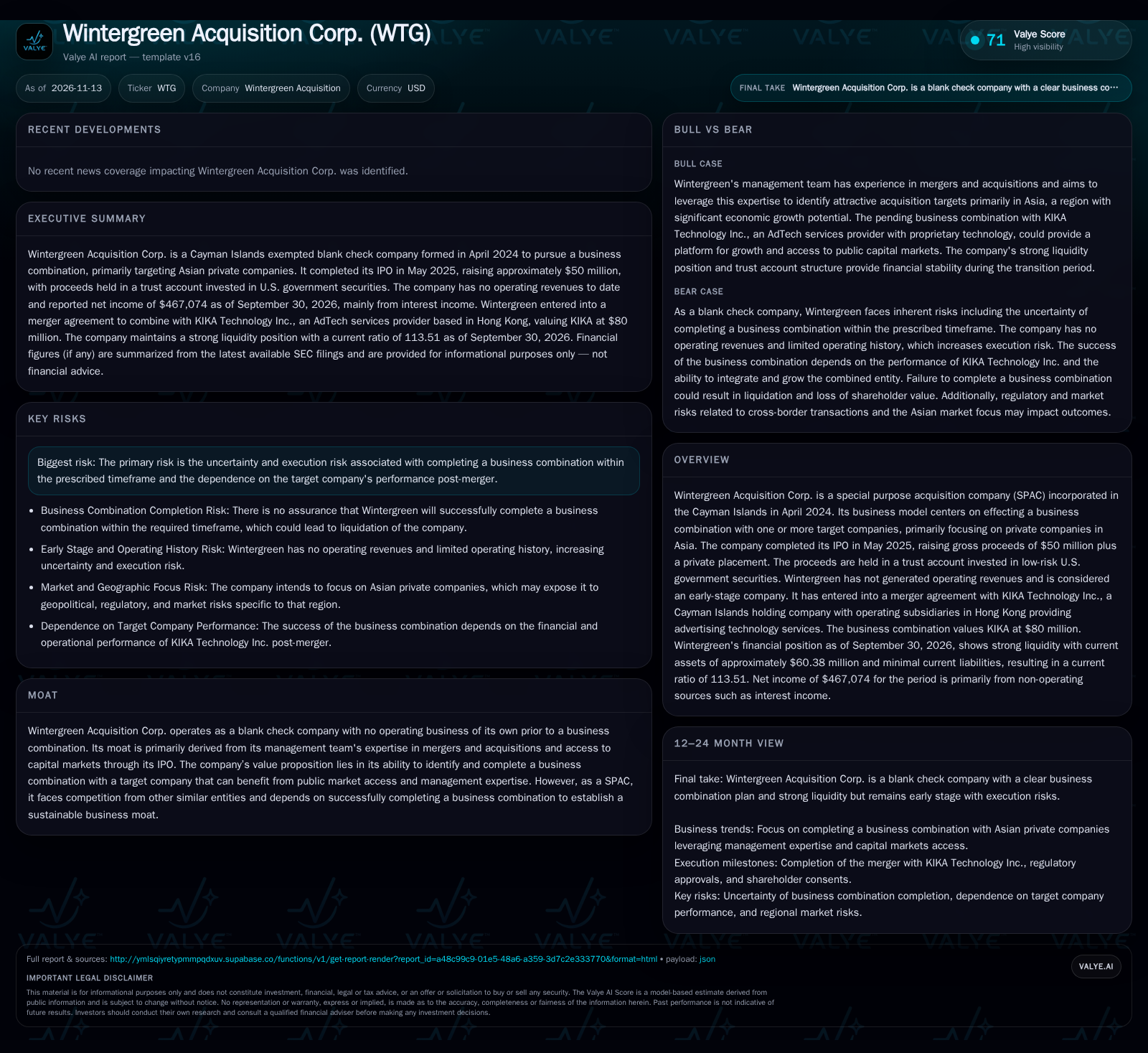
Wintergreen Acquisition Corp. is a SPAC with $60.38 million in current assets and minimal liabilities, now progressing toward an $80 million business combination with KIKA Technology, a Hong Kong-based AdTech firm. The company’s future value will depend on closing this deal, integrating KIKA, and navigating the competitive and regulatory complexities of Asia’s digital advertising space. Execution risk and post-merger performance are critical uncertainties for shareholders. [S1] [S2]
Wintergreen Acquisition Corp. exemplifies the SPAC model’s promise and uncertainty: flush with trust capital, but with no operating business until a merger closes. Its pending acquisition of KIKA Technology—a Hong Kong-based AdTech platform—could transform Wintergreen into a growth story, but only if the deal closes smoothly and KIKA delivers operational traction in a market crowded with both global and local competitors. For investors, the near-term focus is on deal execution, while longer-term value will hinge on KIKA’s ability to scale and differentiate in Asia’s digital advertising ecosystem.
Wintergreen’s Transition Moment: Trust Capital, Pending Merger, and Exposure to Asia’s AdTech
Wintergreen Acquisition Corp. is a Cayman Islands-incorporated SPAC formed in April 2024, with a mandate to acquire promising private firms in Asia. The company completed its IPO in May 2025, raising $50 million (plus $2.54 million in a concurrent private placement) and placing the proceeds in a trust account invested in U.S. government securities [S1]. As of September 30, 2026, Wintergreen reports $60.38 million in current assets and just $0.53 million in liabilities, resulting in a current ratio of over 113 [S2]. This reflects a capital-rich, risk-minimized pre-merger posture typical of SPACs. The most material inflection: Wintergreen’s definitive agreement to merge with KIKA Technology Inc., a Hong Kong-based AdTech company, in a transaction valuing KIKA at $80 million and involving the issuance of approximately 7.98 million shares to KIKA shareholders [S1]. Until the merger closes, Wintergreen generates no operating revenues, and reported net income is derived solely from interest on trust assets [S2]. The next phase will depend on deal execution, regulatory approval, and the operational handoff to KIKA’s business model.
From SPAC Structure to AdTech Economics: How Value Creation Could Shift Post-Merger
Wintergreen’s pre-merger economics are straightforward: it earns interest on trust account assets, incurs modest operating costs, and faces minimal liabilities. This capital preservation phase is designed to minimize risk, but it offers no direct business value creation for shareholders until a transaction closes [S2]. Post-merger, the economics will hinge entirely on KIKA Technology’s business model. AdTech is typically characterized by high gross margins—especially for firms providing proprietary matching algorithms or programmatic advertising infrastructure—but also faces intense customer acquisition costs, rapid technology cycles, and exposure to shifting privacy regulations.
If KIKA’s core offering is a platform for dynamic ad placement or optimization, its revenue model may be based on a mix of usage-based fees, managed service contracts, or software-as-a-service (SaaS) subscriptions. The scalability of such platforms can drive significant operating leverage: incremental revenue, after covering fixed R&D and platform costs, may fall rapidly to the bottom line. However, this is contingent on customer adoption, retention, and the ability to differentiate technologically. Capital needs post-merger will likely shift from capital preservation to investment in product development, sales, and possibly regional expansion. The availability of $60 million-plus in trust assets (subject to redemptions and deal terms) could, if the deal closes, give the combined company a runway for aggressive growth—but only if integration is smooth and KIKA can scale profitably.
Navigating the Asian AdTech Arena: Potential Advantages and Structural Headwinds
Wintergreen’s planned acquisition of KIKA Technology positions the combined company in Asia’s digital advertising sector—a market characterized by rapid growth, fragmentation, and intense competition. While Asia offers large, mobile-first user bases and rising digital advertising budgets, the region is also home to entrenched local platforms, major global players, and a proliferation of niche AdTech providers. KIKA’s potential differentiators could include proprietary dynamic matching algorithms, localized data assets, or integration capabilities with major Asian e-commerce and social media networks.
However, barriers to entry are moderate—technology cycles move quickly, and switching costs for advertisers are generally low unless a platform demonstrates clear ROI or unique audience reach. Regulatory complexity is also rising, with data localization, privacy laws, and content restrictions varying across jurisdictions. The question is whether KIKA (and thus, Wintergreen post-merger) can carve out a defensible market niche, lock in meaningful partnerships, and maintain technology leadership against both regional specialists and global AdTech giants. The SPAC’s capital base could be an advantage in funding go-to-market or M&A, but sustained success will require more than just financial resources.
Execution Excellence and Platform Differentiation: How the KIKA Deal Could Unlock Shareholder Value
A favorable scenario unfolds if Wintergreen closes the KIKA merger without significant shareholder redemptions, retains a strong post-deal cash balance, and leverages KIKA’s AdTech platform to rapidly scale in Asia. Early confirmation would come from prompt regulatory approvals, smooth integration, and evidence of KIKA signing large or strategic customers soon after the merger. If KIKA’s technology demonstrably outperforms competitors—e.g., via higher ad ROI, unique targeting, or data-driven insights—it could achieve above-market growth, drive operating leverage, and potentially attract premium valuations as a public company.
Further upside would be signaled by KIKA’s ability to win exclusive partnerships with major digital platforms or e-commerce players in Asia, or by demonstrating rapid expansion into adjacent AdTech verticals. Investor confidence would also be bolstered by clear, recurring revenue streams, high customer retention, and positive early post-merger financial updates. Conversely, this scenario would be falsified if the deal faces regulatory delays, heavy redemptions drain the cash balance, or if KIKA’s technology fails to win market traction.
What a Typical SPAC-to-Operating Company Transition Might Look Like for Wintergreen
The most plausible outcome for Wintergreen is the successful closure of the KIKA merger with moderate shareholder redemptions, leaving enough cash for post-merger operations, but not a war chest. KIKA enters the public markets with a credible AdTech platform but faces typical integration and go-to-market challenges: ramping up commercial sales, establishing a differentiated value proposition, and managing the costs of public company compliance.
Confirmation would come from the timely closing of the deal, the announcement of stable or growing customer accounts, and early evidence of recurring revenues. The scenario would be falsified if post-merger financials show slow customer adoption, high churn, or if integration costs and public company expenses erode the cash runway. In this base case, Wintergreen/KIKA may achieve steady but unspectacular growth, with valuation driven more by execution and financial discipline than by outsized market share gains.
Deal Failure or Integration Stumbles: How Value Could Erode for Wintergreen Shareholders
A negative scenario centers on failure to close the KIKA transaction—whether due to regulatory hurdles, shareholder redemptions draining the trust account, or a breakdown in negotiations. In this case, Wintergreen faces the prospect of liquidation, returning remaining trust proceeds to shareholders, and incurring the typical SPAC wind-down costs. Shareholders may lose the opportunity for upside, and the sponsor’s investment could be wiped out.
Alternatively, if the deal does close but KIKA struggles post-merger—due to weak customer uptake, inability to meet technology claims, or adverse regulatory changes in key Asian markets—the combined company could quickly burn cash, miss growth targets, and face a falling share price. Early warning signs would include delayed closing, negative news on customer wins, or restatements of guidance. This downside would be confirmed by public disclosures of significant redemptions, missed financial milestones, or regulatory actions impacting operations.
Milestones That Will Determine Whether Wintergreen’s SPAC-to-AdTech Pivot Succeeds
Final regulatory and shareholder approval of the KIKA merger—delays or rejections would directly threaten the deal’s completion.
KIKA’s first public disclosures post-merger on customer growth, contract wins, and recurring revenue—these would help test the commercial traction thesis.
Integration costs and timeline—if disclosed, overruns or delays could signal execution risks and threaten the cash runway.
Retention and performance of KIKA’s management team in the public company context—key for continuity and strategy execution.
Updates on regulatory or data privacy changes in KIKA’s core Asian markets—adverse developments could impact growth or compliance costs.
Gross margin, customer acquisition cost, and churn rate metrics—if disclosed, these would clarify the unit economics and sustainability of KIKA’s business.
Disclaimer: This is research-only, informational analysis and not investment advice. It may include AI-generated interpretation and general industry context. Always verify important details using primary sources.

Comments