
Fortress Biotech’s Portfolio Model: Asset Monetization, Capital Constraints, and the Next Phase of Value Creation
A $205 million asset sale, FDA approval of ZYCUBO, and positive net income in 2026 highlight Fortress Biotech’s ability to generate value across a complex subsidiary structure. The challenge now shifts to sustaining operational momentum and navigating capital structure constraints as financing and regulatory execution remain central to upside and downside scenarios.
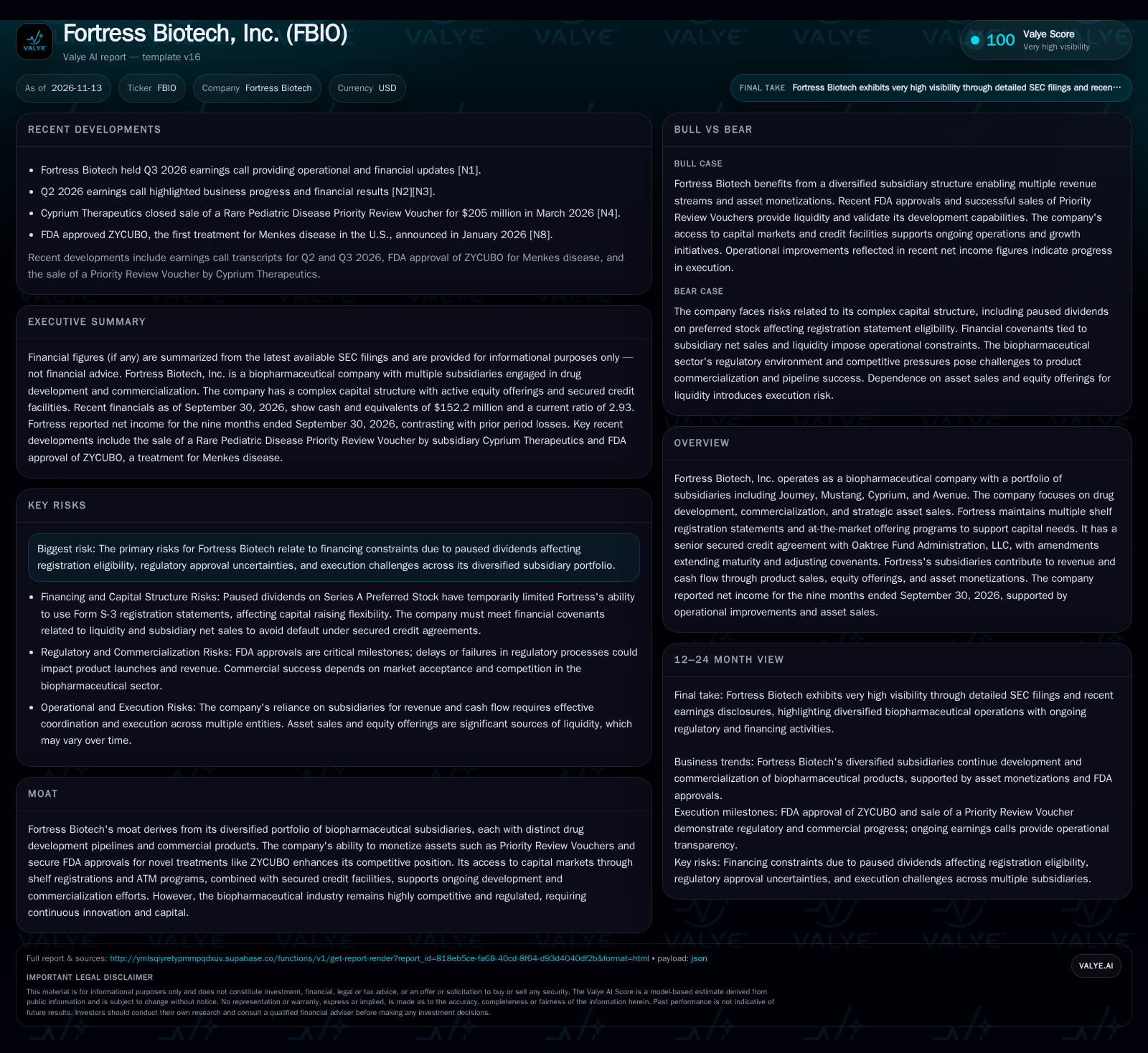
Fortress Biotech’s 2026 results were shaped by a major asset sale, a new FDA-approved therapy, and improved net income. The company’s diversified structure enables value extraction from subsidiaries, but ongoing reliance on asset monetization and equity raises exposes it to regulatory, execution, and capital-raising uncertainties. Future performance hinges on new product uptake, further monetization events, and regaining capital markets flexibility.
Fortress Biotech’s 2026 was defined by a rare convergence of asset monetization, regulatory success, and improved consolidated earnings. With $152.2 million in cash, a major PRV sale, and the first FDA-approved Menkes disease therapy, Fortress demonstrated the financial and operational leverage inherent in its multi-subsidiary model. However, the company’s reliance on episodic asset sales, ongoing regulatory hurdles, and capital structure constraints—such as the paused S-3 eligibility—signal that sustaining value creation will demand both execution discipline and adaptability. The next phase for Fortress will test whether its portfolio approach can deliver recurring value or whether it remains subject to the volatility of milestone-driven biotech economics.
2026 Asset Sale and Regulatory Win Reshape Fortress Biotech’s Financial Profile
The defining events for Fortress Biotech in 2026 were Cyprium Therapeutics’ $205 million sale of a Rare Pediatric Disease Priority Review Voucher (PRV) and the FDA approval of ZYCUBO, the first U.S. therapy for Menkes disease [S2] [N8]. The PRV sale delivered a windfall, enabling Cyprium to declare a $118.6 million dividend, of which approximately $95.4 million flowed to Fortress’s parent-level balance sheet. This influx, combined with a reported $152.2 million in cash and equivalents as of September 30, 2026, underpinned a net income of $129.5 million for the nine-month period—marking a dramatic turnaround from a $27.5 million loss in the prior year [S2]. However, Fortress posted a Q3 net loss of $5.8 million, highlighting the volatility of its results even in a year of major wins [S2].
Critically, Fortress’s ability to raise capital was constrained during the year by a pause in dividends on its Series A Preferred Stock, which temporarily rendered it ineligible to use Form S-3 for new securities offerings. The cited source reports dividend-related activity; that disclosure alone does not establish dividend-policy continuity, management confidence, or a material constraint on capital flexibility. [S2]
How Fortress Biotech Extracts Value: Episodic Monetization Versus Recurring Revenue
Fortress Biotech’s economic engine relies on a hybrid of direct product commercialization, asset monetization, and subsidiary-level financial transactions. Unlike single-product biotech firms, Fortress operates a portfolio of entities (Journey, Mustang, Cyprium, Avenue), each with their own development pipelines and commercialization strategies. This structure allows Fortress to capture windfalls from events such as PRV sales or FDA approvals, as seen with Cyprium’s PRV and ZYCUBO in 2026 [S2] [N8].
However, these monetization events are by nature episodic and unpredictable. While quarterly revenues reached $19.2 million in Q3 2026, Fortress still posted a net loss for the quarter, indicating that recurring operating income from marketed products is not yet sufficient to offset expenses on a consistent basis [S2]. The company supplements operational cash flows with at-the-market equity programs and a $50 million senior secured credit facility, the latter of which has been amended to extend maturity and impose financial covenants tied to Journey’s net sales and liquidity [S2]. The result is a business model with high operating leverage and variable capital needs, where the timing of asset sales, licensing deals, or regulatory milestones can dramatically swing quarterly and annual results.
Looking forward, sustained value creation will likely depend on converting more of the portfolio into steady, royalty-bearing, or commercial-stage assets. Until then, Fortress remains exposed to the inherent lumpiness and capital intensity of late-stage biopharma economics.
Portfolio Approach Versus Pure-Play Biopharma: Fortress’s Strategic Trade-offs
Fortress’s competitive stance is built on diversification. By nurturing multiple subsidiaries, it reduces single-asset risk and increases the odds of capturing regulatory or commercial breakthroughs. This model can be attractive in a sector where clinical and regulatory setbacks are common and where a single failure can be existential for pure-play companies.
However, the downside is complexity: managing a web of equity offerings, intercompany obligations, and diverse development timelines can dilute management attention and introduce coordination challenges. Fortress’s reliance on asset sales and equity offerings also exposes it to market conditions—if risk appetite dries up or regulatory timelines slip, liquidity can become a pressing concern.
Competitors include both pure-play biotechs (with concentrated pipelines) and diversified specialty pharma groups that pursue similar asset aggregation or spin-out strategies. Fortress’s edge lies in its demonstrated ability to monetize assets (such as PRVs) and secure timely regulatory wins, as with ZYCUBO. Still, the ultimate competitive advantage will hinge on whether the company can convert its pipeline into multiple, recurring revenue streams with defendable market positions and pricing power—outcomes not yet fully proven in its current financials.
Sustained Asset Monetization and Commercial Execution Unlocks Recurring Profitability
If Fortress can repeat the 2026 playbook—securing additional FDA approvals, successfully commercializing new therapies, and monetizing assets such as PRVs or licensing rights—the company could transition from episodic windfalls to a more predictable earnings profile. Success would be marked by a growing base of commercialized products, improved gross margins, and the ability to self-fund development pipelines without excessive dilution or debt.
Evidence that would confirm this trajectory includes consecutive quarters of positive operating cash flow (not just net income driven by one-time events), rising product revenues from new launches like ZYCUBO, and successful navigation of financial covenants tied to Journey’s net sales. Additional PRV sales, milestone payments, or out-licensing deals would further validate the model. Regaining S-3 eligibility and demonstrating continued access to capital markets at reasonable terms would also signal operational and financial resilience.
Volatility Persists as Fortress Relies on Opportunistic Capital and Asset Events
The most plausible trajectory for Fortress Biotech is continued financial and operational volatility, with periods of strong performance tied to milestone events and asset monetizations, punctuated by quarters of operating losses. The company is likely to remain dependent on equity raises, credit facility drawdowns, and the timing of regulatory approvals or asset sales to fund ongoing operations.
This scenario would be confirmed by quarterly swings in net income or loss, lumpy cash flow statements, and continued updates on ATM program usage and subsidiary-level financing. A return to S-3 eligibility would improve capital flexibility, but would not fundamentally alter the episodic nature of value realization unless the pipeline matures into a broader commercial base.
Execution Missteps or Financing Constraints Trigger Value Erosion
Fortress’s most acute risk is a breakdown in the timing or execution of asset monetization and capital-raising events. Delays in regulatory approvals, weaker-than-expected commercial uptake of new products like ZYCUBO, or an inability to meet financial covenants on the Oaktree credit facility could quickly erode liquidity and force dilutive capital raises or asset fire sales.
Evidence for this scenario would include persistent net losses, missed net sales or liquidity targets at key subsidiaries, or the need to amend credit agreements under distress. Should capital market conditions deteriorate or the company remain ineligible for S-3 offerings longer than expected, Fortress could be forced to prioritize short-term survival over longer-term value creation—potentially selling assets at unfavorable terms or curtailing development programs.
What Will Determine Fortress Biotech’s Ability to Deliver Sustainable Value?
Quarterly revenue and operating cash flow trends from commercialized products across the subsidiary portfolio, especially post-launch performance of ZYCUBO.
Timing, magnitude, and structure of any additional PRV sales, out-licensing deals, or milestone payments at both the parent and subsidiary levels.
Updates on S-3 registration eligibility and the resumption of preferred stock dividends, which are critical for flexible capital raising.
Compliance with financial covenants tied to Journey’s net sales and minimum liquidity under the Oaktree credit agreement.
ATM program utilization rates and terms, including dilution impacts and the cost of capital for both Fortress and its subsidiaries.
Progress on pipeline development and regulatory submissions, especially for late-stage candidates that could become the next asset monetization events.
If disclosed, subsidiary-level margin trends and product-level profitability metrics, to assess the transition from episodic to recurring income.
External market conditions that affect equity and credit markets, as Fortress’s model is sensitive to shifts in investor risk appetite and biopharma sector sentiment.
Disclaimer: This is research-only, informational analysis and not investment advice. It may include AI-generated interpretation and general industry context. Always verify important details using primary sources.

Comments