
Moving iMage Technologies: Navigating Project Delays While Leveraging Niche Audio Growth
The company’s challenge is to convert operational transparency and specialized product traction into sustainable earnings amid execution volatility.
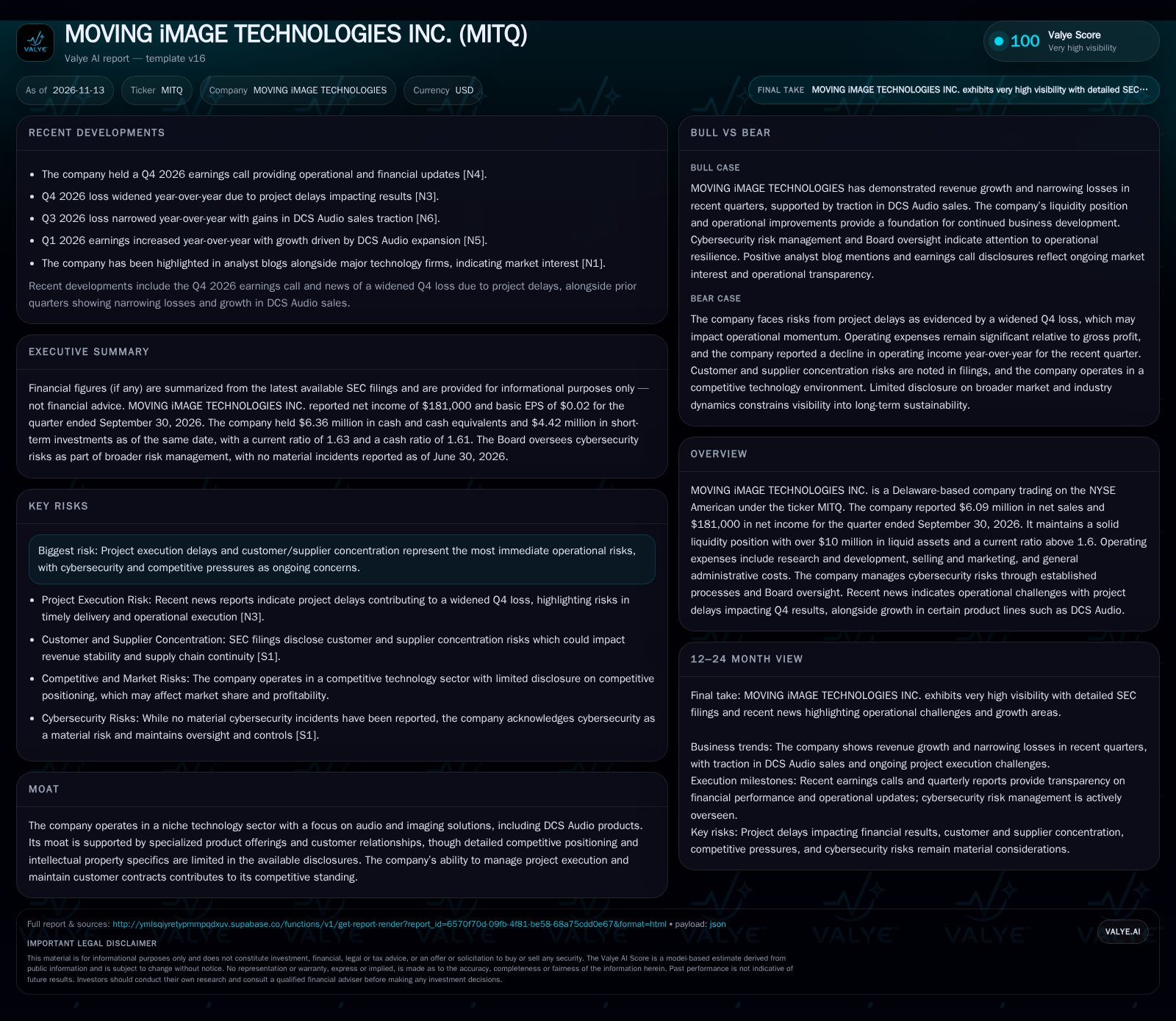
MITQ reported $6.09 million in Q1 2026 net sales and maintained over $10 million in liquid assets as of September 30, 2026, but widened its Q4 loss year-over-year due to project delays. Gains in DCS Audio sales have contributed to narrowing losses in previous quarters, highlighting a potential avenue for growth. The company’s future hinges on its ability to manage execution risks, mitigate customer and supplier concentration, and sustain momentum in specialized product lines. [S2] [N3] [N6]
Moving iMage Technologies (MITQ) stands at an inflection point in late 2026: while it benefits from a reported liquidity position and visible sales progress in its DCS Audio segment, operational setbacks from project delays have weighed on recent results. The company’s financial transparency and focus on specialized technology solutions offer potential, but execution risks and concentration exposures remain central to the investment debate. The next phase will be defined by MITQ’s ability to stabilize execution and deepen its customer base, turning niche product momentum into sustained profitability.
Recent Quarter Reveals Both Financial Strength and Execution Shortfalls
For the quarter ended September 30, 2026, Moving iMage Technologies reported net sales of $6.09 million and net income of $181,000, with operating expenses totaling $1.31 million across research, marketing, and administrative functions. The company reported cash and liquidity metrics for the period; these figures do not by themselves establish operating runway, investment capacity, financial flexibility, or financing capacity. Notably, DCS Audio sales have gained traction, contributing to a narrowing of losses in the preceding quarter. These facts underscore a business with the financial resources to weather short-term volatility, but whose earnings trajectory is vulnerable to operational slippage and customer concentration. [S2] [N3] [N6]
How Project Execution and Product Mix Shape Profitability
Moving iMage Technologies’ revenue model appears to rest on sales of specialized audio and imaging technology solutions—most notably, the DCS Audio product line. The company’s reported sales growth in this segment suggests potential for higher-margin, specialized offerings to drive gross profit if volume can be scaled. However, the company’s fixed cost base, with $1.31 million in quarterly operating expenses, means that execution setbacks (such as project delays) can quickly erode profitability, as evidenced by the swing in quarterly operating income.
The company’s capital requirements are likely moderate, given its classification as a smaller reporting and emerging growth company, but working capital needs are nontrivial due to project-based revenue recognition and inventory management. Operating leverage could be favorable if MITQ can consistently deliver projects on time and expand sales in higher-margin audio solutions. Conversely, inconsistent project delivery or dependency on a few large contracts may introduce significant earnings volatility and limit the ability to amortize fixed costs over a broader revenue base.
Without detailed disclosure on contract structure (e.g., recurring versus one-off sales, service revenue, or long-term maintenance agreements), the durability of MITQ’s revenue remains an open question. If DCS Audio or other product lines transition to more recurring or service-based models, the business could see improved revenue visibility and margin stability.
Specialization in Audio and Imaging: Double-Edged Sword in a Niche Market
MITQ’s competitive stance is built on its focus within a niche technology sector, with specialized product offerings such as DCS Audio. This specialization can foster sticky customer relationships and reduce direct competition from larger, generalist technology providers. However, the limited breadth of offerings and customer/supplier concentration expose MITQ to volatility if key relationships are disrupted or if larger players encroach on its niche.
The company’s moat, to the extent it exists, likely stems from technical know-how, integration capabilities, and the ability to customize solutions for specific customer needs. But the absence of disclosed intellectual property protections, network effects, or scale-driven cost advantages leaves MITQ vulnerable to technological substitution and pricing pressure. Relevant competitor categories may include specialized audio-visual integrators, established cinema technology providers, and emerging digital media solution vendors—each with varying degrees of capital, innovation capacity, and channel reach.
If MITQ can deepen its product integration or move toward offering platform-based solutions, it could raise switching costs and improve retention. However, in the absence of such developments, customer loyalty is likely to remain transactional and project-driven.
Product Line Expansion and Project Execution Could Unlock Operating Leverage
A favorable scenario for MITQ would see continued traction in DCS Audio and related product lines, coupled with improved project management and timely delivery. If the company can convert its specialized solutions into a broader, more recurring revenue base—perhaps through long-term service contracts or by embedding more software and integration services—operating leverage could drive margin expansion as fixed costs are spread across higher sales.
Evidence supporting this upside would include successive quarters of sales growth in DCS Audio or new product categories, a shrinking gap between recognized revenue and project backlog, and operating income consistently rising even as operating expenses grow moderately. Analyst or customer commentary citing improved project delivery and customer satisfaction would further validate the scenario.
The scenario would be falsified if DCS Audio sales plateau, project delays persist, or if new product launches fail to generate incremental revenue and gross margin improvement.
Execution Volatility Remains, With Niche Strength Partially Offsetting Concentration Risks
The most likely trajectory is one of continued execution volatility: MITQ leverages its liquidity and specialized product offerings to maintain a steady but modest growth trajectory, punctuated by periodic setbacks from project delays or customer churn. DCS Audio and other niche products provide a partial buffer, but customer and supplier concentration risks continue to constrain revenue visibility.
Confirmation of this scenario would come from ongoing fluctuations in quarterly results—periodic gains in niche segments offset by quarters where project delays or lost contracts depress margins. Operating expenses may remain stable relative to sales, but without a transition to more recurring revenue, the company’s cost structure will continue to amplify swings in top-line performance.
If disclosed, evidence of growing customer diversification, improvement in project delivery timelines, or a shift toward more predictable revenue streams would challenge this base case and suggest a tilt toward either the upside or downside scenario.
Persistent Delays and Concentration Exposures Erode Earnings and Market Relevance
In a negative scenario, MITQ’s project execution issues persist or worsen, leading to further widening of losses and erosion of customer confidence. Concentration risks materialize—either through the loss of a major customer or supplier disruption—causing sharp declines in revenue that the company’s fixed cost base cannot absorb. Repeated delays could also result in reputational damage, making it harder to win new business and deepening reliance on a shrinking pool of clients.
This scenario would be confirmed by continued year-over-year increases in quarterly losses, evidence of contract non-renewals or customer attrition, and stagnant or declining DCS Audio sales. Additional warning signs would include a shrinking cash position or emergency capital raises to cover operating shortfalls.
Falsification of the downside case would require evidence of improved project execution, successful new customer acquisition, and stabilization or growth in key product lines.
What Will Determine Whether MITQ Converts Niche Momentum Into Durable Profitability?
Quarterly sales growth or contraction in DCS Audio and other specialized product lines—if disclosed, this will reveal the sustainability of recent traction.
Trends in project delivery timelines and backlog conversion, providing insight into execution risk and revenue visibility.
Customer and supplier concentration statistics—if disclosed, changes here will directly affect risk exposure and earnings stability.
Quarterly operating income margins and the ratio of operating expenses to net sales, testing the business’s ability to achieve operating leverage.
Any shift in contract structure toward recurring or service-based revenue, which would suggest improved margin resilience and revenue predictability.
Cash burn rate relative to operating losses, especially if project delays or customer losses accelerate.
Management commentary or analyst feedback on project execution, customer satisfaction, and competitive threats.
Cybersecurity disclosures, as any material incident could disrupt operations and erode customer trust.
Disclaimer: This is research-only, informational analysis and not investment advice. It may include AI-generated interpretation and general industry context. Always verify important details using primary sources.

Comments