
Harvard Apparatus Regenerative Technology: Liquidity Constraints and the Search for Sustainable Operating Leverage
Despite modest revenue gains, Harvard Apparatus Regenerative Technology remains challenged by recurring losses, insufficient current assets, and a going concern warning that underscores its dependency on external funding. The company’s ability to transition its R&D investments into scalable, margin-positive products is critical for its long-term viability.
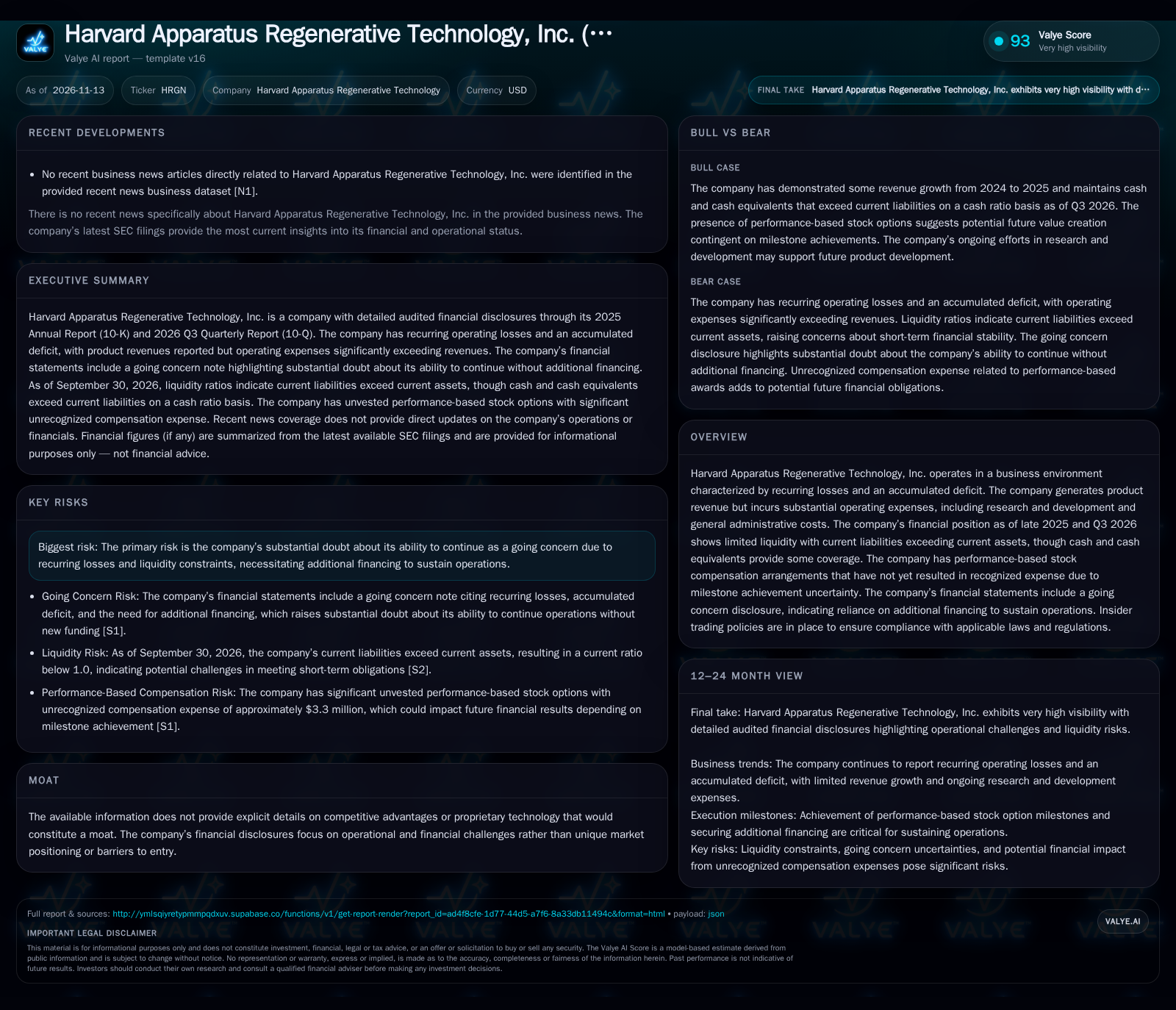
Harvard Apparatus Regenerative Technology continues to report operating losses and an accumulated deficit, with revenues far outpaced by expenses and a current ratio below 1.0 as of Q3 2026. Cash and cash equivalents exceed current liabilities, but the company faces substantial doubt about its ability to continue without new financing. The realization of value from unvested performance-based stock options depends on achieving key milestones.
Harvard Apparatus Regenerative Technology, Inc. sits at a financial crossroads. While the company achieved modest product revenue growth between 2024 and 2025, its operating losses have deepened, and its current liabilities now outweigh current assets. The company’s ongoing R&D investments have yet to translate into a self-sustaining business model, and a going concern warning highlights dependence on securing new funding. Whether Harvard Apparatus can convert its scientific and product initiatives into margin-positive, scalable offerings will determine its fate in the coming quarters.
Recent Financial Results Highlight Liquidity Pressure and Operating Losses
Harvard Apparatus Regenerative Technology reported product revenue of $704,000 in 2025, reflecting an increase from $430,000 in 2024, but this growth was overshadowed by a deepening operating loss of $6.9 million in 2025 [S1]. As of September 30, 2026, the company had $1.85 million in cash and cash equivalents, with current assets totaling $2.3 million against current liabilities of $2.65 million, resulting in a current ratio of 0.87 and a cash ratio of 1.15 [S2]. The company reported cash and liquidity metrics for the period; these figures do not by themselves establish operating runway, investment capacity, financial flexibility, or financing capacity. [S1] Unvested performance-based stock options represent a further $3.3 million in potential future compensation expense, conditional on milestone achievements [S1]. These facts underscore a business under significant financial strain, with near-term survival tied closely to capital-raising efforts.
Beyond the headline liquidity ratios, a deeper analysis of the company’s working capital management and cash flow dynamics would illuminate near-term solvency risks. For instance, the timing of receivables collection, inventory turnover, and payables deferral practices directly impact operating cash flow and the effective runway before additional financing becomes imperative. If the company’s cash conversion cycle is prolonged due to slow customer payments or inventory buildup, liquidity pressures could intensify rapidly. Conversely, efficient working capital management could provide some buffer even in the absence of immediate revenue growth. Understanding these operational cash flow characteristics would help assess the immediacy and scale of the capital gap.
Revenue Growth Remains Modest as Fixed Costs Dominate the Expense Base
The company’s business model appears to center on specialized regenerative technology products, with revenue currently at a subscale level relative to fixed and variable expenses. The increase in product revenue between 2024 and 2025 provides some evidence of commercial traction, but the absolute level remains insufficient to cover high operating expenses, including R&D and administrative costs [S1]. This suggests limited operating leverage at present—fixed costs are not being absorbed by gross profit, leading to persistent losses.
In the absence of detailed disclosures on product mix, pricing structure, or gross margin, it is plausible that unit economics are challenging, potentially due to low production volumes, high input costs, or the need for continued investment in product development and regulatory compliance. If Harvard Apparatus can achieve greater scale or launch higher-margin offerings, operating leverage could improve, but this will likely require significant capital and successful commercialization. The company’s need for external financing is heightened by the inability of current revenues to fund ongoing operations or future growth initiatives.
The current expense structure dominated by fixed costs implies that incremental revenue growth could have a disproportionately positive impact on operating leverage, but only if the incremental gross margin is sufficiently high. If the company’s cost structure includes significant semi-variable components, such as outsourced manufacturing or regulatory compliance expenses that scale with volume, the leverage effect may be muted. Additionally, the stage of product lifecycle matters: early-stage products often incur higher per-unit costs due to low volumes and process inefficiencies, which can distort short-term margin trends. Therefore, a useful metric would be the contribution margin on incremental sales, which would help determine whether scaling revenue can realistically move the company toward profitability or if structural cost reductions are also required.
Competing in a Capital-Intensive, Innovation-Driven Niche
Harvard Apparatus operates in a segment where scientific credibility, regulatory compliance, and product efficacy are prerequisites for commercial success. The report does not specify proprietary technology, unique clinical data, or meaningful barriers to entry that would constitute a defensible moat. In such environments, companies often face competition from better-capitalized medical device or biotech firms, academic spinouts, and established industry players.
Without clear evidence of differentiated technology or regulatory exclusivity, Harvard Apparatus may be exposed to substitution risk and pricing pressure. Customer adoption in life sciences and regenerative medicine is typically slow, with procurement cycles influenced by validation data, reimbursement prospects, and the perceived clinical benefit. The company’s ability to build durable customer relationships or recurring revenue streams remains unproven, and its small scale may limit its negotiating power with suppliers, partners, or end customers.
In capital-intensive innovation sectors, the ability to establish and defend intellectual property rights alongside clinical validation often defines competitive advantage. Without strong patent protection or exclusive licensing arrangements, Harvard Apparatus may face rapid commoditization of its technology, eroding pricing power and margins. Moreover, the lengthy and uncertain regulatory approval processes common in regenerative medicine impose additional barriers to entry but also create risks of delayed market access and increased capital burn. The company’s strategic positioning would benefit from a clear articulation of how it mitigates these risks—whether through partnerships, proprietary know-how, or differentiated clinical data—that could serve as durable moats against competitors and justify ongoing investment.
Breakthrough in Commercialization or Financing Could Shift Trajectory
A favorable outcome for Harvard Apparatus would likely require one of two reinforcing breakthroughs: (1) significant progress in product adoption or clinical validation, leading to accelerated revenue growth and improved gross margins, or (2) the successful closing of a substantial financing round that extends the company’s operating runway and supports further R&D and commercialization. If the company achieves key performance-based milestones—thereby vesting the outstanding stock options and potentially signaling operational success—this could attract investor attention and improve employee retention.
Confirmation of this upside scenario would come from a step-change in quarterly revenue, evidence of growing gross margins, announcements of major customer wins or regulatory clearances, and disclosure of new funding that materially increases liquidity. Conversely, if revenues remain stagnant, milestones are missed, or capital is unavailable, this scenario would be falsified.
If Harvard Apparatus can demonstrate a scalable commercialization model, it would likely need to show not only revenue growth but also improvements in customer retention and repeat purchase rates, which are critical for sustainable margin expansion. Achieving operational milestones that trigger stock option vesting could also align employee incentives with long-term value creation, potentially reducing turnover and fostering innovation. Additionally, securing financing on favorable terms could signal market confidence and provide the capital necessary to accelerate product launches, expand sales channels, and invest in regulatory milestones. These factors combined would create a virtuous cycle supporting a transition from a capital-dependent R&D entity to a cash-generating commercial enterprise.
Ongoing Losses and Incremental Progress as Funding Remains Precarious
The most plausible near-term outcome is that Harvard Apparatus continues to post recurring operating losses while pursuing incremental revenue gains and R&D progress. Product revenue may grow modestly, but is unlikely to cover expenses in the absence of a major commercial or clinical breakthrough. The company will likely seek additional funding through equity or debt issuance, with dilution risk for existing shareholders.
Confirmation of this scenario would include continued going concern disclosures, slow or flat revenue growth, and small capital raises that keep operations afloat but do not fundamentally alter the company’s financial trajectory. The scenario would be challenged if the company announces a large, non-dilutive capital raise, material licensing revenue, or a significant commercial partnership.
Failure to Secure Additional Funding Triggers Restructuring or Liquidation Risk
The primary risk is that Harvard Apparatus fails to raise new capital before exhausting its cash, leading to severe liquidity stress and forced restructuring, asset sales, or even liquidation. With current liabilities exceeding current assets and ongoing operating losses, the company may be unable to meet short-term obligations or fund core operations without external support.
Evidence supporting this adverse outcome would include further deterioration in the current ratio, default on obligations, missed payroll or vendor payments, or a formal announcement of restructuring or bankruptcy proceedings. The downside would be mitigated if the company secures bridge financing or receives a strategic investment, but these outcomes are not assured in the current environment.
Signals That Will Clarify Harvard Apparatus’s Path Forward
Quarterly product revenue growth or contraction—especially any inflection above $1 million per quarter, if disclosed, would indicate commercial traction.
Gross margin trends, if reported, would help assess whether the company is moving towards sustainable unit economics.
Disclosure of major customer contracts, regulatory approvals, or clinical data releases could materially impact the company’s adoption curve.
Updates on performance-based stock option milestone achievement would signal operational progress and future compensation expense.
Announcements of equity or debt financing, including terms and investor participation, will determine near-term solvency.
Changes in the current ratio or cash balance should be monitored, but a more telling sign would be any default on obligations or auditor commentary beyond a standard going concern warning.
Evidence of strategic partnerships or licensing deals could provide non-dilutive funding and validate the company’s technology.
Disclaimer: This is research-only, informational analysis and not investment advice. It may include AI-generated interpretation and general industry context. Always verify important details using primary sources.

Comments