
Indaptus Therapeutics: Patent Platform, Clinical Hiatus, and the Strategic Crossroads of Early-Stage Biotech
Indaptus Therapeutics, Inc. holds a patented immunotherapy platform but faces a critical period with no active clinical programs, recent executive departures, and substantial dilution risk from convertible preferred stock.
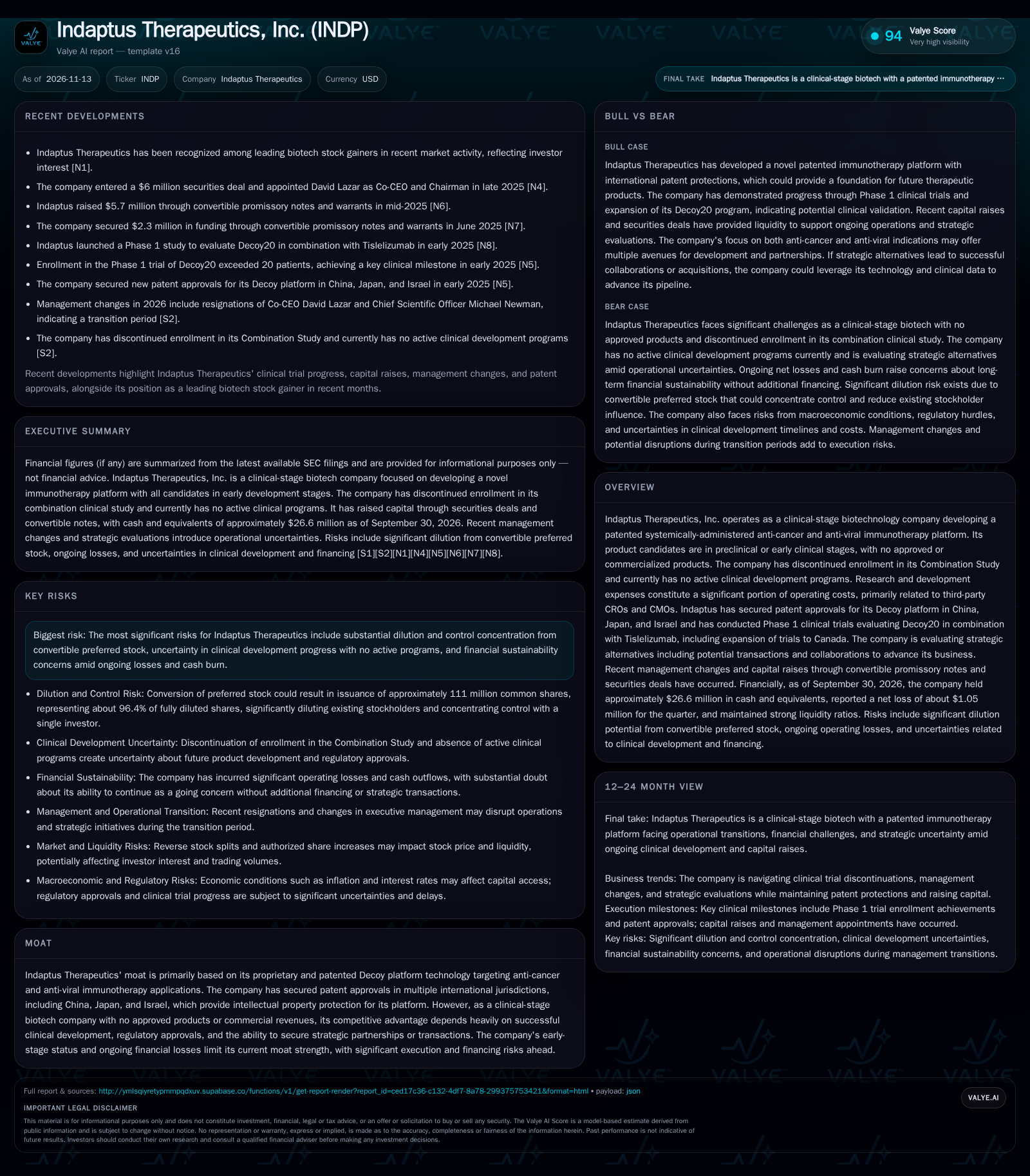
Indaptus Therapeutics has paused all clinical activity and is evaluating strategic alternatives amid management turnover and persistent operating losses. While its patented immunotherapy platform could attract partners or acquirers, the lack of ongoing development and looming dilution from convertible preferred stock means the company’s future hinges on near-term strategic moves and its ability to secure financing or a partnership before cash runs out [S2].
Indaptus Therapeutics, Inc. sits at a challenging inflection point: its once-active immunotherapy pipeline is paused, clinical momentum has stalled, and recent executive resignations add to operational uncertainty. With $26.6 million in cash and no current clinical programs, the company’s future is highly contingent on its ability to unlock value from its patented immunotherapy platform—either by restarting development, securing a strategic partnership, or positioning itself for acquisition. However, with a capital structure that threatens massive dilution and control concentration, existing shareholders face a high-risk, high-uncertainty scenario where near-term strategic decisions will shape the company’s fate [S2].
Clinical Pause, reported cash balance, and Leadership Turnover Define the Present
Indaptus Therapeutics has halted all clinical development activity, with enrollment discontinued in its Combination Study and no active programs ongoing [S2]. As of September 30, 2026, the company reported $26.6 million in cash and cash equivalents, a quarterly net loss of $1.05 million, and reported liquidity position (current ratio: 2.34; cash ratio: 36.01) [S2]. However, these figures reflect a company in stasis rather than on a growth trajectory. Recent resignations of Co-CEO David Lazar and Chief Scientific Officer Michael Newman further underscore a period of operational transition and strategic re-evaluation [S2]. The capital structure is particularly precarious: convertible preferred stock could convert into approximately 96.4% of the company’s common shares, potentially concentrating control with a single investor and severely diluting existing holders [S2]. Indaptus is now actively exploring strategic alternatives, including partnerships, transactions, or a sale, as it seeks a way forward [S2].
How Indaptus Could Monetize Its Platform—and What’s Standing in the Way
Indaptus’s business model, like most early-stage biotech firms, is predicated on taking a promising therapeutic platform through the clinical development gauntlet, then monetizing via out-licensing, partnerships, or eventual direct commercialization if efficacy and safety are proved. The company’s patented immunotherapy approach, which targets both anti-cancer and anti-viral indications, could theoretically create value through milestone payments, royalties, or an acquisition by a larger biopharma seeking pipeline expansion.
At present, however, there is no active clinical program to generate value inflection events, and R&D spend has been largely curtailed as development has paused [S2]. The cost structure in this phase is mostly fixed around G&A and residual R&D commitments, but with no near-term path to revenue, cash burn—while currently modest—will erode the $26.6 million cash balance over time [S2]. If the company restarts development, costs will ramp significantly, especially as clinical trials move into later, more expensive stages. This means Indaptus is highly dependent on either external funding or a strategic partner to finance future growth; absent these, the economic model does not support independent progression.
The capital structure compounds the challenge: any conversion of preferred stock would massively dilute existing shareholders, and the company’s authorization to increase common shares or effect reverse splits could further pressure share price and investor confidence [S2]. In short, without a clear path to clinical progress or a transaction, the economics are currently in limbo.
Patent Protection Offers a Theoretical Edge—But Execution and Validation Remain Unproven
Indaptus’s primary competitive asset is its patented immunotherapy platform, which is protected by international IP. In the fiercely competitive oncology and immunotherapy landscape, patent coverage is a prerequisite for attracting partners or acquirers; however, it does not guarantee clinical or commercial success. The company’s platform targets both cancer and viral diseases, a duality that could in theory broaden its appeal, but the absence of late-stage clinical data and the current lack of ongoing programs mean that its differentiation is entirely potential rather than demonstrated.
Competition in immuno-oncology is intense, with numerous established and emerging players—ranging from large pharmaceutical companies to innovative biotechs—pursuing similar modalities, including checkpoint inhibitors, cellular therapies, and novel immune modulators. Any future clinical success by Indaptus would need to demonstrate clear efficacy and safety advantages over both standard of care and next-generation competitors to attract meaningful commercial or partnership interest.
Switching costs in pharma are primarily regulatory and clinical: once a therapy is proven, physicians and payers may adopt it, but until then, the main barrier is the ability to produce compelling clinical evidence. At this stage, Indaptus’s competitive position is more theoretical than practical, hinging on the perceived promise of its platform and the ability to convince potential partners or acquirers of its value despite the current development pause.
Unlocking Value Through Strategic Transaction or Partnership
The most favorable outcome for Indaptus would be a strategic transaction—such as a partnership, licensing deal, or outright acquisition—leveraging its patented platform. In this scenario, a larger biopharma or specialty pharma player sees unique promise in Indaptus’s science, perhaps based on unpublished preclinical or early clinical signals, and provides non-dilutive capital or a buyout to advance development. This could yield upfront cash, milestones, and royalties, or a premium exit for shareholders.
Confirmation of this scenario would come from public disclosure of a formal partnership, licensing deal, or acquisition agreement, ideally with financial terms that reduce dilution and provide resources for renewed clinical development. Additional evidence would include inbound interest from strategic or financial buyers, or the announcement of a new lead program moving into active clinical development with external funding support.
Falsification would occur if the company is unable to attract interest, is forced into a distressed sale, or if dilution from capital raises becomes so severe that existing shareholders capture little to no upside from any eventual transaction.
Stasis and Slow Burn: Capital Erosion While Seeking a Path Forward
The most plausible near-term trajectory is a period of stasis: Indaptus continues to evaluate strategic alternatives while burning through cash at a modest rate, given the absence of active R&D. Over the next several quarters, the company may announce exploratory discussions with potential partners but fails to secure a definitive transaction or restart clinical development. [S2]
Evidence confirming this scenario would include a continued lack of clinical activity, further management turnover, periodic updates about ongoing strategic reviews, and incremental cash burn reported in future filings. Falsification would require a material change: a new active clinical program, a meaningful partnership, or a completed transaction that alters the company’s financial or operational trajectory.
Dilution, Control Concentration, and the Risk of Strategic Drift
In a negative scenario, Indaptus fails to secure a strategic transaction or new financing before its cash runs low. To sustain operations, it is forced to raise additional capital via convertible securities or equity at depressed valuations, triggering massive dilution and enabling a single investor to effectively control the company through conversion of preferred stock [S2]. This could erode any remaining value for existing shareholders and potentially lead to delisting or a distressed asset sale.
Other risks in this scenario include further management departures, regulatory setbacks related to the company’s ability to maintain exchange listing due to low share price or market cap, and the possibility that the scientific platform loses relevance or is outpaced by competitors. Confirmation would come from large-scale share issuances, reverse stock splits, or regulatory warnings regarding listing compliance. Falsification would require a credible, non-dilutive funding event or a strategic transaction that materially improves the company’s outlook.
Milestones That Will Determine Whether Indaptus’s Platform Survives or Is Monetized
Announcement of any new clinical program initiation or the reactivation of development for existing candidates.
Formal disclosure of a partnership, licensing deal, or acquisition with financial terms that limit shareholder dilution.
Updates regarding additional capital raises, particularly the structure (convertible, equity, non-dilutive) and associated dilution risk.
Quarterly cash burn trends and updated cash runway projections, especially as they relate to ongoing strategic review periods.
Changes in executive leadership or board composition, which could signal shifts in strategic direction or operational capability.
Any regulatory communication regarding compliance with exchange listing requirements—especially in the event of reverse stock splits or share price declines.
If disclosed, progress on patent prosecution, defense, or expansion, as IP status is critical to partnership and transaction value.
Disclaimer: This is research-only, informational analysis and not investment advice. It may include AI-generated interpretation and general industry context. Always verify important details using primary sources.

Comments