
Harte Hanks: Pending Acquisition, Financial Pressures, and the Uncertain Path to Integration
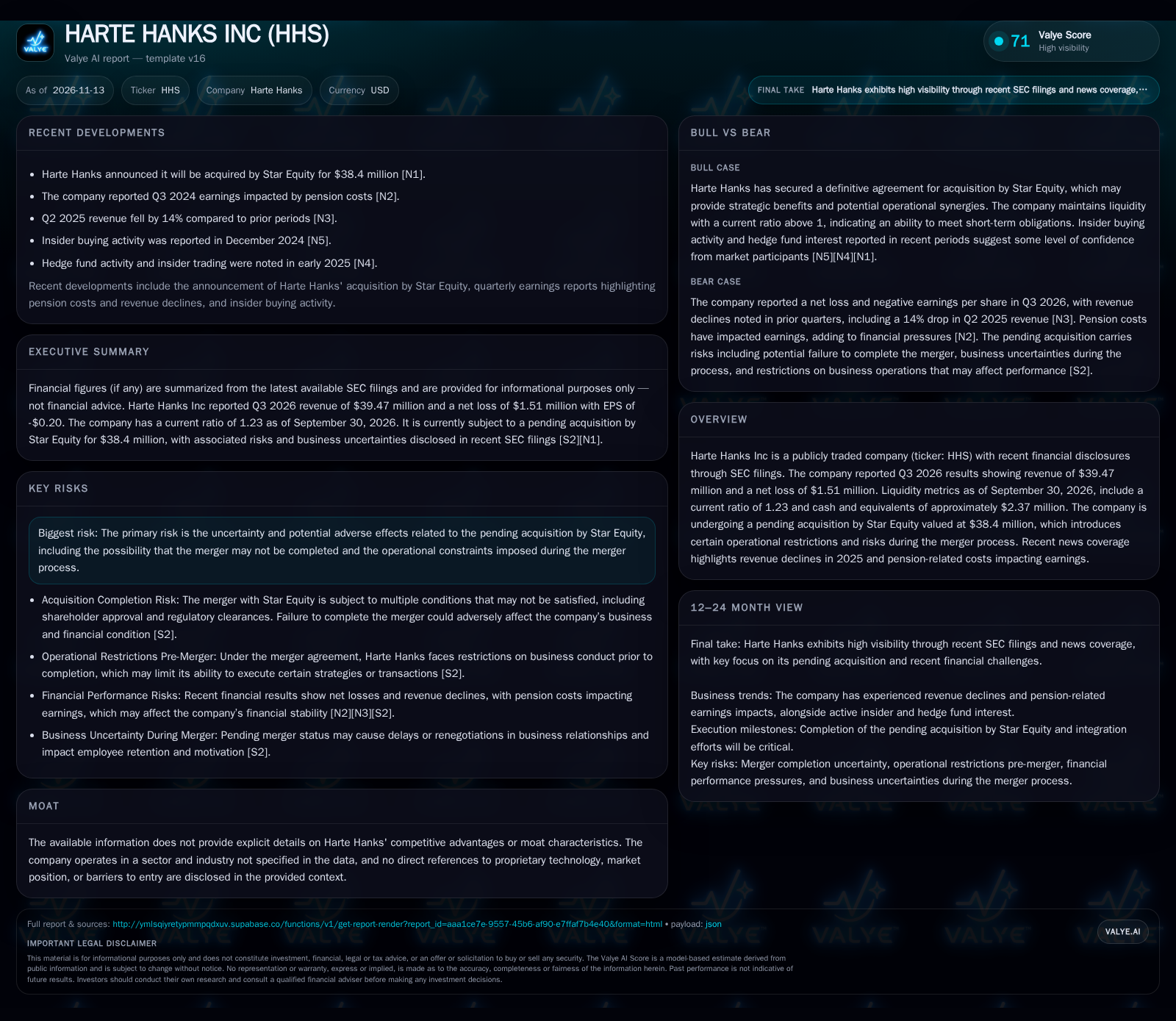
Harte Hanks faces a pivotal transition as it awaits acquisition by Star Equity for $38.4 million, with recent financial disclosures highlighting ongoing losses, revenue declines, and operational constraints under the merger agreement.
Harte Hanks is in the midst of being acquired by Star Equity for $38.4 million, but its Q3 2026 results show continued net losses and reported liquidity position. The merger process introduces operational restrictions and uncertainty, while the company’s recent history includes insider buying and hedge fund activity. The outcome hinges on successful closing and the ability to manage near-term financial and operational challenges.
Harte Hanks, a legacy marketing and customer care services provider, stands at a crossroads as it awaits acquisition by Star Equity for $38.4 million. The company’s recent financial results reveal a mix of ongoing net losses, revenue pressures, and reported cash balance, all magnified by the restrictive environment imposed by the pending merger. While insider and hedge fund activity suggest some market interest, the fundamental challenge is whether Harte Hanks can sustain operations and preserve franchise value as it moves toward integration—or if operational and financial headwinds will erode value before the deal is completed.
Merger in Motion: The State of Harte Hanks as Acquisition Nears
Harte Hanks is in the advanced stages of being acquired by Star Equity for $38.4 million, a transaction that introduces both opportunity and risk for stakeholders [N1] [S2]. As of September 30, 2026, the company reported $39.47 million in quarterly revenue and a net loss of $1.51 million, with basic and diluted EPS at -$0.20 [S2]. The company reported cash and liquidity metrics for the period; these figures do not by themselves establish operating runway, investment capacity, financial flexibility, or financing capacity. [S2] The merger process itself imposes operational restrictions and heightens uncertainty, as Harte Hanks is limited in its ability to pursue new initiatives or strategic pivots prior to closing [S2]. Recent periods have also seen insider buying and hedge fund activity, reflecting both risk and speculative interest in the outcome [N5] [N4].
The operational restrictions imposed by the pending merger agreement typically include limitations on capital expenditures, hiring freezes, and constraints on entering new contracts or strategic partnerships. These limitations can hinder the company's agility in responding to competitive pressures or market shifts, potentially exacerbating revenue declines or client attrition. Furthermore, the uncertainty around the deal's completion may affect employee morale and retention, as key talent might seek more stable opportunities elsewhere. The combination of these factors can create a feedback loop where operational constraints and uncertainty negatively impact performance, which in turn raises risks around the merger's successful closing.
Revenue Streams, Cost Pressures, and the Challenge of Operating Leverage
Harte Hanks generates revenue through a mix of customer care, marketing logistics, fulfillment, and SaaS-based data services, with contracts often invoiced as services are rendered or on a per-transaction basis [S2]. The business is labor- and asset-intensive, especially in print and fulfillment operations, leading to a high proportion of fixed costs relative to variable ones. Recent net losses and revenue declines indicate negative operating leverage: as revenues fall, profitability deteriorates more rapidly due to the company’s fixed cost base. [N2] [N3] The pending acquisition, if completed, could offer a path to restructuring or consolidation of duplicative functions, but until then, Harte Hanks is largely constrained in its ability to adapt or optimize cost structure.
Given the company's fixed cost intensity, the ability to achieve operating leverage improvements depends heavily on scale and efficiency gains post-acquisition. Until the deal closes, Harte Hanks faces a delicate balancing act: maintaining service levels to avoid client losses while managing costs under tight liquidity. If the acquisition proceeds, the new ownership could implement restructuring initiatives such as workforce optimization, facility consolidation, or technology upgrades to lower the fixed cost base. However, such measures often require upfront investment and entail transition risks. Therefore, the timing and execution of cost rationalization efforts will be critical in determining whether the company can reverse negative operating leverage trends and move toward sustainable profitability.
Navigating a Crowded Customer Engagement Landscape
Harte Hanks operates in a highly competitive environment, facing rivals ranging from digital marketing agencies and business process outsourcing firms to logistics and fulfillment specialists. Many peers have evolved toward digital-first, data-driven models, leveraging automation and analytics to drive efficiency and client ROI. Harte Hanks’ legacy in print and traditional fulfillment, while still relevant for certain client segments, may be structurally disadvantaged as client budgets shift toward omnichannel, digital, and self-serve solutions. Switching costs in this sector are typically modest, as clients can often shop for alternative providers or insource functions. Without clear evidence of proprietary technology, unique data assets, or contractual lock-in, Harte Hanks may struggle to differentiate on anything other than price or legacy relationships. The pending acquisition could, in theory, provide scale or enable a pivot, but near-term, the company remains exposed to margin pressure and client churn.
In addition to legacy operational challenges, Harte Hanks must contend with accelerating digital transformation trends that reshape client expectations. Competitors leveraging advanced analytics, AI-driven customer insights, and integrated omnichannel platforms can offer more personalized and measurable marketing solutions. Without proprietary technology or differentiated data assets, Harte Hanks risks commoditization of its services, which typically leads to margin compression. The company's ability to develop or acquire digital capabilities post-acquisition will be a key determinant of its long-term competitiveness. Moreover, the relatively low switching costs in this sector mean that client retention strategies must focus on value-added services and relationship management rather than relying solely on historical ties.
Unlocking Value Through a Smooth Acquisition and Strategic Realignment
The most favorable outcome for Harte Hanks is a timely, uncontested closing of the Star Equity acquisition, followed by rapid integration and strategic investment in higher-margin, growth-oriented service lines. If the buyer brings capital and operational discipline, there is potential to rationalize underperforming segments, invest in automation or SaaS offerings, and leverage combined scale for improved procurement and sales efficiency. Confirmation of this scenario would include: closing the transaction on schedule; public disclosure of integration plans and cost synergies; and evidence of revenue stabilization or margin expansion in subsequent quarters. Signs of a successful pivot to digital or data-driven offerings, or the announcement of new client wins under the combined entity, would further bolster the case.
Integration Stalls, but Core Operations Continue Under Constraint
The most plausible near-term outcome is that Harte Hanks continues to operate in a holding pattern as the merger process plays out, with limited ability to invest, restructure, or pursue growth. Revenue may remain flat or decline modestly, and net losses continue due to the fixed cost base and ongoing pension obligations. If the acquisition closes as planned, there may be a period of operational disruption followed by gradual integration and selective rationalization of overlapping functions. Evidence supporting this scenario would include continued reporting of modest losses, disclosure of incremental merger delays or renegotiations, and operational performance tracking close to recent trends. If the deal is extended or renegotiated, or if regulatory or shareholder hurdles emerge, the company may face a prolonged period of uncertainty and stagnation.
Deal Failure Triggers Liquidity Stress and Accelerates Erosion
If the Star Equity acquisition fails to close—due to regulatory hurdles, shareholder rejection, or other contingencies—Harte Hanks could face acute liquidity risk. With limited cash and ongoing losses, the company may be forced to seek emergency financing, divest assets at unfavorable terms, or undertake drastic cost-cutting. Operational restrictions during the merger process may have already delayed needed investments or client renewals, accelerating revenue declines if the deal falls apart. Confirmation of this scenario would include public disclosure of deal termination, sharp declines in revenue or client count, and announcements of layoffs, asset sales, or distressed financing. Any breach of debt covenants or negative going-concern language in filings would further validate this adverse outcome.
Milestones and Metrics That Will Shape Harte Hanks’ Post-Acquisition Trajectory
Progress toward closing the Star Equity acquisition, including regulatory approval status and any disclosed delays or renegotiations.
Quarterly revenue and margin trends—does the company stabilize, continue to decline, or show early signs of turnaround post-acquisition?
Cash flow from operations and net working capital changes—especially if disclosed in the context of post-closing integration.
Updates on pension obligations and any changes in benefit-related costs or funding requirements.
Disclosures around client retention, contract renewals, or new business wins, which would indicate the health of the customer base.
Any announced restructuring, cost-reduction plans, or asset sales following deal close.
If disclosed, metrics on SaaS or digital service adoption, which would signal progress toward higher-margin offerings.
Management or board commentary on strategic priorities and capital allocation following integration.
Disclaimer: This is research-only, informational analysis and not investment advice. It may include AI-generated interpretation and general industry context. Always verify important details using primary sources.

Comments