
NOODLES & Co: Strategic Uncertainty Shape the Next Chapter
The company’s ability to refinance, restructure, or reposition its business model will determine whether it can reverse persistent losses and restore potential financial flexibility.
The company’s future hinges on securing new financing, executing operational improvements, or finding a buyer—each path carrying distinct risks and potential outcomes. [S2]
NOODLES & Co’s current financial picture is defined by severe liquidity pressure, significant debt coming due, and persistent operating losses. The ongoing review of alternatives, including a potential sale, adds a layer of uncertainty but also represents a potential inflection point for the business. The outcome of these efforts will likely determine whether NOODLES & Co can stabilize, restructure, or face more disruptive measures.
Liquidity Crunch and Strategic Review Define Present Reality
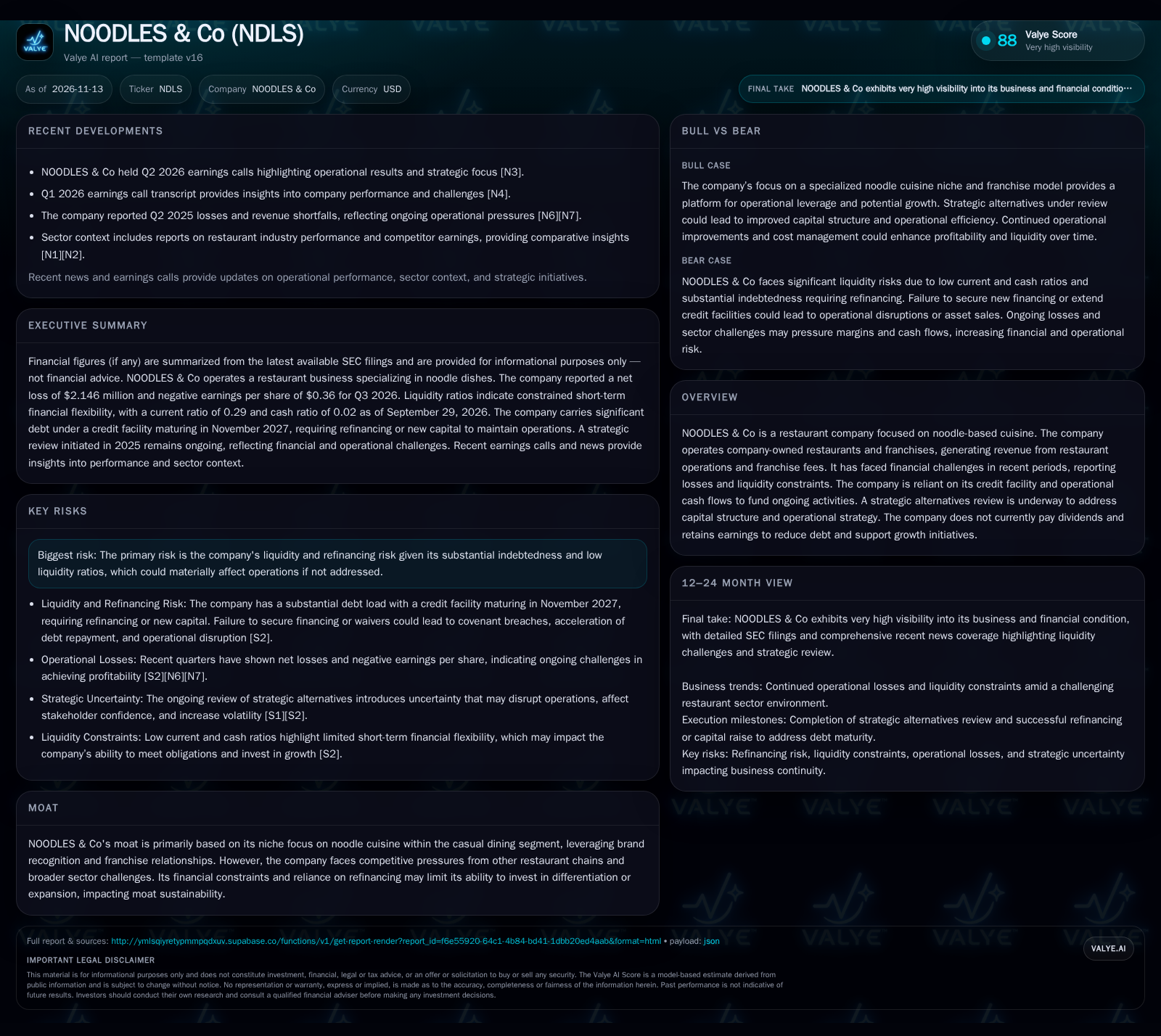
As of September 29, 2026, NOODLES & Co reported a net loss of $2.146 million for the quarter, with negative earnings per share of -$0.36 [S2]. The company’s cash and cash equivalents stood at just $1.532 million, while current liabilities reached $67.576 million, producing a current ratio of 0.29 and an reported cash ratio of 0.02 [S2]. The company reported cash and liquidity metrics for the period; these figures do not by themselves establish operating runway, investment capacity, financial flexibility, or financing capacity.
The company’s debt profile compounds this pressure: approximately $101 million is outstanding under a credit facility maturing in November 2027, but ongoing operations require refinancing or new capital well before that date [S2]. In September 2025, the Board launched a formal review of strategic alternatives, including refinancing, restructuring, or sale of the business, reflecting recognition of mounting financial and operational challenges [S1] [S2].
No dividends are paid, and the company’s stated intent is to retain earnings (when available) for debt reduction and potential expansion, though both are currently constrained by credit facility covenants [S1].
How the NOODLES & Co Business Model Struggles Under Financial Strain
NOODLES & Co generates revenue primarily from company-owned restaurant operations and, to a lesser extent, franchise fees. The core economics of a fast-casual restaurant chain hinge on driving sufficient traffic and average ticket size to cover high fixed costs (rent, labor, utilities) and variable costs (ingredients, supplies). When same-store sales stagnate or decline, operating leverage works in reverse, amplifying losses—a dynamic evident in recent quarters.
The $101 million credit facility is both a lifeline and a constraint, as restrictive covenants may limit investment flexibility and require prioritization of debt service over growth initiatives [S2].
Pricing power is likely limited by intense competition in the casual dining segment and consumer price sensitivity, especially in an inflationary environment. The company’s menu focus on noodles offers some differentiation, but does not inherently command premium pricing. Volume growth is therefore critical, yet difficult to achieve without marketing investment or new store openings—both of which require capital the company currently lacks.
Niche Differentiation Meets Sector Headwinds and Imitability
NOODLES & Co’s primary competitive edge is its specialized focus on noodle-based, globally inspired menu items, which differentiates it from broader fast-casual and quick-service peers. The brand has some recognition and a modest franchise presence, which, if leveraged, could provide network effects and operational scale.
However, the casual dining and fast-casual sectors are saturated with both national chains and local independents offering diverse cuisine, often at aggressive price points. Larger chains benefit from purchasing power, marketing budgets, and digital ordering infrastructure—advantages that NOODLES & Co cannot easily match given its current financial constraints.
Substitution risk is high: consumers can easily switch to other fast-casual formats or home meal solutions if value or experience falters. The company’s ability to maintain relevance depends on menu innovation, customer engagement, and operational consistency—all of which require ongoing investment. With capital restricted and a strategic review underway, the risk of ceding market share to better-capitalized competitors is pronounced.
Successful Restructuring or Sale Could Reset the Growth Narrative
If NOODLES & Co secures favorable refinancing terms, restructures its debt, or completes a strategic transaction—such as a sale to a better-capitalized restaurant group—it could resolve immediate liquidity pressures and restore operating flexibility. Access to fresh capital could fund turnaround initiatives, menu innovation, technology upgrades, or targeted expansion, allowing the company to leverage its brand and franchise relationships.
Confirmation of this upside would require public disclosure of a completed refinancing or sale, evidence of covenant relief, and a measurable improvement in the current ratio and cash balances (e.g., moving above 1.0 and 0.1, respectively). Early signs might include new board appointments, disclosed offers, or announced partnership agreements. A positive inflection in same-store sales or a return to operating profitability would further support the thesis that restructuring has positioned the company for recovery.
Operational Strain Persists Pending Strategic Outcome
The most plausible scenario is one of continued operating strain, with NOODLES & Co managing day-to-day liquidity tightly while the strategic alternatives review unfolds. The company may pursue interim measures such as cost-cutting, selective asset sales, or modest franchise expansion to stabilize cash flow, but these are unlikely to fully offset the impact of high debt service and limited access to new capital.
This scenario would be confirmed by ongoing net losses, continued low liquidity ratios, and incremental updates on the strategic review without resolution. If the company manages to avoid covenant breaches and maintain operations, but cannot materially improve its financial position, the status quo could persist for several quarters. A lack of progress on refinancing or asset sales would falsify any near-term turnaround thesis.
Liquidity Crisis Forces Drastic Restructuring or Asset Sales
If NOODLES & Co fails to secure refinancing or a capital infusion before cash runs out, the company could face forced asset sales, closure of underperforming locations, or even bankruptcy proceedings. Credit facility covenants may be breached, triggering acceleration of debt repayment and further constraining liquidity.
Confirmation of this scenario would include a rapid decline in cash balances, public disclosure of covenant breaches or default notices, and announcements of location closures or workforce reductions. If the Board is unable to find a buyer or new lender, stakeholders could face significant value impairment or wipeout. This scenario would also likely result in loss of customer and franchisee confidence, compounding the operational challenges.
Milestones That Will Determine NOODLES & Co’s Next Move
Disclosure of refinancing, new capital raises, or credit facility amendments—timing, terms, and impact on liquidity.
Updates on the strategic alternatives review: whether a sale, merger, or restructuring transaction is announced or completed.
Trends in the current ratio and cash ratio in subsequent quarterly filings; improvement above 1.0 and 0.1, respectively, would be significant.
Sustained positive same-store sales growth or a return to operating profitability (if disclosed) as evidence of business stabilization.
Covenant compliance status and any waivers or breaches disclosed in filings or press releases.
Announcements regarding company-owned store closures, franchise conversions, or asset sales.
Turnover in executive or board leadership, which could signal a change in strategic direction.
Volume and terms of franchise fee income, if disclosed, as an indicator of underlying unit-level economics and franchisee confidence.
Disclaimer: This is research-only, informational analysis and not investment advice. It may include AI-generated interpretation and general industry context. Always verify important details using primary sources.

Comments