
Kentucky First Federal Bancorp: Dividend Resumption, Regulatory Milestones, and Sustainable Banking Economics in Focus
With the recent termination of heightened regulatory capital oversight and the resumption of dividend payments, Kentucky First Federal Bancorp enters a new phase of operational normalcy. The bank’s stability now hinges on its ability to navigate regulatory risk, manage capital prudently, and adapt to evolving technology and competitive pressures.
Kentucky First Federal Bancorp has moved past a period of regulatory constraint, resuming dividends and posting positive net income. The company’s business model remains exposed to regulatory, operational, and technology risks, while its capital management and ability to maintain shareholder returns will be tested by industry-wide shifts and ongoing compliance demands.
Kentucky First Federal Bancorp’s return to dividend payments and improved net income mark a significant shift following the end of a restrictive regulatory capital agreement. As a federally chartered mutual holding company, the bank is tightly bound to evolving oversight and compliance standards, shaping its capital allocation, shareholder returns, and operational priorities. The next chapter will test whether Kentucky First can sustain performance and dividends while adapting to technological, regulatory, and competitive headwinds that are reshaping the banking sector.
Recent Developments in Regulation and Financial Performance
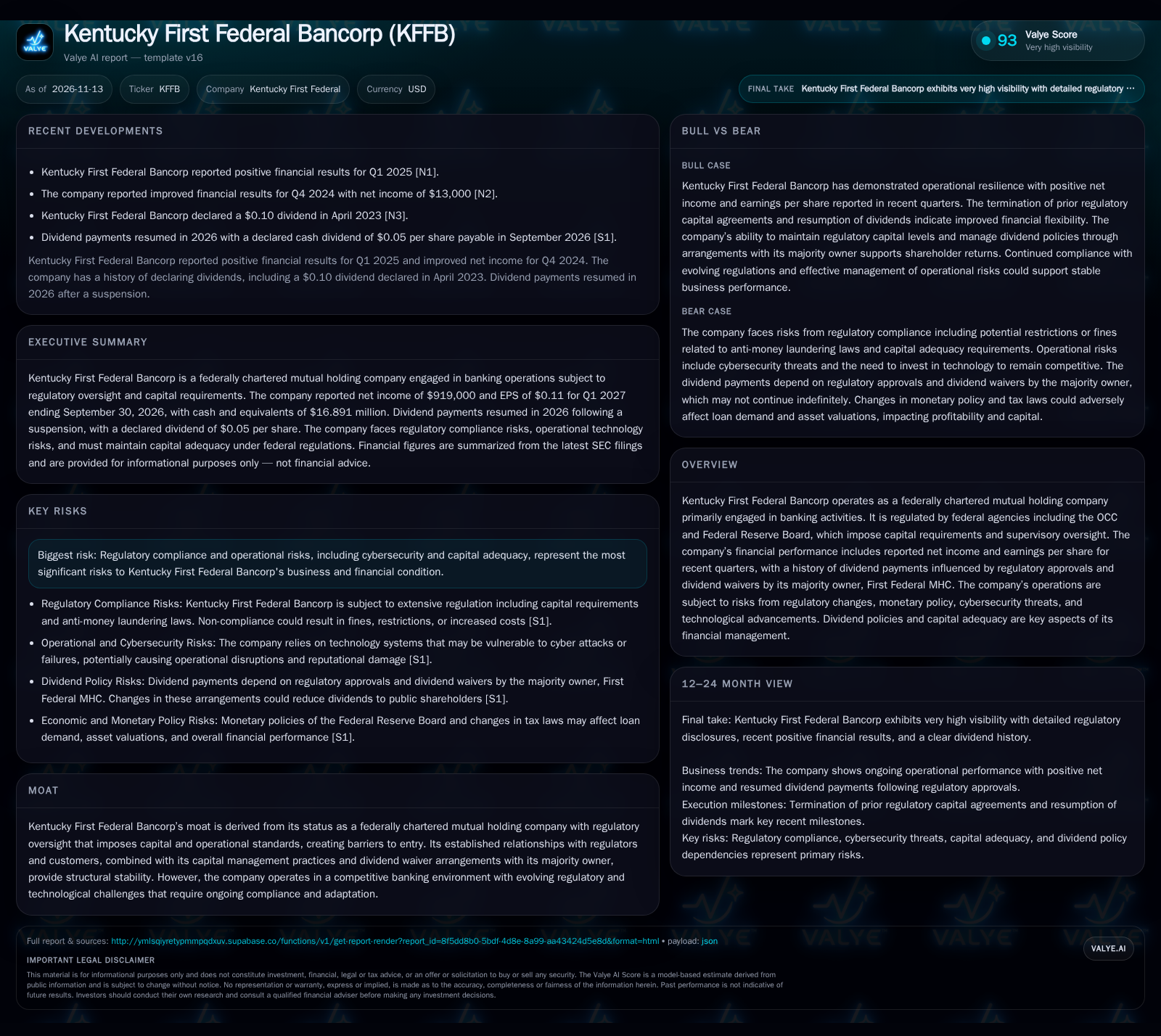
Kentucky First Federal Bancorp reported net income of $919,000 for the quarter ended September 30, 2026, with basic and diluted earnings per share of $0.11, suggesting a return to stable profitability after a period of constrained results [S2]. The company resumed dividend payments in 2026, declaring a cash dividend of $0.05 per share payable in September, following a suspension that coincided with heightened regulatory capital requirements [S1] [S2]. Notably, the OCC terminated its capital agreement with the bank in February 2026, signaling regulatory confidence in the company’s capital position [S1]. As of September 30, 2026, Kentucky First held $16.891 million in cash and cash equivalents [S2]. These developments collectively mark a transition from a period of regulatory remediation to one of normalized operations and resumed shareholder returns.
Revenue Drivers and Emerging Cost Pressures at Kentucky First Federal
As a federally chartered mutual holding company, Kentucky First Federal Bancorp’s core revenue streams are driven by traditional banking activities: net interest income from lending and investing deposit balances, with fee income and other noninterest revenues playing a supporting role. The bank’s earnings are sensitive to net interest margin (NIM), which is affected by the spread between loan yields and funding costs, and by the volume and mix of loans versus lower-yielding securities. Fixed costs—regulatory compliance, technology infrastructure, and branch operations—create significant operating leverage, meaning incremental revenue growth can disproportionately benefit the bottom line. However, the need to invest in technology and cybersecurity, as well as competitive deposit pricing, may increase variable costs and compress margins over time.
The cited source reports dividend-related activity; that disclosure alone does not establish dividend-policy continuity, management confidence, or a material constraint on capital flexibility. The cited source reports dividend-related activity; that disclosure alone does not establish dividend-policy continuity, management confidence, or a material constraint on capital flexibility. The company reported cash and liquidity metrics for the period; these figures do not by themselves establish operating runway, investment capacity, financial flexibility, or financing capacity. [S1]
Kentucky First Federal Bancorp's revenue sensitivity to net interest margin fluctuations underscores the critical importance of interest rate risk management. In a rising rate environment, the bank could benefit from repricing assets faster than liabilities, enhancing margins. Conversely, a flattening or inverted yield curve compresses margins by reducing the spread between short-term funding costs and long-term loan yields. The bank's asset-liability management strategies, including the mix and duration of loans and securities, will be pivotal in navigating these dynamics. Additionally, fee income, while currently a smaller portion of total revenue, could become a strategic focus to diversify earnings and mitigate interest rate volatility.
Operating leverage at Kentucky First is a double-edged sword; while fixed costs amplify profitability during revenue growth, they also constrain flexibility during downturns. Investments in technology, although increasing variable costs, may yield long-term efficiency gains if they enable automation and reduce manual processing. However, the timing and scale of such investments must be carefully balanced against capital constraints and regulatory expectations. Furthermore, regulatory compliance costs, often fixed or semi-fixed, are unlikely to abate and may rise with evolving standards, necessitating ongoing cost discipline and innovation in compliance processes to protect margins.
Competitive Dynamics in a Stringently Regulated Banking Environment
Kentucky First Federal Bancorp operates in a densely competitive regional banking landscape, facing pressure from larger commercial banks, community banks, credit unions, and increasingly, digital-first financial service providers. Its status as a federally regulated mutual holding company offers some structural stability and legacy customer relationships, but these are not insurmountable advantages. The bank’s ability to differentiate may depend on local market knowledge, customer service, and prudent risk management rather than pricing power or technological leadership.
Rising customer expectations for digital banking and seamless service put pressure on Kentucky First to invest in technology, even as regulatory compliance absorbs significant management bandwidth and capital. Cybersecurity and anti-money laundering compliance are now baseline requirements, not differentiators. The company’s dividend waiver arrangement with its majority owner is a unique structural feature, but it does not insulate the business from competitive deposit pricing or the risk of customer attrition to more technologically advanced peers. In this context, any sustained outperformance will likely require disciplined underwriting, cost control, and adaptation to evolving customer preferences.
Opportunities for Strengthening Profitability and Shareholder Returns
An upside scenario could materialize if Kentucky First Federal Bancorp leverages its normalized regulatory standing to drive disciplined loan growth, maintain or expand net interest margins, and generate consistent fee-based income. Successful investment in digital banking capabilities could help retain and attract customers, reducing attrition and potentially lowering operating costs per customer. If the bank continues to manage credit quality effectively while keeping expenses in check, incremental revenue growth may translate into meaningful operating leverage, supporting higher dividends and/or share repurchases.
Conversely, signals that loan growth is stalling, NIM is under pressure, or expenses are rising faster than revenues would challenge the upside case.
The bank's potential to enhance shareholder returns could also be influenced by its capacity to optimize capital allocation beyond dividends. For instance, strategic share repurchases or targeted investments in higher-yielding loan segments might improve return on equity if executed without compromising credit quality. Moreover, leveraging analytics to refine underwriting and pricing could improve risk-adjusted returns. Success in these areas depends on maintaining regulatory capital ratios within acceptable thresholds, as excessive risk-taking or capital depletion would invite regulatory intervention, negating any short-term profitability gains.
Digital transformation offers a pathway not only to customer retention but also to operational scalability. If Kentucky First Federal Bancorp can effectively integrate digital channels with personalized service, it may reduce customer acquisition costs and increase wallet share. However, the bank must also consider the competitive threat from fintech firms that excel in user experience and speed. Partnerships or technology collaborations could be conditional strategies to bridge capability gaps without overextending capital. Ultimately, the bank's ability to balance innovation investments with prudent risk management will determine its success in capturing growth opportunities.
Maintaining Profit Margins Amid Regulatory and Market Challenges
The bank is likely to operate in a low-growth environment, with net interest margins pressured by competitive deposit pricing and a flat yield curve, but offset by disciplined expense management and a conservative loan portfolio.
In this base case, the company avoids major credit losses or regulatory setbacks, but also does not achieve breakout growth. Confirmation would include a stable or slightly improving efficiency ratio, consistent net income, and regular, if modest, dividends. Falsification would come from renewed regulatory intervention, a deterioration in asset quality, or significant margin compression.
Potential Impacts of Regulatory or Operational Disruptions on Dividends
A downside scenario would be triggered if Kentucky First Federal Bancorp encounters renewed regulatory scrutiny—potentially from loan losses, compliance violations, or capital shortfalls—leading to dividend suspensions or forced capital raises. Operationally, a significant cybersecurity breach or technology failure could damage customer trust and result in costly remediation, fines, or legal exposure. Prolonged margin compression from rising funding costs or deteriorating loan demand could also erode profitability, eventually forcing the company to cut expenses, reduce dividends, or shrink the balance sheet.
Evidence supporting this scenario would include regulatory enforcement actions, a spike in nonperforming loans, a sharp drop in net interest income or margin, or public disclosures of operational failures. The loss of the dividend waiver arrangement or a refusal by regulators to approve shareholder payouts would be a clear negative inflection point.
Factors That Could Alter Kentucky First Federal’s Long-Term Value
Quarterly net interest margin trends—if disclosed—will be a primary indicator of core earnings power and competitive positioning.
Evidence of sustained or accelerating loan growth, including loan mix and credit quality disclosures, would clarify the company’s growth trajectory and risk profile.
Expense trends, particularly technology and compliance-related costs, should be monitored to assess operating leverage and efficiency.
Disclosures of cybersecurity incidents, technology investments, or digital banking adoption rates—if provided—would shed light on the company’s adaptability to evolving operational risks.
Regulatory filings or news indicating new enforcement actions, capital requirements, or compliance challenges would signal potential downside risk.
Changes in the competitive landscape, such as new digital entrants or local market consolidation, could alter Kentucky First’s relative positioning and customer retention prospects.
Disclaimer: This is research-only, informational analysis and not investment advice. It may include AI-generated interpretation and general industry context. Always verify important details using primary sources.

Comments