
OSR Holdings: Innovation-Driven Healthcare Portfolio Confronts Acute Liquidity and Execution Pressures
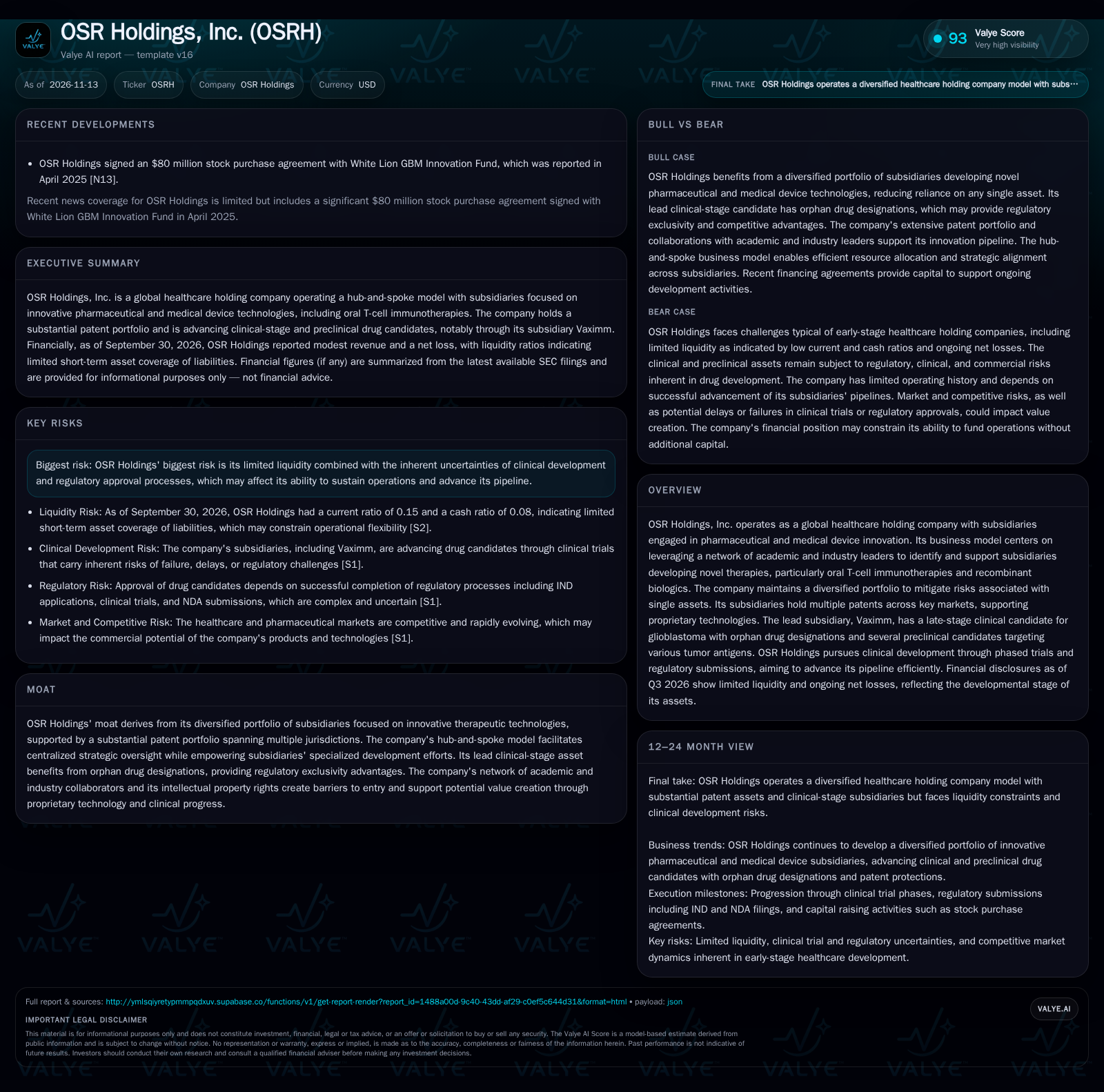
OSR Holdings leverages a hub-and-spoke model to advance novel immunotherapies and medical device technologies through its subsidiaries, backed by a multi-jurisdictional patent estate. With its lead asset in late-stage trials and orphan drug status, the company’s prospects hinge on pipeline progression and urgent capital needs, as persistent losses and a thin balance sheet heighten operational risk.
OSR Holdings operates a diversified healthcare holding structure focused on innovative therapies, notably oral T-cell immunotherapies via its Vaximm subsidiary. Sustained net losses and the capital intensity of clinical advancement underscore the urgency of successful fundraising or business development to maintain momentum and unlock portfolio value. [S1] [S2]
OSR Holdings, Inc. stands at the intersection of innovation and risk in the global healthcare sector, orchestrating a portfolio of subsidiaries focused on breakthrough immunotherapies and medical devices. Its hub-and-spoke structure enables strategic oversight and resource allocation across diverse assets, including late-stage clinical candidates with regulatory advantages. However, acute liquidity pressures and persistent net losses amplify the stakes of clinical development and financing execution. The company’s future rests on its ability to translate scientific progress and intellectual property into commercial milestones before financial runway constraints force strategic pivots or capital-raising at unfavorable terms.
Acute Liquidity Strains Shape OSR Holdings’ Immediate Strategic Horizon
As of September 30, 2026, OSR Holdings reported just $1.37 million in cash and equivalents against $16.68 million in current liabilities, yielding a current ratio of 0.15 and a cash ratio of 0.08. For the quarter, revenue reached $524,793, while net losses totaled $1.61 million. These figures underscore a severe short-term liquidity crunch, with the company’s obligations vastly outstripping available cash resources. The financial reality raises the prospect of urgent fundraising, cost containment, or asset monetization to sustain operations and advance its pipeline. Concurrently, the company’s lead clinical asset (VXM01) has completed Phase 2 trials and holds orphan drug designations from both the FDA and EMA, marking a significant scientific and regulatory milestone that could underpin future value if subsequent development is successful. [S1] [S2]
Portfolio Economics Hinge on Clinical Milestones, Capital Access, and Partnering
OSR Holdings operates as a holding company, deriving potential value from equity stakes in subsidiaries developing novel therapeutics and devices. The business model relies on funding early- and mid-stage R&D, achieving clinical inflection points, and then capturing value through out-licensing, strategic partnerships, or eventual commercialization. Revenue to date remains modest, likely reflecting milestone payments, early-stage licensing, or service agreements rather than product sales. The cost base is dominated by R&D and administrative expenses, with limited operating leverage until a portfolio asset achieves late-stage clinical success or attracts a major partner.
The economics of oral T-cell immunotherapies—if proven safe and effective—could be attractive due to premium pricing for oncology indications, especially those with orphan drug exclusivity. However, the capital intensity of advancing multiple clinical and preclinical programs is high, and operating leverage only materializes upon late-stage success or a licensing event.
Innovation Moat and Patent Estate Offer Defensive Advantages, but Market Entry Remains Fraught
OSR Holdings’ competitive position is anchored by its diversified pipeline, a substantial patent estate (10 families, with coverage through at least 2041 in some regions), and the regulatory benefits conferred by orphan drug designations. These attributes create barriers to entry and could enable premium pricing and market exclusivity if assets reach commercialization. The hub-and-spoke structure allows for centralized strategic control while leveraging specialized subsidiary management, potentially accelerating innovation and alignment.
Nevertheless, the competitive landscape in oncology and immunotherapy is crowded, with large pharmaceutical companies and well-funded biotechs pursuing overlapping targets and modalities. The company’s focus on oral T-cell vaccines is differentiated, but success will depend on demonstrating robust safety, efficacy, and manufacturability relative to both traditional therapies and emerging cell/gene therapies. Without disclosed commercial contracts or major partnerships, OSR Holdings currently lacks the scale, distribution, and brand presence of established competitors, making business development, intellectual property enforcement, and regulatory execution critical to defending its position.
Pipeline Acceleration and Strategic Partnerships Unlock Disproportionate Value
In a favorable scenario, OSR Holdings secures sufficient funding—either through equity, non-dilutive grants, or licensing—to advance Vaximm’s VXM01 into pivotal Phase 3 trials and accelerate preclinical candidates into the clinic. Positive data from these programs, particularly in high-need oncology indications, could catalyze out-licensing deals or partnerships with large pharmaceutical companies, providing upfront payments, milestones, and cost-sharing to defray further development expenses. Orphan drug designations could support regulatory fast-tracking and market exclusivity, enabling premium pricing and higher margins if approved.
Confirmation of this scenario would come from announced funding rounds, major licensing or co-development partnerships, and the initiation or completion of pivotal clinical trials. Evidence of regulatory engagement (e.g., IND or NDA submissions, fast-track status), as well as expansion of the intellectual property portfolio or additional orphan drug designations, would further validate the upside path. Conversely, delays in fundraising, clinical setbacks, or lack of external interest would weaken the case for rapid value creation.
Incremental Pipeline Progress Amid Ongoing Capital Constraints
The most plausible trajectory for OSR Holdings is continued incremental advancement of its lead and preclinical assets, punctuated by periodic fundraising efforts to bridge liquidity gaps. Modest revenue streams—likely from grants, research collaborations, or early-stage licensing—help offset, but do not eliminate, the need for external capital. Clinical progress may be steady but subject to the inherent delays and setbacks of drug development, with regulatory submissions and trial initiations staggered across the next 12-24 months.
This scenario is confirmed by a continued cadence of scientific updates, incremental pipeline milestones, and a series of smaller financing transactions rather than transformative partnerships. Persistent net losses and limited cash coverage of liabilities would be expected to remain visible in quarterly disclosures. The thesis would be falsified if the company is unable to raise sufficient capital to continue operations, or if key clinical programs are discontinued due to lack of funding or disappointing data.
Liquidity Crisis Forces Strategic Retrenchment or Asset Fire Sale
This could force abrupt cost-cutting, the suspension of clinical programs, or the sale of subsidiary assets at distressed valuations. Inability to meet short-term obligations may trigger creditor actions, loss of key personnel, or even bankruptcy proceedings—especially if ongoing net losses remain unaddressed.
Confirmation of the downside would include failed or delayed financing attempts, management guidance indicating going-concern risks, or announcements of asset sales, program discontinuations, or workforce reductions. Regulatory or clinical setbacks could accelerate these pressures, as could adverse changes in the external funding environment for early-stage healthcare companies.
Milestones and External Catalysts That Will Make or Break the OSR Holdings Thesis
Announcement and terms of new funding rounds, including equity, debt, or non-dilutive grants—timing and scale will be critical to runway extension.
Progression of Vaximm’s VXM01 into Phase 3 clinical trials, as well as any interim or final data readouts from ongoing studies.
Disclosure of new out-licensing, co-development, or strategic partnership agreements with larger pharmaceutical companies.
Regulatory milestones such as IND filings, NDA submissions, or receipt of additional orphan drug or fast-track designations for pipeline assets.
Updates on preclinical pipeline progress, including movement of vaccine or biologic candidates into first-in-human studies.
If disclosed, details on commercial interest, term sheets, or early revenue streams from milestone payments or licensing deals.
Evidence of management turnover, workforce reductions, or program discontinuations that could signal distress or reprioritization.
Disclaimer: This is research-only, informational analysis and not investment advice. It may include AI-generated interpretation and general industry context. Always verify important details using primary sources.

Comments