
Lifeward Ltd.: Exoskeleton Innovation Confronts Regulatory, Concentration, and Execution Pressures
Lifeward’s advanced exoskeleton devices and regulatory clearances underpin its market opportunity, but persistent losses, key customer dependence, leadership turnover, and evolving compliance challenges highlight the need for durable execution and diversification.
Lifeward’s powered exoskeletons serve a growing rehabilitation market, supported by FDA and EU clearances and positive clinical outcomes. However, ongoing losses, customer concentration, and regulatory and leadership risks threaten stability and growth. Execution on AI integration, product adoption, and regulatory navigation will determine the company’s ability to achieve sustainable scale and profitability. [S1] [S2] [N6] [N8]
Lifeward Ltd. stands at a pivotal juncture as its portfolio of FDA- and EU-cleared powered exoskeletons gains clinical and commercial validation for individuals with spinal cord injuries and stroke-related mobility impairments. While recent regulatory wins and positive clinical data affirm the company’s technological edge, persistent net losses, high customer concentration, and leadership turnover temper the outlook. The company’s ability to navigate evolving regulatory landscapes, diversify its customer base, and integrate AI-enabled functionality will shape whether Lifeward can convert its innovation into sustainable growth and operational resilience.
Recent Results Highlight Lifeward’s Progress and Persistent Risks
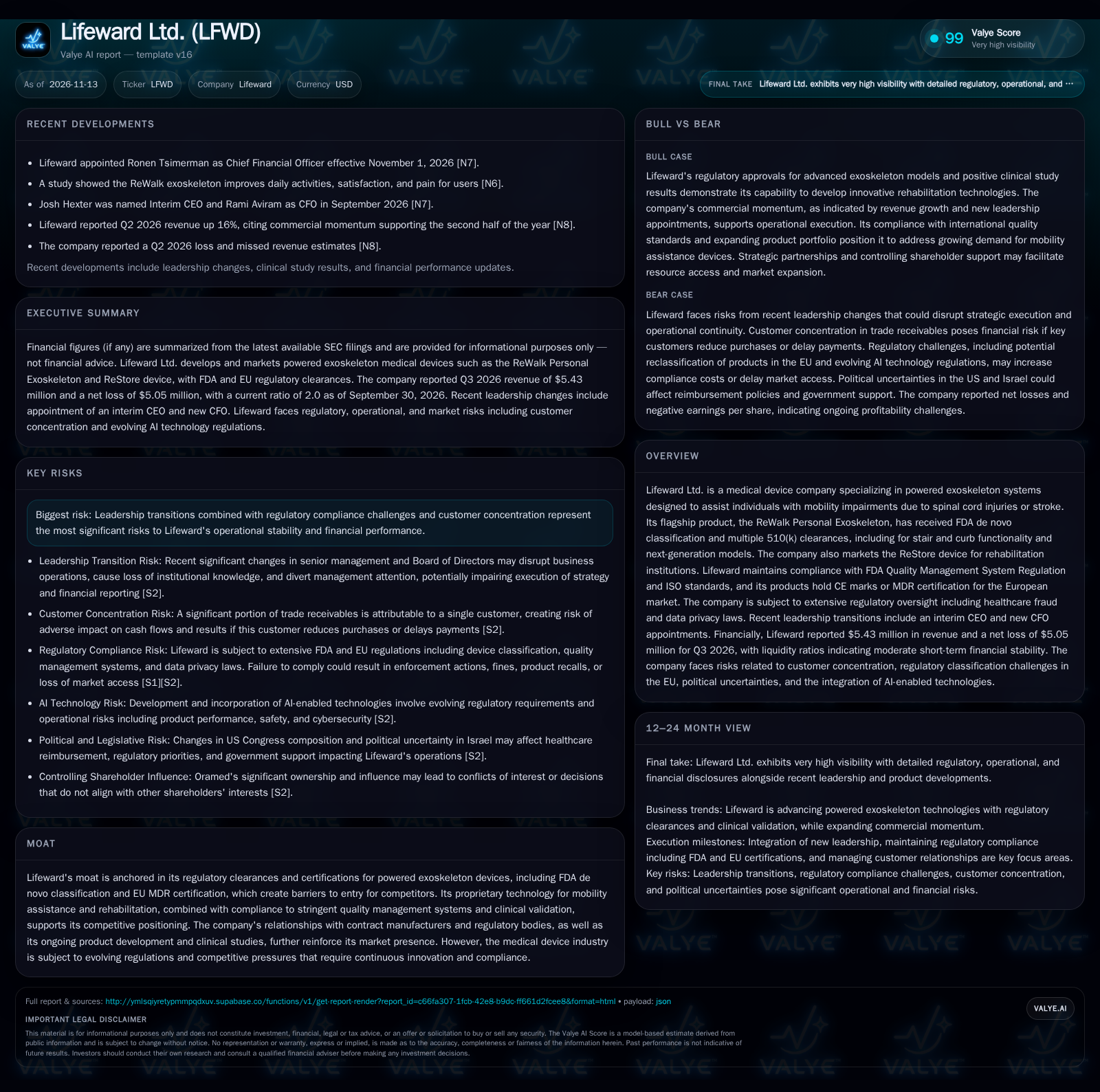
Lifeward reported Q3 2026 revenue of $5.43 million and a net loss of $5.05 million, continuing a pattern of negative earnings despite recent commercial momentum. The company reported cash and liquidity metrics for the period; these figures do not by themselves establish operating runway, investment capacity, financial flexibility, or financing capacity. A notable operational risk is that a significant portion of trade receivables is attributable to a single customer, raising exposure to sudden changes in purchasing or payment behavior. Regulatory progress was marked by the FDA 510(k) clearance for the ReWalk 7 Personal Exoskeleton in March 2025 and EU MDR certification in September 2025, while a recent clinical study reported improved user outcomes for the ReWalk device. Leadership transitions, including the appointment of an interim CEO and new CFO in late 2026, add a layer of execution uncertainty. [S1] [S2] [N6] [N7]
Understanding Lifeward’s Revenue Drivers and Cost Structure
Lifeward’s core revenue stream derives from the sale of powered exoskeleton devices, primarily the ReWalk Personal Exoskeleton for home and community use and the ReStore device for rehabilitation clinics. The company’s pricing power is partly anchored in regulatory clearances and clinical validation, which may allow for premium pricing relative to less validated or uncertified alternatives. However, the addressable market is constrained by payer reimbursement policies, clinical adoption rates, and capital budgets of healthcare providers.
Fixed costs are significant, reflecting ongoing R&D, regulatory compliance, and quality management system maintenance, while variable costs are tied to manufacturing, sales, and support services. The company’s reliance on contract manufacturing may provide some flexibility, but regulatory requirements (such as FDA QMSR and ISO 13485:2016) add baseline costs that scale only modestly with volume. Operating leverage could be realized if device adoption accelerates, but the company’s persistent net losses suggest current volumes are insufficient to cover fixed overhead. The integration of AI-enabled features could improve device functionality and create new service or software revenue streams, but also introduces new regulatory and development costs. [S1] [S2]
Regulatory Barriers and Technology Validation: Moat or Mirage?
Lifeward’s competitive position is anchored in its regulatory clearances—such as FDA de novo and 510(k) approvals and EU MDR certification—and its ability to demonstrate clinical efficacy in improving patient outcomes. These credentials create meaningful barriers to entry in a field where unapproved or insufficiently validated products face severe market access constraints. However, the exoskeleton market is drawing increasing interest from diversified medtech firms and robotics companies, many of which possess greater scale, broader distribution, and deeper R&D resources.
Customer switching costs may be moderate: while clinical integration and training create some stickiness, hospitals and rehabilitation clinics are accustomed to evaluating new technologies and may be sensitive to device pricing, payer reimbursement, and service quality. The risk of technology substitution is real, especially as AI-driven rehabilitation tools, soft exosuits, or next-generation robotic mobility aids enter the market. Lifeward’s ability to maintain its lead will depend on continual innovation, regulatory agility, and demonstrable clinical and economic value.
If Clinical Validation and AI Innovation Drive Broader Adoption
A favorable scenario would see Lifeward leveraging its recent regulatory wins and positive clinical data to accelerate adoption in both institutional and home settings. If reimbursement policies become more favorable—driven by mounting evidence of improved patient outcomes and quality of life—device sales could scale meaningfully, improving gross margins through operating leverage. The integration of AI-enabled features might differentiate Lifeward’s offerings, enabling new subscription-based or service revenue streams and further clinical validation.
Evidence that would confirm this trajectory includes sustained double-digit revenue growth, diversification of the customer base (reducing reliance on any single buyer), successful market entry or expansion in additional geographies, and positive payer coverage decisions. Increasing software or service attachment rates and improved gross margins would also indicate value capture from innovation.
Commercial Momentum Tempered by Execution and Compliance Hurdles
The most plausible outcome is that Lifeward continues to generate incremental revenue growth as its exoskeletons gain awareness and more rehabilitation centers and individuals trial the products. However, the pace of adoption is likely to be gradual, constrained by lengthy sales cycles, reimbursement uncertainties, and the need to continually invest in regulatory compliance and product support. The company may remain dependent on a small number of customers and distributors, limiting its negotiating leverage and amplifying revenue volatility.
Operational losses could persist unless Lifeward achieves a step-change in volume or is able to supplement device sales with higher-margin software or service revenues. Confirmation of this scenario would include steady but unspectacular revenue growth, ongoing net losses, and periodic regulatory or policy hurdles that slow expansion. Falsification would be evident if the company rapidly diversifies its revenue base, achieves profitability, or encounters an unexpected regulatory setback that curtails market access.
Concentration, Compliance, or Execution Failure Derails Progress
The most adverse trajectory would see Lifeward’s customer concentration risk materialize—such as a key customer delaying payments or sharply reducing purchases—triggering cash flow pressure and potentially necessitating capital raises on unfavorable terms. Regulatory headwinds, including reclassification or delayed conformity assessments in the EU, could interrupt sales or force costly product redesigns. Leadership instability may impair strategic focus or delay critical operational initiatives, compounding execution risk.
Further downside could result if AI-enabled product development encounters regulatory or technical setbacks, or if competitive innovations leapfrog Lifeward’s offerings. Evidence of this scenario includes revenue contraction, rising receivables or bad debt, regulatory enforcement actions, unexpected leadership departures, or the inability to secure new payer coverage or distribution partnerships.
Milestones That Will Define Lifeward’s Trajectory in Powered Mobility
Revenue mix by customer and geography: A useful metric would be the percentage of revenue attributable to the top five customers and any reduction in concentration over time.
Gross margin trends: If disclosed, improvement in gross margin would signal operating leverage and better pricing discipline.
Payer reimbursement expansion: Announcements of new insurance coverage, government reimbursement, or payer pilots would test Lifeward’s ability to expand market adoption.
AI-enabled product launches and regulatory clearances: Progress in bringing AI-integrated devices to market and securing necessary regulatory approvals would validate the innovation strategy.
Receivables aging and cash flow from operations: Monitoring the pace of collections and any increase in overdue receivables would help assess liquidity and customer risk.
Leadership and board stability: Retention of key executives and absence of further turnover would support operational continuity.
Regulatory developments in the EU and US: Updates on product classification, conformity assessments, and compliance with evolving standards will determine market access and cost structure.
Clinical study publications and real-world data: The release of additional studies showing functional and economic benefits would strengthen adoption arguments.
Disclaimer: This is research-only, informational analysis and not investment advice. It may include AI-generated interpretation and general industry context. Always verify important details using primary sources.

Comments