
KB Global Holdings: Severe Financial Stress and the Absence of a Commercial Foundation
With no revenue, escalating net losses, and a capital structure dominated by related-party obligations, KB Global Holdings faces existential risk. The lack of operational disclosure and negative liquidity ratios leave little visibility into future prospects or business viability.
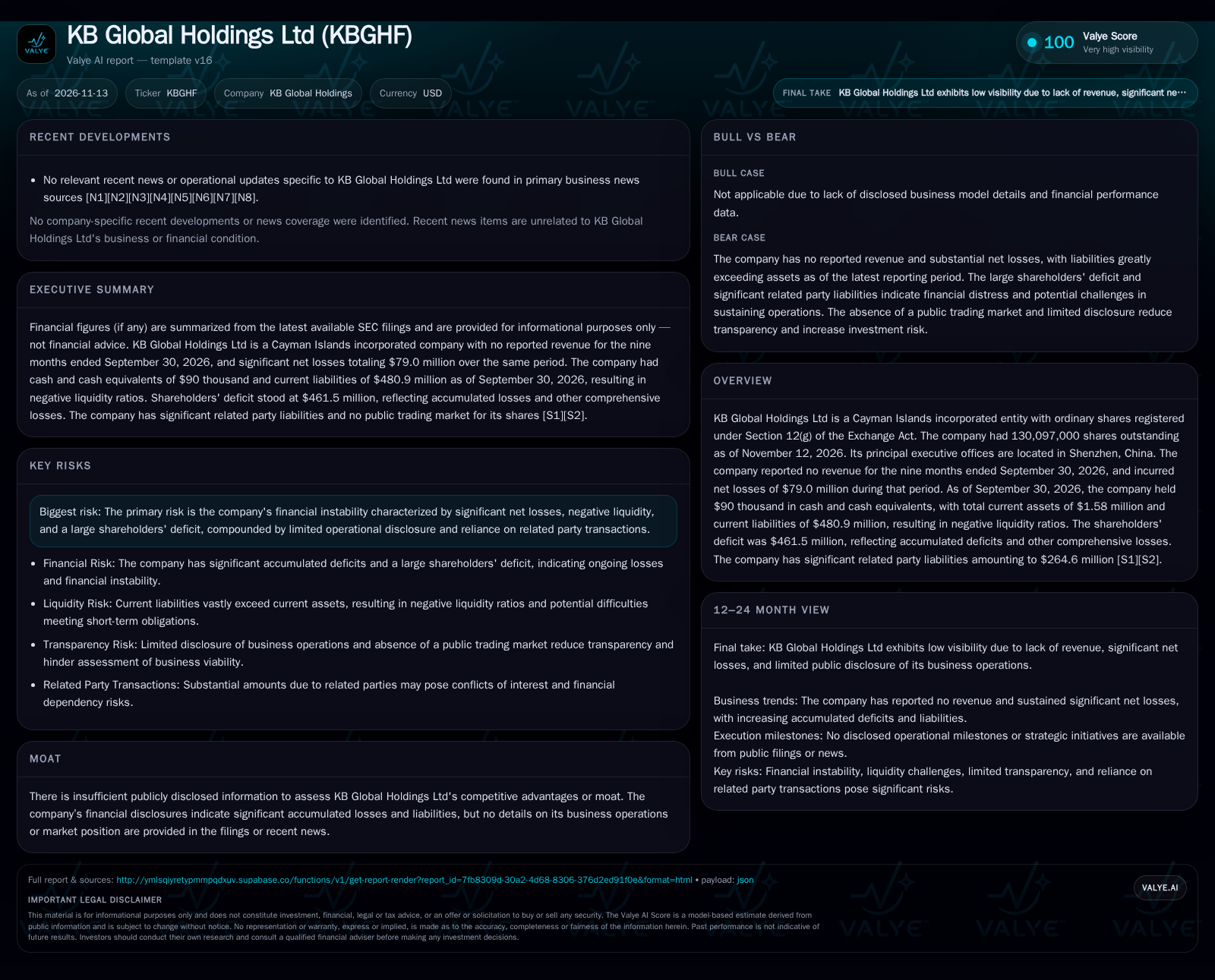
KB Global Holdings Ltd has reported zero revenue and steep losses for the nine months ended September 30, 2026, while holding just $90,000 in cash against $480.9 million in current liabilities. The company’s total shareholders’ deficit stands at $461.5 million, compounded by $264.6 million owed to related parties and no public trading market. There is no evidence of a functioning business model or commercial traction, raising acute questions about survival as a going concern. [S2]
KB Global Holdings Ltd stands at a precarious crossroads: the company has generated no revenue for the nine months ended September 30, 2026, and its financial statements reveal a capital structure overwhelmed by liabilities, most notably to related parties. With only $90,000 in cash and no evident commercial operations, the company’s ability to continue as a going concern is in serious doubt. The absence of a public market for its shares and minimal operational disclosure further obscure any plausible path to recovery or value creation.
A Company Without Revenue or Liquidity: The Facts Shaping the Crisis
The most consequential facts are stark: KB Global Holdings Ltd reported zero revenue for both the three and nine months ended September 30, 2026, and registered net losses of $20.9 million and $79.0 million for those respective periods [S2]. The company’s liquidity position is dire, with just $90,000 in cash and total current assets of $1.58 million, dwarfed by current liabilities of $480.9 million [S2]. The company reported cash and liquidity metrics for the period; these figures do not by themselves establish operating runway, investment capacity, financial flexibility, or financing capacity. Shareholders’ deficit stands at $461.5 million, reflecting deep cumulative losses and other comprehensive losses [S2]. Finally, the company’s obligations to related parties—a total of $264.6 million—underscore both financial dependence and the risk of governance conflicts [S2]. No trading market exists for the company’s shares, and there is no evidence of operational execution or commercial progress.
Business Model Vacuum: Economics Without Revenue or Product
The absence of revenue and the lack of any disclosed commercial operations mean that KB Global Holdings currently has no observable business model—no pricing, volume, or mix dynamics can be analyzed. Operating leverage is entirely negative, as fixed and variable costs continue to generate losses without offsetting income. The company’s accumulated deficit and persistent net losses indicate that expenses—likely administrative, technology, and compliance—are being funded either through related-party support or deferral of obligations, rather than by a functioning business. The overwhelming liabilities, especially to related parties, suggest that the company is reliant on insider or affiliate financing to remain solvent, a situation that is inherently unstable and unsustainable without a transition to external capital or genuine commercial activity. There is no evidence of capital deployment into productive assets, nor any indication of a path to positive cash flow.
The financial dynamics at play also suggest that the company’s cost structure is unlikely to adjust favorably without a fundamental shift in strategy or operational focus. Fixed costs, such as administrative overhead and compliance expenses, typically represent a significant portion of outflows in early-stage or distressed enterprises. Without revenue to offset these costs, the company faces a structural imbalance that deepens with time. Moreover, the absence of capital expenditures or investments in scalable assets further indicates a lack of strategic reinvestment, which is critical for long-term value creation. If disclosed, a useful metric would be the burn rate relative to any incoming financing, as this would help test the sustainability of current operations and the timeline for capital exhaustion.
Competitive Position Is Moot: No Market Presence or Defensible Niche
With no revenue, no active customers, and no disclosed products or services, KB Global Holdings does not currently occupy any competitive position in a defined market. There is no evidence of product-market fit, customer relationships, or technology differentiation. The company’s filings reference intentions to develop enterprise software and invest in IT infrastructure, but there is no demonstration of execution or commercial uptake [S1]. In the context of enterprise software, competitive advantage typically stems from established customer bases, recurring revenue, proprietary platforms, or integration ecosystems. KB Global Holdings lacks any of these attributes. The company’s reliance on related-party financing and the absence of public-market discipline further erode confidence in its ability to compete, even if operations were to commence.
What Would a Turnaround Require? Rebooting with Capital and Proof of Execution
The company would also need to disclose and execute a credible business plan, with evidence of customer acquisition, product launches, or strategic partnerships. Confirmation of this scenario would require concrete disclosures: new capital infusions from arms-length investors, signed customer contracts, and recognized revenue. Falsification would be simple: continued absence of revenue, persistent reliance on related-party support, and no operational milestones. Unless such a dramatic pivot occurs, the company’s prospects for a turnaround remain remote.
No Revenue, Mounting Losses: The Most Likely Trajectory Is Further Erosion
Absent any evidence of commercial traction, the most plausible path is continued operating losses, further growth in liabilities, and deepening shareholders’ deficit. The company’s dependence on related-party funding may persist in the near term, but this form of support is inherently unstable and may be withdrawn at any time. Without new external capital or the emergence of a revenue-generating business, the risk of insolvency, creditor actions, or forced restructuring increases with each quarter. Confirmation of this scenario would be the continued reporting of zero revenue, mounting losses, and no new business disclosures in future filings. Any deviation—such as revenue recognition or a material capital raise—would be a signal that the base case assumptions no longer hold.
Potential for Insolvency or Delisting: How Collapse Could Unfold
The adverse scenario is one of imminent financial collapse. The absence of a public trading market reduces both transparency and access to new financing sources. If the company fails to secure additional funding or restructure its obligations, it could face insolvency proceedings or be forced into liquidation. Confirmation of this scenario would include auditor warnings about going concern, legal actions from creditors, or the initiation of bankruptcy or dissolution processes. The lack of operational disclosure and the absence of a turnaround plan make this not just a theoretical risk, but an increasingly likely outcome.
What Would Demonstrate a Shift in KB Global Holdings’ Trajectory?
Any disclosure of recognized revenue from external customers would be a critical signal that commercial operations have begun.
Evidence of a substantial arms-length capital infusion, not reliant on related parties, would indicate renewed financial viability.
Signed customer contracts, product launches, or announced strategic partnerships—if disclosed—would demonstrate operational execution.
Material reduction in current liabilities, especially related-party obligations, would suggest improved financial discipline or restructuring progress.
Disclosure of a clear business model, including pricing, target market, and go-to-market strategy, would help clarify the company’s path.
Auditor or management statements regarding the company’s status as a going concern would provide insight into the risk of imminent insolvency.
The emergence of a trading market for the company’s shares would enhance transparency and potentially facilitate future capital raising.
Disclaimer: This is research-only, informational analysis and not investment advice. It may include AI-generated interpretation and general industry context. Always verify important details using primary sources.

Comments