
Twenty One Capital: Bitcoin Accumulation Model, Structural Leverage, and the Regulatory Crossroads
Twenty One Capital, Inc. has rapidly established itself as a Bitcoin-native operating company, leveraging capital markets to amass substantial Bitcoin holdings and positioning for future expansion into Bitcoin-centric financial services. The company’s fortunes are tightly bound to Bitcoin price volatility and regulatory clarity, creating both asymmetric upside and acute risk. With a reported liquidity position and major Bitcoin assets acquired via a business combination, the company’s next phase will test whether it can translate capital-efficient accumulation into defensible long-term economics.
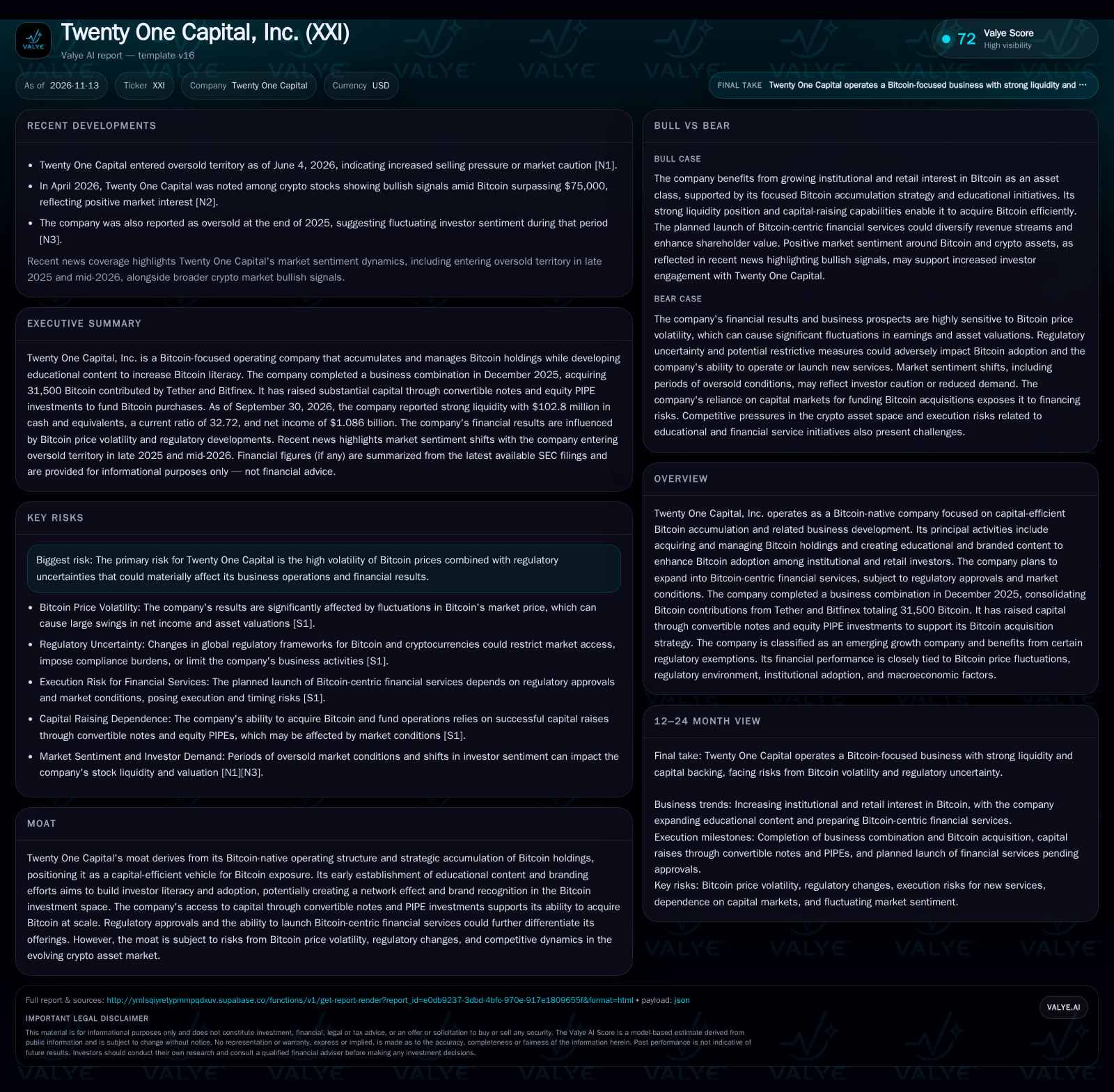
Twenty One Capital, Inc. is a newly formed company focused on accumulating and managing Bitcoin, with $102.8 million in cash and 31,500 Bitcoin contributed via a business combination with Tether and Bitfinex. The company’s current financials reflect substantial exposure to Bitcoin price movements, and future plans include launching Bitcoin-centric financial services pending regulatory approval. While its capital structure and liquidity are robust, the business remains highly sensitive to crypto market cycles, regulatory developments, and its ability to execute on new service offerings. [S1] [S2]
Twenty One Capital, Inc. is a purpose-built vehicle for capital markets exposure to Bitcoin, blending direct cryptocurrency accumulation with ambitions for future financial product offerings. By orchestrating a business combination that delivered 31,500 Bitcoin to its balance sheet and raising significant capital through convertible notes and PIPE investments, the company has rapidly scaled its asset base. However, its results are inextricably linked to the volatility of Bitcoin prices and the evolving regulatory landscape. As it eyes expansion into Bitcoin-centric services, the company’s ability to manage market cycles, regulatory hurdles, and execution risk will be central to its long-term value proposition.
A New Entrant with Massive Bitcoin Holdings and Reported Liquidity Position
Twenty One Capital, Inc. entered the public markets as a Bitcoin-native company, with its defining event being a December 2025 business combination that brought in 31,500 Bitcoin contributed by Tether and Bitfinex. This immediately positioned the company among the largest corporate holders of Bitcoin, giving shareholders direct exposure to the cryptocurrency’s price movements. As of September 30, 2026, the company reported $102.8 million in cash and equivalents and a current ratio of 32.72, reflecting a highly liquid balance sheet. The company’s net income for the period was $1.086 billion, underscoring the direct impact of Bitcoin price appreciation on its reported financials. [S1] [S2]
Recent headlines have highlighted that Twenty One Capital’s shares entered oversold territory in late 2025 and again in mid-2026, suggesting that investor sentiment and trading activity remain volatile and closely tied to broader crypto market trends. [N1] [N3]
How Bitcoin Accumulation Drives Reported Earnings—and Its Limits
The company’s core economic engine is straightforward: it raises capital through convertible notes and PIPE investments, uses these funds to acquire Bitcoin, and manages these holdings as its principal asset base. This model creates a direct link between the company’s reported earnings and the market value of its Bitcoin holdings, effectively passing through Bitcoin price appreciation or depreciation to the income statement. The resulting earnings volatility is extreme, as seen in the $1.086 billion net income for the latest period—a figure that could swing sharply with Bitcoin price moves. [S2]
This structure offers substantial operating leverage when Bitcoin prices rise, as the asset base can appreciate rapidly without a commensurate increase in operating expenses. Conversely, during Bitcoin downturns, asset write-downs or unrealized losses could lead to large reported losses. Fixed costs appear modest, as the company’s main spending is directed toward asset acquisition and content development, but future expansion into financial services could require more operating infrastructure and regulatory compliance costs.
The capital-efficient model depends on continued access to capital markets—if investor appetite for crypto exposure wanes, the company may face constraints on future Bitcoin acquisitions or on funding new business lines. The planned launch of Bitcoin-centric financial services could diversify revenue streams, but the mechanics—fee structures, customer acquisition costs, and regulatory burdens—remain to be proven.
Structural Advantages and the Race for Institutional Credibility
Twenty One Capital’s current moat centers on its large, transparent Bitcoin holdings and Bitcoin-native operating structure. By consolidating a significant stash of Bitcoin and offering a public equity vehicle, it enables investors—especially those unable or unwilling to hold Bitcoin directly—to gain exposure through traditional capital markets. This is a distinct positioning compared to crypto miners, trading platforms, or diversified holding companies.
The company faces competitive threats from other public Bitcoin holding vehicles, crypto ETFs, and asset managers offering synthetic or direct Bitcoin exposure. Its edge may come from early-mover status, brand-building through educational content, and the potential to launch specialized Bitcoin-centric financial services. However, these advantages are tenuous: regulatory changes could open or close the door to new entrants, and larger asset managers may be able to leverage scale, distribution, and trust more effectively. The company’s ability to create a defensible network effect or sticky customer base depends on the quality and reach of its educational initiatives and the eventual structure of its planned services.
If Institutional Adoption Accelerates and Regulatory Clarity Emerges
A favorable scenario for Twenty One Capital unfolds if institutional and retail adoption of Bitcoin continues to grow, driving sustained demand and price appreciation. In this environment, the company’s large Bitcoin holdings would function as a leveraged bet on the asset class, with net income and book value rising rapidly. Regulatory clarity—such as the approval of new Bitcoin-related financial products or clear guidelines for digital asset services—would reduce existential risks and enable the company to launch its planned Bitcoin-centric financial services.
Confirmation of this scenario would come from continued capital inflows, successful launches of new financial products, and evidence of growing engagement with the company’s educational content and branded initiatives. A rising Bitcoin price, increased institutional allocations, and positive regulatory developments would create a virtuous cycle, enhancing both the company’s intrinsic value and its appeal as a public proxy for Bitcoin exposure.
Tethered to Bitcoin Cycles, Awaiting Service Diversification
The most plausible trajectory is that Twenty One Capital’s financial results continue to mirror Bitcoin price cycles, with periods of strong reported earnings during bull markets and significant volatility during downturns. The company maintains its core position as a Bitcoin holding vehicle, with educational initiatives supporting modest brand differentiation but not yet translating into substantial new revenue streams.
Progress on launching Bitcoin-centric financial services remains slow, as regulatory approvals and market readiness are unpredictable. The company’s reported liquidity position in the near term, but future capital raises may become more challenging if crypto market sentiment deteriorates. Confirmation of this scenario would be ongoing earnings volatility tied to Bitcoin prices, limited new product revenue, and slow but steady growth in educational reach.
Regulatory Shocks or Bitcoin Bear Markets Expose Fragility
An adverse scenario plays out if there is a sharp, prolonged decline in Bitcoin prices or a regulatory crackdown on corporate Bitcoin holdings or related services. In this case, the company’s reported net income could turn deeply negative, and asset values would fall, eroding shareholder equity. Regulatory obstacles could block or delay the rollout of new financial services, leaving the company with a narrow, volatile business model and limited levers for growth.
Evidence of this scenario would include persistent net losses, asset impairments, negative book value trends, inability to access capital markets, and regulatory actions directly targeting the company’s operations or the broader corporate holding model for Bitcoin.
Testing the Twenty One Capital Thesis: What Will Determine Long-Term Value?
Quarterly changes in the company’s Bitcoin holdings and their market value—if disclosed—would clarify the direct impact of price swings and acquisition strategy.
Progress updates and regulatory milestones for the planned launch of Bitcoin-centric financial services would indicate the feasibility of business model expansion.
Trends in capital raising activity, including terms and investor appetite for future PIPEs or convertible note offerings, would reveal the sustainability of the accumulation strategy.
Adoption rates and measurable engagement with educational and branded content—if disclosed—would help test whether these initiatives create a defensible brand or network effect.
Evidence of new or retained institutional investors in the shareholder base could signal growing credibility and demand for public Bitcoin exposure.
Any regulatory actions, guidance, or legal developments affecting the company’s ability to hold or offer services around Bitcoin would be critical inflection points.
Material changes in reported net income or book value, especially in relation to Bitcoin price cycles, would confirm or challenge the company’s earnings sensitivity and resilience.
Competitive responses—such as the launch of new public Bitcoin holding vehicles or asset management products—would affect the company’s differentiation and market share.
Disclaimer: This is research-only, informational analysis and not investment advice. It may include AI-generated interpretation and general industry context. Always verify important details using primary sources.

Comments