
VYNE Therapeutics: Liquidity Strength, Pipeline Reset, and the Search for Sustainable Value Creation
VYNE Therapeutics stands at a strategic crossroads: flush with cash following clinical trial wind-downs and equity issuances, but with minimal revenue and a narrowed pipeline, the company’s next steps will determine whether its resources can translate into sustainable long-term value.
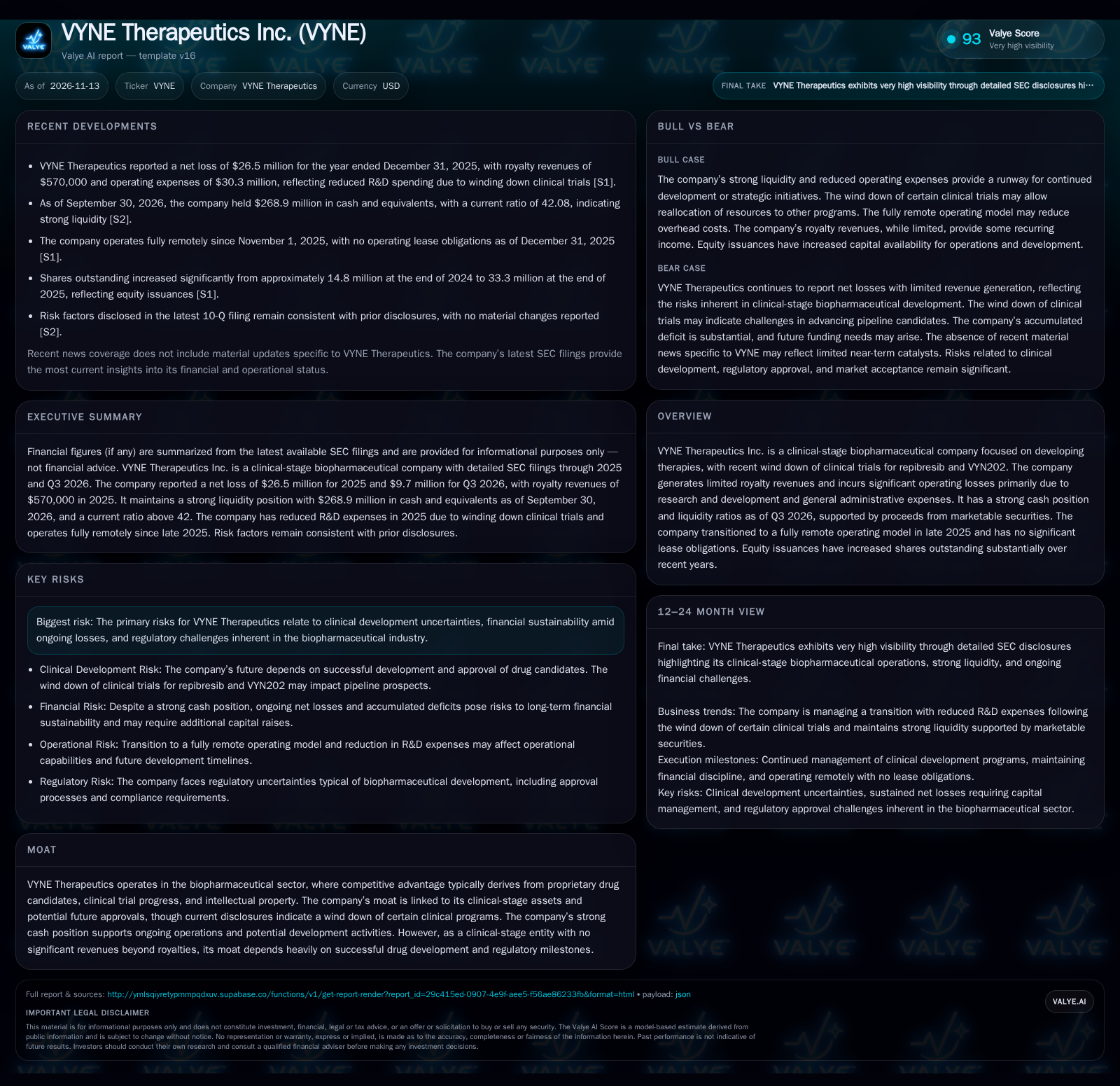
VYNE Therapeutics has amassed a significant cash position ($268.9M as of Q3 2026) and reduced R&D spending after winding down clinical trials for lead candidates. Despite this, revenues remain negligible and net losses persist, making future value creation dependent on redeployment of capital and pipeline rejuvenation. [S1] [S2]
With its once-active clinical programs for repibresib and VYN202 now wound down, VYNE Therapeutics finds itself in a rare position for a clinical-stage biotech: substantial cash on hand and minimal near-term obligations, but a pipeline in flux and revenue still a rounding error against ongoing losses. The company’s future will hinge on whether management can leverage its capital and low-burn operating structure to either rejuvenate its pipeline—organically or through external deals—or return value through other strategic avenues. This analysis explores the economics, competitive structure, and scenarios that will determine if VYNE’s war chest is a launchpad for growth or a temporary buffer against chronic value erosion.
VYNE’s Cash Position and Pipeline Retrenchment: Where Things Stand
As of September 30, 2026, VYNE Therapeutics reported $268.9 million in cash and equivalents, with a current ratio of over 42, far exceeding typical industry norms and signaling extraordinary short-term liquidity. However, this strength comes amid a period of contraction: the company’s R&D expenses dropped from $30.9 million in 2024 to $19.2 million in 2025 following the wind-down of clinical trials for its lead assets, repibresib and VYN202. Revenues remain limited to $570,000 in 2025, primarily from royalties, and net losses continue, with a $9.7 million loss reported for Q3 2026 and a $26.5 million loss for 2025. The doubling of shares outstanding to 33.3 million in 2025 reflects aggressive equity issuance, which has supported the balance sheet at the cost of dilution. The company’s recent transition to a fully remote model further reduces fixed overhead, positioning VYNE with maximum flexibility but also underscoring the absence of near-term commercial milestones. [S1] [S2]
How VYNE’s Model Converts Cash to Prospects—And Where It Breaks Down
VYNE’s economics are currently defined by capital preservation rather than value generation. With royalty revenues immaterial relative to operating costs, the company remains dependent on external financing and asset monetization. The sharp reduction in R&D spending after trial wind-downs shrinks the cash burn, but also leaves the future revenue engine unclear. In the absence of marketed products, the only path to sustainable economics is through successful clinical development, out-licensing, asset sales, or strategic partnerships.
The fully remote model and elimination of lease obligations mean VYNE’s cost structure is unusually lean for a biotech, with most expenses variable and tied to R&D, G&A, and transaction costs. The company’s ability to flex spending up or down provides optionality, but also raises the risk of under-investment in capabilities needed to restart or acquire new development programs. The increase in shares outstanding illustrates the dilutive tradeoff of equity-funded operations; while the current cash pile provides time, it does not by itself create value unless deployed into productive assets or pipeline catalysts. If VYNE cannot convert its liquidity into pipeline progress or accretive deals, the company risks drifting toward liquidation value over time.
Positioning Amidst Biotech Peers: Cash-Rich but Pipeline-Light
Within the clinical-stage biotech universe, VYNE’s balance sheet strength is a rare asset, especially as early-stage peers often struggle with continual fundraising. However, its competitive position is weakened by the recent wind-down of its most advanced clinical programs. In this sector, durable advantage is typically built on proprietary clinical assets, strong IP, and a clear path to regulatory approval—none of which are currently prominent in VYNE’s disclosures.
The company’s future competitiveness will rely on its ability to redeploy capital into high-potential programs, either through internal development, in-licensing, or M&A. Potential competitors include both similarly situated small biotechs seeking to out-license or merge, and larger pharma companies with broader pipelines. The absence of ongoing clinical trials or disclosed partnerships means VYNE is not currently positioned to benefit from near-term catalysts or sector momentum. If management can identify undervalued assets or forge strategic alliances, the cash position could quickly become a differentiator; otherwise, the company risks being left behind as the innovation cycle continues elsewhere.
Turning Liquidity Into Pipeline: What a Strategic Reset Could Achieve
The most favorable outcome for VYNE would be a rapid and disciplined redeployment of capital into new clinical assets with strong development prospects and clear milestones. This could occur through in-licensing promising molecules, acquiring smaller biotechs with near-term catalysts, or forming co-development partnerships that leverage VYNE’s cash as non-dilutive funding for partners. The fully remote structure and lack of fixed overhead would enable swift integration of new programs without legacy cost drag.
Confirmation of this scenario would include announcements of new clinical-stage asset acquisitions, partnerships with credible biotech or pharma players, or the initiation of new internal development programs with published timelines and regulatory objectives. Early evidence of out-licensing deals or the resumption of material R&D spend would also support this thesis. If VYNE can demonstrate that its capital is being converted into pipeline value with market recognition, the company could re-rate as a growth story rather than a cash shell.
Cash Preservation, Slow-Burn Losses, and the Wait for Opportunity
The most plausible scenario is that VYNE continues to operate in a holding pattern: preserving cash, minimizing fixed costs, and incurring modest losses while management evaluates external opportunities or awaits more favorable market conditions for asset deals. In this case, R&D spend remains subdued, revenues stay negligible, and the company’s valuation is anchored to its cash and marketable securities, minus the value of net operating losses.
Evidence supporting this scenario would be the continued absence of new clinical programs, sustained low operating expenses, and no material partnership or licensing announcements. The share count could remain stable, but the risk is that time erodes shareholder value through administrative burn and opportunity cost. This scenario is common among biotechs that have exited late-stage programs and are seeking a reset but have yet to find a credible path forward.
Cash Erosion and Strategic Drift: How Value Could Unwind
The most adverse outcome would be a prolonged period of indecision or failed business development, during which VYNE’s cash is steadily depleted by ongoing losses, with no offsetting pipeline progress or strategic transactions. In this scenario, the company could become increasingly vulnerable to value-destructive outcomes, such as shareholder activism, a forced sale at a discount, or even liquidation if no credible business plan materializes.
Confirmation of this scenario would be persistent net losses with no new asset announcements, continued reduction in R&D, and a shrinking equity base as cash is consumed. Further dilution through additional capital raises without corresponding value creation would intensify the downside. Regulatory or operational missteps, or further write-downs of intangible assets, would also signal strategic drift. Ultimately, the risk is that VYNE’s cash advantage dissipates without leaving a lasting mark on the pipeline or market.
Milestones That Will Define VYNE’s Next Chapter
The announcement of new clinical programs, in-licensing deals, or M&A activity—either as an acquirer or target—would test whether management can convert liquidity into future value.
A resurgence in R&D spending or disclosure of pipeline candidates would indicate renewed development ambitions and a break from cash preservation mode.
If disclosed, the terms and structure of any new partnerships or collaborations would help evaluate whether VYNE is creating accretive value rather than simply spending down cash.
Shareholder communications regarding strategic priorities, capital allocation, and potential return-of-capital policies (such as buybacks or special dividends) would clarify management’s intent.
Changes in executive leadership or board composition could signal a shift in strategic direction or openness to external proposals.
Any regulatory or compliance setbacks—such as restatements, investigations, or delayed filings—would raise concerns about operational discipline.
Disclaimer: This is research-only, informational analysis and not investment advice. It may include AI-generated interpretation and general industry context. Always verify important details using primary sources.

Comments