
FRP Holdings: Diversification, Development Risk, and the Challenge of Value Creation in a Cyclical Real Estate Landscape
FRP Holdings’ multi-segment real estate model offers exposure to stabilized income, royalty streams, and development upside.
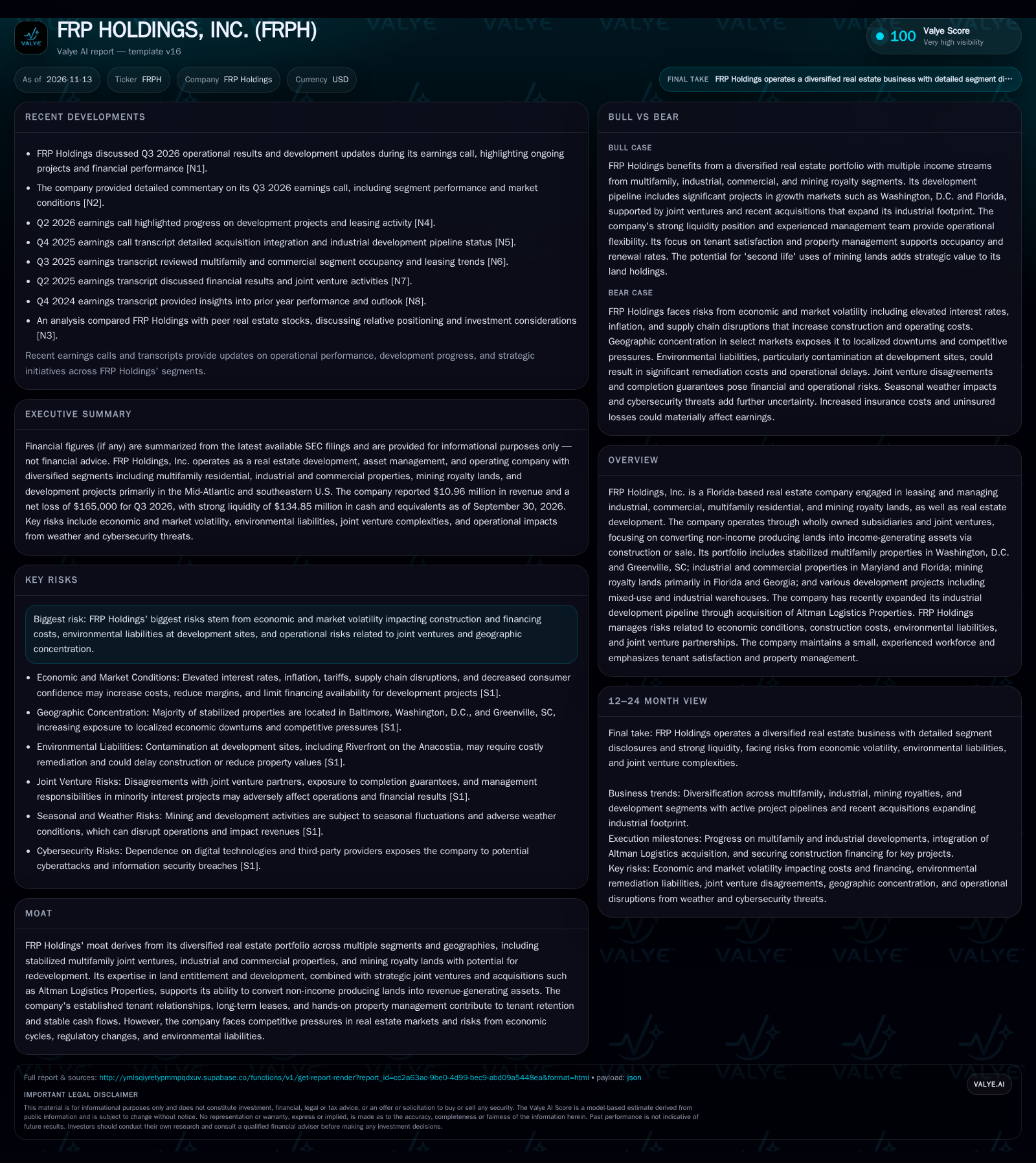
FRP Holdings operates across multifamily, industrial, mining royalty, and development segments, reporting $10.96 million in Q3 2026 revenue and a modest net loss. Recent acquisitions expand its industrial pipeline, but earnings remain susceptible to economic cycles, environmental liabilities, and joint venture execution. [S2]
FRP Holdings stands at a crossroads of opportunity and risk. With a diversified real estate portfolio spanning multifamily, industrial, mining royalty, and development assets, the company leverages both stabilized income and the potential for value creation through new projects and land conversions. However, recent results show that this diversification does not insulate FRP from the realities of cyclical markets, rising construction and insurance costs, and localized economic or regulatory shocks.
Recent Financials and Portfolio Moves: FRP’s Position as of Q3 2026
FRP Holdings reported $10.96 million in revenue and a net loss of $165,000 for the quarter ending September 30, 2026, with basic and diluted EPS of -$0.01. This modest loss highlights the thin margin environment and the drag from development-stage assets as the company pursues new projects. [S2]
The company’s liquidity position is notable, with $134.85 million in cash and equivalents and a cash ratio of 7.18. This provides a buffer for ongoing development and acquisition activities, as well as flexibility in the face of market volatility. [S2]
Recent strategic moves include the acquisition of Altman Logistics Properties, which adds a pipeline of industrial warehouse projects in Florida. This expands FRP’s exposure to the logistics and distribution sector, but also increases development and execution risk as the company integrates new assets and joint ventures. [S1] [S2]
FRP’s mining royalty lands segment continues to generate stable income from long-term leases with major tenants such as Vulcan Materials and Martin Marietta, but remains exposed to fluctuations in construction activity and weather disruptions. [S1] [S2]
How FRP Monetizes Assets: Income Streams, Development Returns, and Capital Allocation
FRP’s business model blends stabilized rental income, royalty revenue, and development-driven value creation. The multifamily and industrial/commercial segments generate recurring cash flows from leased properties, with typical lease terms of 12–15 months (residential), 10–15 years (retail), and 3–10 years (warehouse/office), the latter often on triple net terms. This structure shifts some operating and capital expense risk to tenants, supporting margin stability in mature assets. [S2]
Mining royalty lands offer high-margin, low-capex income, with revenue tied to tenant extraction volumes and underlying construction demand. However, this segment is cyclical—mining royalties rise and fall with regional building activity and infrastructure investment, and are also subject to weather variability.
Development is the most capital- and risk-intensive activity. FRP either converts owned land into income-producing assets via construction (sometimes in joint ventures) or sells/partners at various stages of entitlements. Returns can be substantial if projects lease up or sell into strong markets, but upfront costs, regulatory hurdles, and timeline risk are significant. Recent acquisitions add both potential for scale and further capital commitments.
Operating leverage is moderate in the stabilized segments, where incremental occupancy and rent growth can flow through to the bottom line once fixed costs are covered. In contrast, the development pipeline introduces lumpiness and potential negative leverage if projects are delayed, over budget, or fail to achieve target rents/sales prices.
Positioning Among Real Estate Peers: Diversification Versus Concentration Risk
FRP’s multi-segment model offers some insulation against single-segment downturns, as mining royalties and stabilized multifamily/industrial assets can offset development volatility. However, the company’s geographic footprint is highly concentrated in the Mid-Atlantic and southeastern U.S., with particular exposure to Baltimore, Washington, D.C., and Greenville, SC. This can amplify the impact of local economic cycles, competitive supply, or regulatory changes. [S1]
In the industrial/warehouse sector, FRP competes with both national REITs and regional developers. Recent moves to expand its logistics footprint in Florida place it in a more competitive, capital-intensive environment, where scale, tenant relationships, and development execution are critical. Larger peers may have advantages in cost of capital, tenant pipeline, and diversification.
The mining royalty segment faces few direct substitutes, but its fortunes are tied to the construction sector’s health. Multifamily assets compete with both institutional and local landlords, with differentiation hinging on location, property quality, and management effectiveness.
FRP’s hands-on property management and long-standing tenant relationships can support retention and renewal rates, but the lack of national scale and concentration in a few metro areas remain structural vulnerabilities. Environmental liabilities and project complexity could further erode competitive standing if not managed proactively.
Unlocking Value Through Successful Development and Strategic Asset Recycling
The most favorable outcome for FRP would be a scenario in which recently acquired and existing development projects are delivered on time and on budget, leasing up into strong markets with robust tenant demand, particularly in industrial/logistics assets. This would allow the company to recycle capital from stabilized or mature assets into higher-yielding opportunities, compounding returns and supporting earnings growth.
Mining royalty income could remain resilient or even grow if infrastructure and construction activity in Florida and Georgia remains robust, supporting stable base cash flow.
Evidence confirming this scenario would include: sustained increases in development segment revenues and margins; successful lease-up of new industrial and multifamily projects; asset sales or refinancings at attractive valuations; and continued high occupancy rates in stabilized segments. Disclosure of above-market rent growth, low vacancy, and strong tenant retention in new properties would further validate the upside thesis.
Falsification would be signaled by persistent construction delays, cost overruns, or inability to achieve targeted rents and occupancy in new projects, as well as a stall or decline in mining royalty income unrelated to one-off weather events.
Managing Through Cycles: Modest Growth Amid Execution and Market Volatility
A middle-ground outcome would see FRP maintaining stable to modestly growing recurring income streams from its multifamily, industrial, and mining royalty segments, while managing development risk such that new projects are delivered, but with some delays or margin compression due to elevated construction and insurance costs.
Confirmation of this scenario would be reflected in steady, incremental revenue growth in core segments, moderate net income volatility tied to development completion timing, and manageable increases in operating expenses. Continued disclosure of joint venture activity and progress on major projects would support the plausibility of this outcome.
The scenario would be invalidated by a sharp drop in occupancy, unexpected remediation costs, or a material decline in mining royalty income due to broader construction market weakness.
Development Missteps, Localized Downturns, and Hidden Liabilities Derail Returns
The adverse scenario for FRP involves a combination of development setbacks (delays, cost overruns, or regulatory hurdles), environmental remediation costs at key sites (such as Riverfront on the Anacostia), and localized economic downturns in its core markets that drive down occupancy, rental rates, and property values.
Joint venture disagreements or failures could force FRP to assume completion guarantees or additional capital commitments at unattractive terms, further pressuring margins. A sustained downturn in regional construction could cut into mining royalty revenues, while rising insurance costs or uninsured losses could erode earnings.
Confirmation of this scenario would come from repeated quarterly losses, large write-downs or impairment charges, negative cash flow from operating and development activities, and disclosures of material environmental or legal liabilities. A sharp drawdown of cash reserves without corresponding income-generating asset growth would also be a warning sign.
Falsification would be seen if, despite macro or project-specific shocks, FRP maintains stable occupancy, controls development costs, and avoids major environmental or JV-related setbacks.
Operational and Strategic Markers That Will Shape FRP’s Value Trajectory
Quarterly progress on development timelines and budgets for new industrial and multifamily projects—delays or cost overruns would test the thesis.
Occupancy rates, rent roll, and lease renewal activity in stabilized multifamily and industrial segments—especially in Baltimore, D.C., and Greenville—if disclosed.
Mining royalty revenue trends and tenant volumes, particularly as indicators of regional construction activity—disclosure of volume-based royalty payments would help test the thesis.
Environmental remediation costs and status updates at sites such as Riverfront on the Anacostia—new liabilities or regulatory actions would be material.
Joint venture performance, including partner disputes, completion guarantees, or recapitalizations—disclosure of JV outcomes would clarify risk.
Cash deployment into new projects versus cash flow from operating activities—sustained outflows without income growth would be a warning sign.
Insurance cost inflation and any disclosure of uninsured losses or claims—material increases could impact margins.
Disclaimer: This is research-only, informational analysis and not investment advice. It may include AI-generated interpretation and general industry context. Always verify important details using primary sources.

Comments