
Verrica Pharmaceuticals: Dermatology Commercialization, Pipeline Leverage, and the Challenge of Scaling a Single-Asset Launch
With the U.S. launch of YCANTH for molluscum contagiosum and a global Phase 3 program for common warts underway, Verrica faces the commercial realities of specialty pharma: translating clinical assets into durable revenue, managing liquidity under debt covenants, and broadening its pipeline beyond a single approved product.
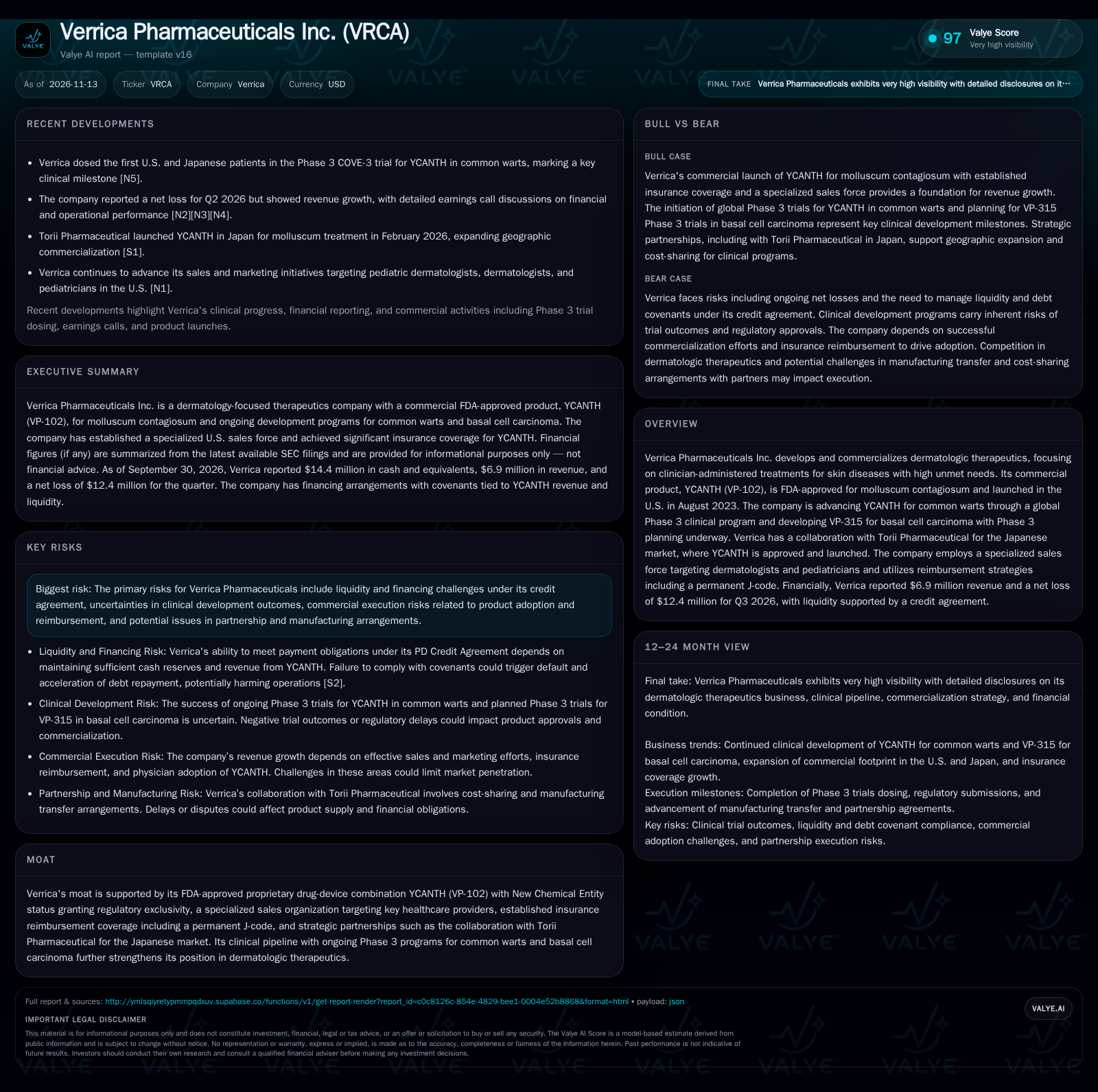
Verrica Pharmaceuticals has commercialized YCANTH for molluscum contagiosum, reporting $6.9 million in Q3 2026 revenue but a $12.4 million net loss. The company is pursuing label expansion for YCANTH in common warts (Phase 3 ongoing) and developing VP-315 for basal cell carcinoma. A permanent J-code and broad U.S. reimbursement support adoption, while a Japanese launch via Torii Pharmaceutical expands its footprint. [S1] [S2] [N5]
Verrica Pharmaceuticals stands at a pivotal juncture: its first commercial launch, YCANTH for molluscum contagiosum, is in market with broad reimbursement and a targeted sales force, but the company continues to report substantial net losses as it invests in marketing, pipeline advancement, and international expansion. The next phase of value creation hinges on scaling adoption in the U.S., securing label expansion into common warts, and advancing its oncology asset VP-315. Meanwhile, Verrica must manage liquidity amid operational losses and comply with revenue-linked debt covenants. The question for investors is whether the company can make the leap from a niche single-product firm to a sustainable dermatology platform with pipeline leverage and commercial momentum.
YCANTH Commercialization and Pipeline Progress Define Near-Term Trajectory
The most material current facts shaping Verrica’s outlook are: (1) YCANTH (VP-102) is FDA-approved, fully launched in the U.S. for molluscum contagiosum, and supported by a permanent J-code and insurance coverage for approximately 250 million lives [S1]; (2) Q3 2026 revenue reached $6.9 million, but net losses continue ($12.4 million for the quarter), with $14.4 million in cash and equivalents at quarter-end [S2]; (3) The Phase 3 clinical program for YCANTH in common warts has dosed its first U.S. and Japanese patients, expanding the addressable market [N5] [S1]; and (4) VP-315 for basal cell carcinoma has shown positive Phase 2 data and is advancing toward pivotal testing [S1].
These facts matter because they mark the transition from development to commercial execution, test the scalability of Verrica’s business model, and set up binary clinical catalysts over the next 12-24 months. The company’s financial condition and credit agreement covenants heighten the importance of commercial ramp and clinical progress.
How Verrica’s Model Could Scale: Pricing, Volume, and the Leverage of Label Expansion
Verrica’s current economics are anchored in a specialty pharmaceutical model: a single, proprietary, clinician-administered product (YCANTH) targeting a high-unmet-need dermatologic indication. The company relies on a 40-person field sales force and reimbursement strategies—including a permanent J-code—to drive adoption among dermatologists, pediatricians, and select primary care providers [S1].
Revenue potential is a function of addressable patient volume (millions annually for molluscum and common warts), pricing (typically premium for in-office, procedure-based therapies), and breadth of insurance coverage. However, the revenue base remains narrow: $6.9 million in Q3 2026, against a quarterly net loss of $12.4 million [S2].
Operating leverage is possible if sales scale faster than fixed commercial and R&D expenses, but the path is not assured. Expansion into common warts—if Phase 3 is successful—could roughly double the addressable market, with similar sales infrastructure and potentially higher margin contribution from incremental volume. Pipeline assets like VP-315 for BCC offer future optionality, but require additional investment and carry clinical risk.
The company’s capital needs are notable: ongoing net losses, active clinical trials, and minimum liquidity covenants under a $27.5 million credit facility [S2]. Near-term cash burn and debt compliance will likely dictate the pace of investment in commercial and clinical activities unless offset by accelerated revenue growth or additional financing.
Defensible Niche or Easily Replicated Play? Barriers and Substitution Risk in Dermatologic Therapeutics
Verrica’s competitive position is built on YCANTH’s proprietary drug-device combination, New Chemical Entity status, and regulatory exclusivity in the U.S. for molluscum contagiosum [S1]. The permanent J-code and broad payor coverage are meaningful advantages, reducing friction for physician adoption.
However, the moat is not absolute. While there are no other FDA-approved treatments for molluscum, off-label use of other therapies and procedural interventions (curettage, cryotherapy, topical agents) remain widespread. If YCANTH’s ease of use, efficacy, and reimbursement prove superior, switching costs and clinical inertia could work in Verrica’s favor. Otherwise, clinicians may revert to familiar, if suboptimal, alternatives.
In warts and basal cell carcinoma, competition is fiercer. Numerous topical and procedural treatments exist for warts, and the BCC market is crowded with established therapies for both localized and advanced disease. The key will be demonstrating clear clinical and economic advantages—such as higher clearance rates, better safety, or lower total cost—for YCANTH and VP-315 in these follow-on indications.
Partnerships, such as the collaboration with Torii Pharmaceutical for Japan, offer geographic diversification and shared commercialization risk, but also introduce counterparty execution and manufacturing transfer risks.
A Winning Formula: Clinical Success, Rapid Adoption, and Multi-Asset Expansion
In a favorable outcome, Verrica successfully scales YCANTH for molluscum, leveraging its sales force, J-code, and insurance coverage to accelerate adoption. Phase 3 data in common warts are positive, enabling a label expansion that meaningfully increases the addressable market with minimal incremental commercial cost. VP-315 advances smoothly into Phase 3 and demonstrates compelling efficacy and safety, opening a new, high-value oncology franchise.
Japanese sales via Torii Pharmaceutical ramp, providing a non-dilutive revenue stream and international validation. The company manages cash burn and meets all credit covenants, possibly accessing further tranches of debt or securing non-dilutive capital through milestones and royalties.
Evidence confirming this scenario would include: (1) sequential revenue acceleration for YCANTH in the U.S.; (2) strong patient and prescriber uptake in Japan; (3) positive, statistically significant Phase 3 results for YCANTH in warts; (4) successful advancement of VP-315 into pivotal studies; and (5) continued compliance with debt covenants and reported liquidity position without dilutive equity raises.
Incremental Growth as Commercial Realities Temper Pipeline Ambitions
The most plausible near-term path is moderate growth for YCANTH as the sales force continues to penetrate the U.S. market for molluscum, but adoption is gradual due to entrenched physician habits and reimbursement bottlenecks. The Phase 3 program for common warts progresses, but regulatory approval and launch remain 18-24 months away, so incremental revenue contribution is limited in the interim.
VP-315 advances into Phase 3, but enrollment and cost pressures extend timelines and increase cash burn. Japanese sales contribute modestly through the Torii partnership, but the domestic business remains the primary driver.
In this scenario, Verrica manages to comply with credit facility covenants—helped by steady, if unspectacular, revenue growth—but must carefully ration investment across commercial and clinical activities. Any acceleration in ramp or new clinical data could shift the trajectory up or down.
Evidence supporting this scenario would be steady but unspectacular sequential revenue growth, continued net losses and modest cash burn, ongoing clinical enrollment without major setbacks, and maintenance of minimum liquidity and revenue requirements under the credit agreement.
Liquidity Constraints and Clinical Setbacks Undermine the Commercial Platform
The adverse chain begins with slower-than-expected YCANTH uptake—perhaps due to physician reluctance, reimbursement barriers, or the persistence of off-label alternatives—which limits top-line growth and accelerates cash depletion. If Phase 3 trials for common warts or VP-315 in BCC deliver negative or equivocal results, the company loses its most credible pipeline catalysts.
Failure to meet revenue or liquidity covenants under the $27.5 million credit agreement could trigger a default, forcing operational retrenchment, asset sales, or dilutive recapitalization. Manufacturing or partnership challenges, particularly in the Japanese collaboration, could exacerbate supply or cash flow strains.
Evidence of this downside would include: (1) flat or declining YCANTH sales in the U.S.; (2) negative or inconclusive Phase 3 trial results; (3) missed debt covenants and urgent financing actions; and (4) operational cutbacks or restructuring announcements.
Milestones to Clarify Verrica’s Transition from Single-Asset to Platform Play
Quarterly U.S. YCANTH sales growth: Sequential acceleration would demonstrate commercial momentum; stall or contraction would signal adoption challenges.
Enrollment progress and data readouts for the Phase 3 common warts trial: Positive interim or topline results would be a key inflection point.
Updates on VP-315’s advancement into and through Phase 3 for BCC: A useful metric would be enrollment pace, trial design clarity, and early safety/efficacy signals.
Cash burn rate and quarter-end liquidity: Monitoring whether the company can maintain liquidity above the $5 million credit agreement minimum, if disclosed.
Compliance with YCANTH revenue-linked debt covenants: Any breach or risk of breach would materially affect potential financial flexibility.
Japanese sales and milestone payments from the Torii partnership: Evidence of meaningful non-U.S. revenue contribution would test the geographic expansion thesis.
Physician adoption and payer reimbursement trends for YCANTH: Metrics such as formulary additions, prior authorization rates, or claims data (if disclosed) would help gauge market penetration.
Regulatory and manufacturing updates related to the Japanese commercialization and any manufacturing transfer arrangements: Delays or quality issues would increase operational risk.
Disclaimer: This is research-only, informational analysis and not investment advice. It may include AI-generated interpretation and general industry context. Always verify important details using primary sources.

Comments