
Lument Finance Trust: High-Yield CRE Debt Strategy Faces Earnings Headwinds and Sectoral Risk
Lument Finance Trust’s focus on floating-rate, middle-market multifamily loans delivers high yields but exposes it to credit, interest rate, and refinancing risks—recent net losses and elevated preferred yields highlight both the income promise and the structural vulnerabilities of its leveraged REIT model.
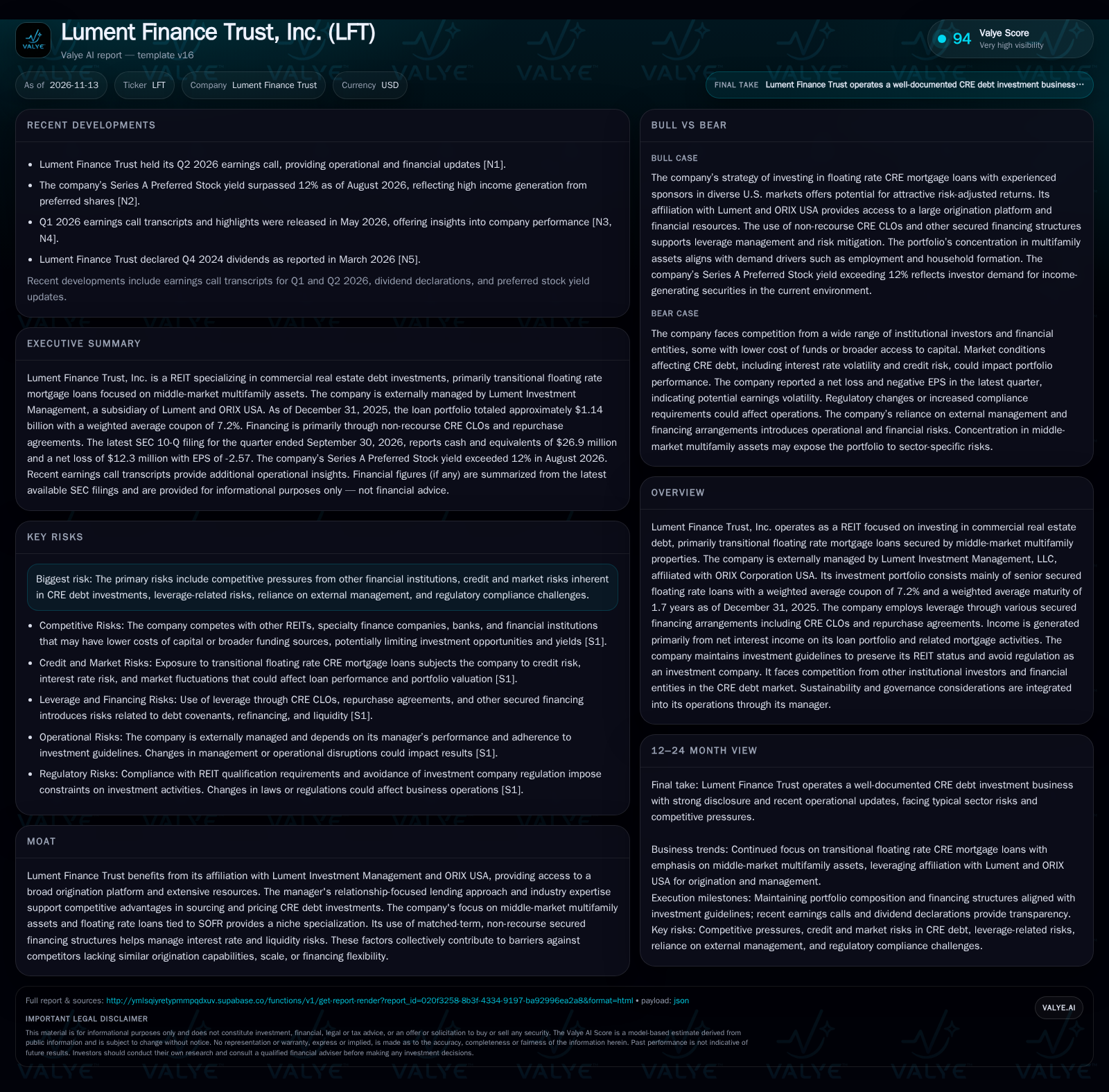
Lument Finance Trust operates as a CRE debt REIT with a $1.14B floating-rate loan portfolio heavily concentrated in multifamily assets, leveraging non-recourse CLOs and repurchase agreements for funding. Despite access to origination scale via ORIX, the company reported a $12.3M net loss in Q3 2026, and its Series A Preferred Stock yield exceeded 12% in August 2026, flagging market concerns over risk and earnings power. The model’s reliance on short-duration, floating-rate loans and external management offers both flexibility and exposure to sectoral and refinancing risks.
Lument Finance Trust, Inc. is a REIT specializing in transitional, floating-rate commercial real estate mortgage loans, with a sharp focus on middle-market multifamily assets. The company’s $1.14 billion loan portfolio is highly levered and almost entirely floating-rate, financed predominantly through non-recourse CRE CLOs and secured repo lines. While the model is built for yield and flexibility, recent results—a $12.3 million net loss in Q3 2026 and a preferred stock yield over 12%—underscore the inherent trade-offs: attractive income potential comes with pronounced earnings volatility, refinancing risk, and sectoral concentration. As the CRE debt market remains turbulent, Lument’s ability to navigate credit performance and funding costs will be decisive for forward returns.
Recent Results Reveal Tensions Between Yield and Volatility
Lument Finance Trust’s latest filings show a portfolio of 61 senior secured floating-rate loans with an aggregate unpaid principal balance of $1.14 billion and a weighted average coupon of 7.2% as of December 31, 2025. The portfolio’s average term to maturity is just 1.7 years, and 92.7% of loans are backed by multifamily properties [S1]. This high concentration in a single asset class and short loan duration amplifies sensitivity to sector trends and refinancing cycles.
As of September 30, 2026, the company reported $26.9 million in cash and cash equivalents, but posted a net loss of $12.3 million for the quarter, translating to a basic and diluted EPS of -2.57 USD [S2]. Notably, the Series A Preferred Stock yield surpassed 12% as of August 2026, a level that signals market skepticism about the risk-return profile and sustainability of distributable income [N2].
Leverage remains a core feature, with $997 million in outstanding secured financing (including non-recourse CRE CLOs and repos) as of year-end 2025 [S1]. The interplay between high portfolio yields, funding costs, and credit performance is now at the forefront as earnings volatility and capital market risk intensify.
How Lument Finance Trust Generates—and Risks—Income
Lument’s business model is built around net interest income: it originates or acquires senior secured floating-rate CRE loans, typically with three-year terms and extension options, and funds these assets with a combination of equity and secured debt. The spread between loan yields (7.2% weighted average coupon as of December 2025) and the cost of funds determines core profitability [S1].
Floating-rate structures tie both portfolio income and funding costs to short-term benchmarks (primarily SOFR or replacements). In a rising rate environment, this can protect net interest margins—provided that loan coupons reset faster or more fully than funding costs, and that borrowers can absorb higher debt service. However, volatility in short-term rates or sudden credit deterioration can quickly erode margins and trigger losses.
Leverage is high—portfolio financing stood at $997 million versus $1.14 billion in loans at the end of 2025 [S1]—reflecting a REIT model designed to amplify returns but also exposing the company to refinancing and covenant risks. Because loan durations are short and asset turnover is high, recurring reinvestment and refinancing events are routine, making the business more sensitive to market liquidity and borrower performance than a longer-duration, fixed-rate mortgage REIT.
Externally managed by Lument Investment Management (an ORIX subsidiary), the company pays management and incentive fees, which can dilute returns to common shareholders, especially in weaker earnings periods. The external model may also create agency issues around risk appetite, reinvestment pace, and cost discipline.
Competitive Dynamics in Transitional CRE Lending
Lument Finance Trust operates in a crowded field of institutional CRE debt providers, including other REITs, specialty finance companies, banks, and private credit funds. Many of these competitors have access to lower-cost funding, broader origination networks, or greater flexibility in asset selection.
The company’s affiliation with Lument and ORIX USA is a double-edged sword: it offers origination scale and market intelligence, but also imposes external management costs and potentially limits strategic flexibility [S1]. The focus on floating-rate, middle-market multifamily loans provides a niche, but not a proprietary moat—other lenders can and do compete aggressively in this segment, particularly when capital is abundant.
Barriers to entry in transitional CRE lending include expertise in underwriting transitional assets, strong sponsor relationships, and access to structured financing (CLOs, repos, warehouses). However, these are not insurmountable, and periods of market stress often see new entrants, especially from private credit funds seeking higher yields.
Threats from substitutes—such as direct bank lending, agency multifamily lending, or non-bank private credit—can compress spreads or siphon off higher-quality borrowers. The short-term, floating-rate loan structure also means that Lument must continually reprice risk and compete for new origination at every loan turnover.
If Credit Holds and Rates Stabilize, Earnings Power Could Recover
An upside scenario for Lument Finance Trust centers on stabilization in short-term interest rates and resilient credit performance among its multifamily borrowers. If floating-rate loan yields remain elevated while funding costs plateau or recede, net interest spreads could widen, improving distributable earnings and restoring confidence in common and preferred share payouts.
Credit stability is crucial: if transitional property borrowers can refinance, stabilize assets, and avoid defaults, loan losses and provisioning would remain contained. The company’s affiliation with Lument and ORIX could enable it to selectively originate higher-quality loans and recycle capital into attractive risk-adjusted opportunities.
Confirmation of this scenario would come through a return to positive net income, narrowing or positive EPS, and declining preferred yields (signaling reduced perceived risk).
Falsification would be evident in further net losses, rising credit impairments, or continued market skepticism reflected in persistently high preferred yields.
Most Likely: Elevated Volatility and Modest Earnings Amid Sectoral Pressures
The most plausible path is continued volatility in both earnings and market sentiment. Transitional CRE markets are likely to remain unsettled, with refinancing risk and asset value uncertainty weighing on both loan performance and origination activity. Lument’s earnings may swing between modest profits and losses, depending on the interplay of credit outcomes, funding costs, and fee drag from external management.
Portfolio turnover will remain high, with frequent reinvestment needs and ongoing competition for new loans. The multifamily focus may provide some cushion, as rental housing demand is typically more resilient than other CRE sectors, but localized oversupply or borrower distress could still drive impairments.
Confirmation would involve stabilization of net interest margins, manageable credit losses, and continued access to secured funding channels. Falsification would come from a sustained rise in non-performing loans, inability to refinance portfolio assets, or a structural widening between loan yields and funding costs that erodes core earnings.
Adverse Credit Cycle or Funding Disruption Could Undermine Solvency
A negative scenario would unfold if a downturn in the multifamily CRE market triggers a spike in borrower defaults, property value declines, and loan losses across the portfolio. Because the company is highly levered and reliant on short-term, secured financing, any material credit impairment could rapidly erode book value and threaten compliance with debt covenants.
A simultaneous tightening of capital markets—making repo, warehouse, or CLO refinancing more expensive or unavailable—would further stress liquidity and could force asset sales at distressed prices. External management fees would continue to be paid, even as returns to common shareholders evaporate.
Evidence confirming this scenario would include a sharp rise in non-performing loans, realized credit losses, distressed asset sales, or a dividend suspension. Persistent negative EPS and further widening of preferred yields would indicate deepening market concern over solvency and income stability.
Falsification of this scenario would require clear evidence of credit containment, stable refinancing access, and a return to positive distributable earnings.
Factors That Could Reshape Lument’s CRE Debt Thesis
Quarterly net interest margin trends, as reported in earnings calls, will be essential to gauge the sustainability of core profitability.
Credit performance metrics—specifically, non-performing loan ratios and realized credit losses—would help test the resilience of the loan book if disclosed.
Trends in Series A Preferred Stock yield: a declining yield could signal reduced risk perception, while sustained elevation would indicate persistent market skepticism.
Portfolio turnover and new loan origination volume: would reveal the company’s ability to source and recycle capital into attractive opportunities.
Funding cost disclosures and refinancing activity on repo, warehouse, and CRE CLO facilities: any tightening or disruption would be a material negative.
External management fee levels and any changes in fee structure: a useful metric would be the ratio of management/incentive fees to core earnings, if disclosed.
Loan-to-value (LTV) and debt service coverage (DSCR) statistics for the portfolio, if disclosed, would illuminate underlying collateral quality and borrower resilience.
Disclaimer: This is research-only, informational analysis and not investment advice. It may include AI-generated interpretation and general industry context. Always verify important details using primary sources.

Comments