
Medalist Diversified REIT: Capital Deployment, Regulatory Flexibility, and the Challenge of Strategic Repositioning
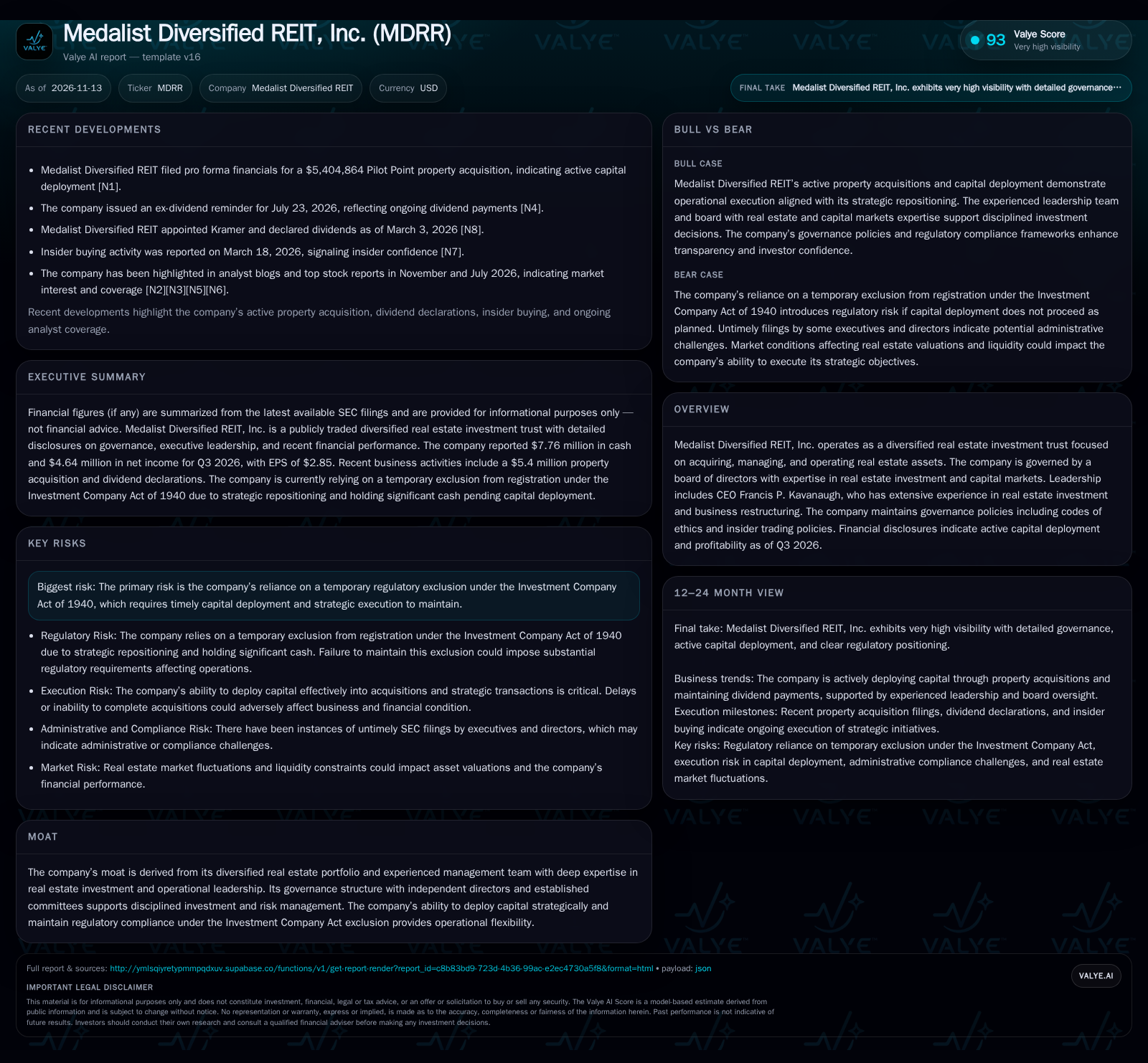
Medalist Diversified REIT is executing an active capital deployment strategy amid a critical regulatory transition, leveraging experienced leadership and board oversight. The company’s recent property acquisition and profitability highlight operational momentum, but its reliance on a temporary Investment Company Act exclusion and the imperative to convert cash into productive assets create a high-stakes environment for both risk and opportunity.
Medalist Diversified REIT is in a transitional phase, deploying significant cash into new acquisitions while temporarily relying on a regulatory exclusion that demands swift execution. The company’s recent profitability, dividend continuity, and insider buying point to operational momentum, but its future rests on the pace and quality of capital deployment and the ability to maintain compliance as a diversified REIT rather than an investment company. Market conditions and execution risks will define the next chapter.
Medalist Diversified REIT stands at a pivotal crossroads, balancing a reported cash position and recent profitability with the urgent need to redeploy capital into real estate assets. The company’s active acquisition of the Pilot Point property and continued dividends demonstrate operational momentum, but its reliance on a temporary regulatory exclusion underscores both opportunity and risk. The effectiveness of this strategic repositioning, overseen by a board with robust real estate expertise, will determine whether Medalist can sustain its momentum—or face regulatory headwinds and execution pitfalls.
Recent Profitability, Acquisitions, and Regulatory Status Define the Moment
As of Q3 2026, Medalist Diversified REIT reported $4.64 million in net income and $2.85 in basic and diluted EPS, with cash and cash equivalents totaling $7.76 million [S2]. This profitability coincides with an active capital deployment initiative, highlighted by the $5.4 million acquisition of the Pilot Point property [N1].Insider transaction activity was reported in the cited source; this activity does not by itself establish insider confidence. [N4] [N7] Critically, Medalist is operating under a temporary exclusion from registration as an investment company under the Investment Company Act of 1940, due to its current capital structure and strategic repositioning [S2]. This creates both a window of flexibility and a ticking clock for capital deployment. The company’s ability to exit this regulatory limbo and re-assert its status as a traditional diversified REIT will be decisive for its future trajectory.
How Asset Mix, Capital Deployment, and Yield Drive Value Creation
REIT economics fundamentally hinge on the spread between property yields and the cost of capital, amplified by leverage and the efficiency of capital deployment. Medalist’s current business model is defined by a large cash position and the imperative to convert that cash into income-generating real estate assets. The $5.4 million Pilot Point acquisition is a concrete example of this process, but the company’s ability to replicate such deals at attractive cap rates will determine its long-term distributable cash flow.
With relatively few shares outstanding (1.43 million as of December 2025) [S1], per-share economics are highly sensitive to both acquisition quality and dilution. Dividend payments and reported net income provide evidence of some positive spread in the current portfolio, but the sustainability of these metrics depends on redeployment speed and the avoidance of cash drag. If capital is not quickly and efficiently invested, yield on assets can fall below the implicit hurdle rate required for REIT status, especially given the regulatory pressure to avoid classification as an investment company.
Operating leverage is structurally limited in REITs due to the capital-intensive nature of real estate, but scale can drive modest G&A efficiency. Medalist’s board and management composition suggest a focus on disciplined investment, but the economics will ultimately be determined by asset-level returns, acquisition timing, and the ability to maintain or grow the dividend without overextending the balance sheet.
Competing for Assets and Capital in a Crowded Real Estate Landscape
Medalist Diversified REIT operates in a highly competitive real estate investment environment, vying for attractive properties against other public and private REITs, institutional investors, and increasingly, alternative asset managers. The company’s relatively small size and recent repositioning mean it must compete on agility, niche expertise, or relationship-driven deal flow rather than scale.
Diversification across property types can provide some insulation from sector-specific downturns, but it also requires deep domain knowledge and the ability to underwrite a range of asset classes. Larger peers may have advantages in cost of capital, access to off-market deals, and operational synergies. Medalist’s board includes independent directors with real estate and investment expertise, supporting a disciplined approach, but the company’s competitive edge will likely depend on its ability to identify and close on overlooked or mispriced assets before larger players.
A key risk is the potential for asset price inflation or yield compression as capital floods into real estate, raising the bar for accretive acquisitions. Conversely, market dislocation or distress could create opportunities for nimble buyers—if Medalist can move quickly and manage risk.
Accelerated Capital Deployment Unlocks Sustainable Dividend Growth
In a favorable scenario, Medalist rapidly redeploys its cash into high-yielding, well-underwritten properties, maintaining or increasing its current dividend while boosting net income. The Pilot Point acquisition is followed by additional deals with similarly attractive economics, and the company exits its temporary regulatory exclusion on schedule, reaffirming its REIT status without triggering Investment Company Act registration.
This outcome could be confirmed by a series of timely acquisition announcements, rising property-level cash flow, and stable or improving dividend coverage ratios. If the company demonstrates consistent asset growth, maintains low administrative overhead, and avoids significant share dilution, investors may reward the stock with a higher valuation multiple. Evidence of successful capital recycling or opportunistic asset sales at a profit would further validate the thesis.
Disciplined But Measured Redeployment Amid Market Volatility
The most plausible path forward is one of steady but cautious capital deployment: Medalist completes several additional acquisitions at reasonable cap rates, gradually reducing its cash position while maintaining regulatory compliance.
The company remains profitable, but net income and per-share metrics fluctuate quarter to quarter depending on deal timing and asset performance. Administrative challenges persist but do not materially disrupt operations. A lack of major regulatory developments or compliance setbacks would further support this narrative.
Delayed Deployments and Regulatory Headwinds Threaten Momentum
In a negative scenario, Medalist faces delays or difficulties in deploying its cash, either due to a lack of attractive assets or competitive bidding driving down yields. Prolonged cash drag erodes net income and puts pressure on the dividend, while the company’s reliance on the temporary Investment Company Act exemption becomes increasingly precarious.
If capital is not redeployed within the regulatory timeline, the company may be forced to register as an investment company, triggering additional compliance burdens and potentially restricting its real estate operations. Administrative missteps or untimely filings could compound these risks. Confirmation of this scenario would include stagnant or declining earnings, warnings about regulatory deadlines, dividend cuts, or a shift in strategic messaging toward defensive measures. Disclosures about failed or abandoned acquisitions would also be red flags.
What Will Determine Whether Medalist’s Transition Succeeds
Pace and scale of property acquisitions: Frequent and sizable acquisition announcements would signal successful capital deployment and progress toward a fully invested balance sheet.
The company reported profitability for the period.
Cash and cash equivalents trend: Monitoring the reduction of cash balances in favor of income-producing assets will indicate execution on the redeployment plan.
Regulatory disclosures regarding Investment Company Act status: Updates on the company’s exemption, timeline, or any shift in status would be critical for risk assessment.
Net income and per-share earnings: Quarterly trends will reveal whether asset additions are accretive and whether profitability is sustainable.
Insider transactions: Additional insider buying (or selling) could provide insight into management’s confidence in the current strategy.
Board and management changes: New appointments or departures, especially among directors with real estate or compliance expertise, may signal shifts in strategic direction.
Administrative or compliance disclosures: Any untimely filings or SEC communications would warrant scrutiny for potential operational risks.
Disclaimer: This is research-only, informational analysis and not investment advice. It may include AI-generated interpretation and general industry context. Always verify important details using primary sources.

Comments