
Caring Brands, Inc.: Patent-Fortified Wellness Pipeline Seeks Commercial Traction Beyond Early-Stage Revenue
Despite a robust patent portfolio and recent capital infusions, Caring Brands, Inc. faces the critical challenge of converting its clinically-supported wellness products into meaningful revenue streams. The company's international licensing and product relaunch plans set the stage for a pivotal period, with execution on US commercialization, regulatory navigation, and market adoption as the primary levers for future value creation.
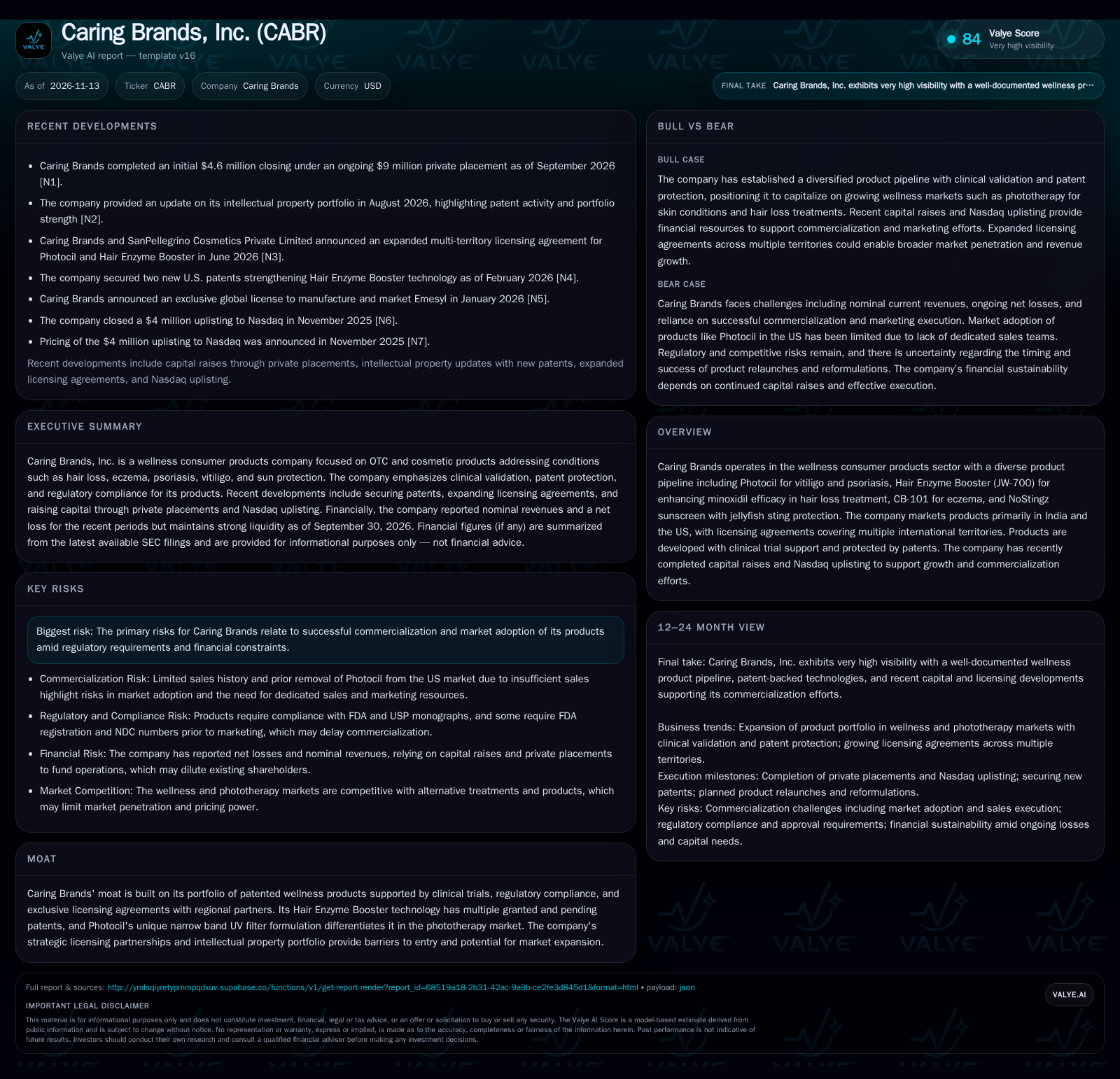
Caring Brands, Inc. develops and licenses wellness products for hair loss, skin conditions, and sun protection, emphasizing clinical validation and patent protection. Recent capital raises and new licensing agreements have reinforced its financial and strategic position, but tangible revenues remain minimal. The company’s near-term trajectory will hinge on successful commercialization of its pipeline—particularly US relaunches and international expansion—against a backdrop of reported liquidity position and ongoing net losses. [S1] [S2] [N1] [N3]
Caring Brands, Inc. stands at a strategic inflection point: its diverse portfolio of clinically-backed, patent-protected wellness products is matched by a reported liquidity position and expanding international licensing footprint. Yet, the company’s actual revenue generation has been negligible, with recent launches and US market entries failing to gain commercial traction. As Caring Brands prepares for new product relaunches and broader global expansion, the next 12-24 months will test whether its intellectual property, clinical credibility, and licensing model can translate into sustainable growth—or whether execution risks and market hurdles will continue to impede its path.
Liquidity Strength Meets Revenue Scarcity: The Present State of Caring Brands
The company reported cash and liquidity metrics for the period; these figures do not by themselves establish operating runway, investment capacity, financial flexibility, or financing capacity. However, revenue for the year ended December 31, 2025 was a nominal $4,215, and the company posted a net loss of $700,978 for the first nine months of 2026. [S2] Recent developments—including a $4.6 million private placement, new patent issuances, and expanded licensing agreements in Asia and beyond—suggest a focus on building future potential rather than harvesting current cash flows. [N1] [N3] [N4] [N5]
How Caring Brands Could Monetize: Product Mix, Licensing Leverage, and Commercial Hurdles
Caring Brands’ business model is anchored in the development, licensing, and commercialization of OTC and cosmetic wellness products targeting niche but persistent health needs—hair loss, eczema, psoriasis, vitiligo, and sun protection. The company’s economics could derive from a blend of direct sales (especially in the US and online channels), licensing/royalty streams from international partners, and potential milestone or upfront payments in sublicensing deals. However, the mechanics of these arrangements—including royalty rates, minimum purchase commitments, and exclusivity terms—are not disclosed, leaving the magnitude and timing of revenue uncertain.
The capital-light nature of licensing (with manufacturing and sales handled by partners) could allow for high-margin, recurring revenue if products gain traction. Conversely, direct commercialization—particularly in the US—entails higher fixed costs in sales, marketing, and regulatory compliance, with operating leverage materializing only if consumer adoption scales. The company’s focus on patent protection and clinical validation may support premium pricing and defensibility, but actual pricing power will depend on competitive alternatives and payer acceptance, especially for cosmetic and OTC categories where out-of-pocket spending dominates.
The current financials suggest the company is still in a pre-commercial or early-launch phase, with cash burn driven by R&D, regulatory, and partnership development rather than scaling sales operations. The company’s recent capital raises and Nasdaq uplisting provide funding flexibility, but repeated reliance on equity financing could dilute shareholders if commercial milestones are not met. [S2] [N1] [N6] [N7]
Defensibility in the Wellness Market: Patents, Partnerships, and the Challenge of Differentiation
Caring Brands’ moat is rooted in its expanding patent portfolio, clinical validation, and exclusive licensing relationships with regional players. The Hair Enzyme Booster (JW-700) now benefits from two new US patents, and the exclusive global license for Emesyl further broadens the company’s intellectual property footprint. [N4] [N5] This IP-centric strategy could deter direct competition and enable favorable licensing economics—if the products themselves prove compelling to consumers and partners.
However, the company operates in highly competitive, often fragmented OTC and cosmetic markets. For phototherapy and dermatology, alternatives span prescription drugs, generic topicals, and established consumer brands. For hair loss, minoxidil and finasteride are entrenched standards, and the incremental benefit of enzyme boosters must be proven at scale. Sun protection is crowded with both legacy brands and new entrants, where regulatory hurdles (e.g., FDA sunscreen guidelines) and consumer trust are significant barriers.
The critical test for Caring Brands is whether its clinical and regulatory rigor—combined with IP and regional partner reach—can carve out durable shelf space and consumer loyalty, or whether well-capitalized incumbents and fast followers will limit pricing power and adoption.
Unlocking Product-Market Fit: What a Commercial Breakthrough Would Look Like
In a favorable scenario, Caring Brands successfully relaunches Photocil in the US in 2026, this time with a dedicated sales and marketing team, resulting in measurable consumer uptake and repeat purchases. The Hair Enzyme Booster gains traction on Amazon and through international partners, supported by its patent-protected positioning and clinical claims. Licensing revenue from expanded agreements in Asia, Africa, and South America begins to contribute meaningfully to the top line, and new or reformulated products (CB-101, NoStingz) clear regulatory hurdles and enter the market without major delays.
Evidence that would confirm this scenario includes: sequential quarterly revenue growth, rising royalty or licensing income from international partners, positive updates on regulatory clearances and product launches, and third-party data or testimonials indicating consumer adoption. Announcements of new distribution partnerships, retailer listings, or digital channel traction would further validate commercial momentum. If the company demonstrates an ability to scale sales without proportionally increasing cash burn, operating leverage could emerge, supporting a path to profitability.
Bridging the Gap: Incremental Progress Amid Lingering Execution Risks
The most plausible trajectory is one of gradual, uneven progress: Caring Brands secures regulatory approvals and launches/relaunches products in targeted markets, but adoption ramps slowly as the company builds out sales infrastructure and brand awareness. Licensing agreements generate some royalty income, but the pace of international uptake is measured, with partners requiring time to establish local demand. Direct-to-consumer channels (e.g., Amazon) provide modest revenue streams, but do not immediately achieve critical mass.
Confirming evidence would include modest but consistent revenue growth, press releases on new partnerships or regulatory milestones, and controlled operating losses as investments in commercialization are phased. Falsifying evidence would be repeated product withdrawals, regulatory setbacks, or a need for additional dilutive capital raises without corresponding commercial progress.
Execution Stalls: When IP and Cash Are Not Enough
The adverse case centers on continued failure to achieve meaningful commercial traction. Photocil’s US relaunch could falter due to inadequate demand, regulatory complications, or ineffective marketing. International licensing partners may deprioritize the products if early sales are disappointing, resulting in minimal royalty flows. New or reformulated pipeline products could face regulatory delays, technical setbacks, or competitive responses that erode their value proposition.
Confirming evidence would include flat or declining revenue, repeated net losses with no improvement in gross margin, further product removals from key markets, or announcements of terminated or amended licensing agreements. If the company returns to the capital markets for new funding without having demonstrated progress toward commercialization, investor confidence and equity value could erode further.
Milestones That Will Define Whether Caring Brands Can Convert Promise Into Performance
Quarterly revenue growth, broken out by product and geography, especially evidence of US and international licensing income, would help test whether commercialization efforts are gaining traction.
Updates on the status and timing of the planned US relaunch of Photocil, including details on marketing spend, distribution agreements, and early consumer response, would clarify execution risk.
News of regulatory submissions, approvals, or setbacks for pipeline products (CB-101, NoStingz), as well as compliance with FDA or other relevant guidelines, will be critical for market entry.
Announcements of new or expanded licensing agreements, particularly those with minimum purchase commitments or upfront payments, would help gauge the potential for non-linear revenue growth.
Disclosure of royalty rates, unit volumes, or minimum guarantees in licensing contracts (if provided) would illuminate the economics of the company’s partnership model.
Evidence of consumer adoption and retention for Hair Enzyme Booster and Photocil—such as reorder rates, customer reviews, or third-party endorsements—would validate product-market fit.
Any changes in the competitive landscape, such as new generic entrants or regulatory changes impacting OTC/cosmetic market access, could materially alter the company’s opportunity set.
Disclaimer: This is research-only, informational analysis and not investment advice. It may include AI-generated interpretation and general industry context. Always verify important details using primary sources.

Comments