
Yinfu Gold Corporation: Navigating a Pre-Revenue Stalemate Amid Liquidity and Regulatory Pressures
Yinfu Gold Corporation remains a pre-revenue entity, reporting a net loss for the recent period and sustaining operations only through director and stockholder funding.
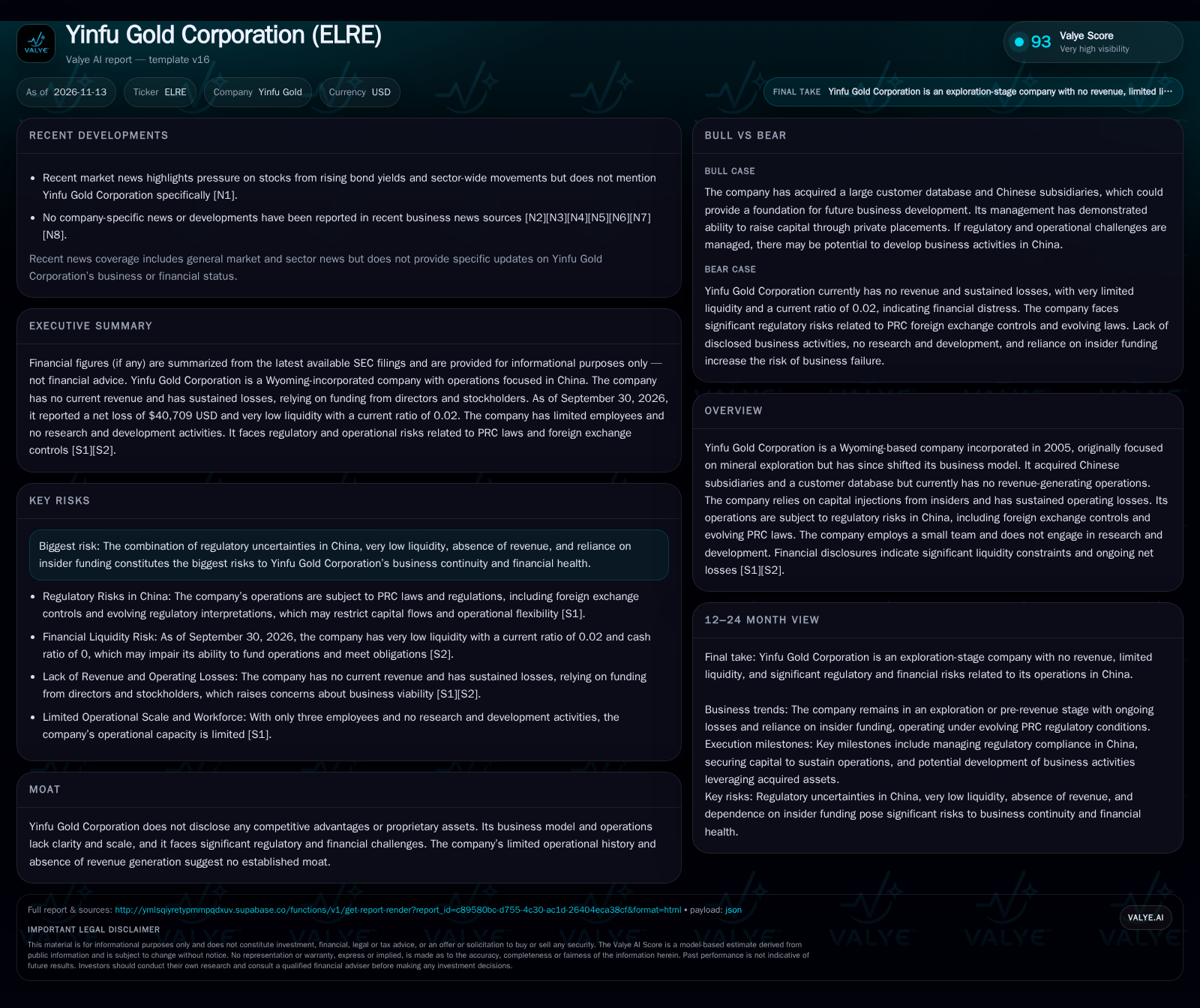
Yinfu Gold Corporation remains a pre-revenue entity, reporting a net loss for the recent period and sustaining operations only through director and stockholder funding. Its cash position is critically low, and its business activities in China are subject to significant regulatory uncertainty. The company’s ability to generate value will depend on converting its historical assets—such as a legacy customer database—into actionable commercial operations, a process complicated by operational, financial, and legal headwinds [S1] [S2].
Yinfu Gold Corporation presents a stark case of a pre-revenue, capital-constrained microcap entity attempting to pivot from its mineral exploration roots to new business lines in China. Despite a history of asset acquisitions—including subsidiaries and a large customer database—the company has not established any revenue-generating operations as of late 2026.
Liquidity Erosion and Absence of Revenue Define Present Reality
As of September 30, 2026, Yinfu Gold Corporation reported zero revenue and a net loss of $40,709 USD for the period, continuing a pattern of sustained losses and non-existent operating income [S2]. The company’s cash and equivalents stood at only $560 USD as of December 31, 2022, and its current assets totaled $14,634 USD against current liabilities of $747,215 USD at the end of September 2026, resulting in a current ratio of 0.02 and a cash ratio of zero [S2]. Operations are currently maintained through periodic capital infusions from directors and major stockholders, with no evidence of external financing or commercial revenue streams [S1] [S2]. These facts underscore an acute liquidity crisis and a lack of operational momentum, making business continuity highly contingent on ongoing insider support.
Business Model Stagnation and Capital Constraints
Yinfu Gold’s economics are currently defined by the absence of revenue and persistent operating losses. With no disclosed commercial activity or monetization of its legacy assets, the company’s cost structure is dominated by fixed overhead—primarily minimal staff salaries—and administrative expenses, with no variable cost base tied to sales or production. The company employs just three people, including the president, whose salary represents a significant portion of ongoing expenses [S1].
The company reported cash and liquidity metrics for the period; these figures do not by themselves establish operating runway, investment capacity, financial flexibility, or financing capacity. Funding to date has been provided through private placements to insiders, such as the $120,000 USD raised in February 2023 via issuance of 120 million shares [S1]. Without an external revenue engine or access to commercial debt, Yinfu Gold’s ability to invest in new ventures, cover working capital needs, or absorb shocks is severely constrained. Any future business model would require either a dramatic improvement in capital access or a high-margin, asset-light operation that can be bootstrapped from minimal resources.
Asset Legacy and the Absence of Moat or Differentiation
Yinfu Gold’s competitive position is currently theoretical rather than actual. The company’s primary legacy asset is a customer database of 31 million members acquired in 2014 alongside its Chinese subsidiaries [S1]. However, there is no evidence these assets have been monetized or integrated into any coherent business model. In the absence of proprietary technology, active product lines, or demonstrable market engagement, Yinfu Gold lacks tangible differentiation relative to both established operators and new entrants in any potential sector it might target.
The company’s stated ambition to pursue opportunities in emerging fields such as Internet Technology, Artificial Intelligence, and the Internet of Things is not backed by internal R&D or disclosed partnerships [S1]. In China’s rapidly evolving tech and financial services sectors, barriers to entry are high, and incumbents wield scale, regulatory relationships, and technology advantages. Unless Yinfu Gold can leverage its legacy database or relationships into exclusive distribution, network effects, or proprietary service offerings, it is likely to be structurally disadvantaged.
Unlocking Value from Dormant Assets: What a Turnaround Would Require
A favorable scenario for Yinfu Gold hinges on activating its historical assets—especially the large customer database—into a revenue-generating business in China. If management can secure external capital or strategic partnerships, the company could attempt to launch a digital platform, fintech service, or online marketplace targeting its legacy user base. Success would require not only funding but also regulatory navigation, technical execution, and rapid customer re-engagement.
Confirmation of this scenario would involve evidence of product launches, signed commercial agreements, or meaningful revenue generation tied to the Chinese subsidiaries or database. Announcements of new partnerships, external investments, or regulatory approvals would also suggest progress. Falsification would be the continued absence of operating income, lack of disclosed business activity, or further reliance on insider loans without commercial traction.
Stalled Operations Persist Amid Ongoing Losses and Insider Reliance
The most plausible trajectory is continued operational stasis, with Yinfu Gold sustaining periodic losses and funding basic operations through director and stockholder advances. In this scenario, there is no meaningful monetization of the company’s Chinese assets or customer database, and no external capital is attracted due to the lack of a credible business plan or demonstrable progress.
The company’s small workforce and absence of R&D activity further limit its ability to pivot or develop new products. Confirmation would come from ongoing SEC filings showing zero revenue, persistent net losses, and continued reference to insider funding as the principal source of liquidity. This scenario would be falsified if the company discloses new commercial agreements, external fundraising, or regulatory breakthroughs that enable business development.
Liquidity Exhaustion and Regulatory Barriers Precipitate Business Failure
A negative scenario involves the company exhausting its capacity to secure additional insider funding, resulting in the inability to meet payroll, service debts, or maintain basic operations. Given the current ratio of 0.02 and no external revenue, even minor cash flow disruptions could trigger insolvency or forced liquidation.
Regulatory risks compound this fragility. The company’s exposure to PRC foreign exchange controls and evolving Chinese legal frameworks may further constrain its ability to repatriate capital, launch new ventures, or attract partners. Confirmation of this scenario would be a cessation of filings, resignation of key personnel, legal proceedings related to unpaid obligations, or bankruptcy filings. Falsification would require clear evidence of renewed funding, operational scale-up, or regulatory accommodation.
Milestones That Will Determine Yinfu Gold’s Strategic Viability
Any disclosure of new commercial agreements, partnerships, or product launches tied to the Chinese subsidiaries or customer database would materially alter the business outlook.
Updates on external capital raises—especially those involving non-insider investors or strategic partners—would signal improved funding optionality and potential for business development.
Regulatory filings or announcements detailing the company’s compliance with, or exemption from, PRC foreign exchange and operational regulations would clarify the feasibility of operating in China.
A useful metric would be detailed breakdowns of legacy asset utilization: for example, re-engagement rates or monetization conversion for the 31 million-member database, if disclosed.
Evidence of staff expansion, new hires with domain expertise, or investments in product development would indicate operational scaling and strategic intent.
Disclosure of cash flow from operations or any positive change in working capital structure would help test the sustainability of the business model.
If disclosed, information on outstanding liabilities, renegotiation of debts, or creditor settlements would provide insight into near-term solvency risks.
Disclaimer: This is research-only, informational analysis and not investment advice. It may include AI-generated interpretation and general industry context. Always verify important details using primary sources.

Comments