
Vycor Medical: Minimal Disclosure, Liquidity Strain, and the Unknowns of Microcap Medtech
The company’s ability to sustain itself or generate growth remains highly uncertain, highlighting the risks of investing in under-disclosed microcap healthcare firms.
The company’s ability to sustain itself or generate growth remains highly uncertain, highlighting the risks of investing in under-disclosed microcap healthcare firms. [S2]
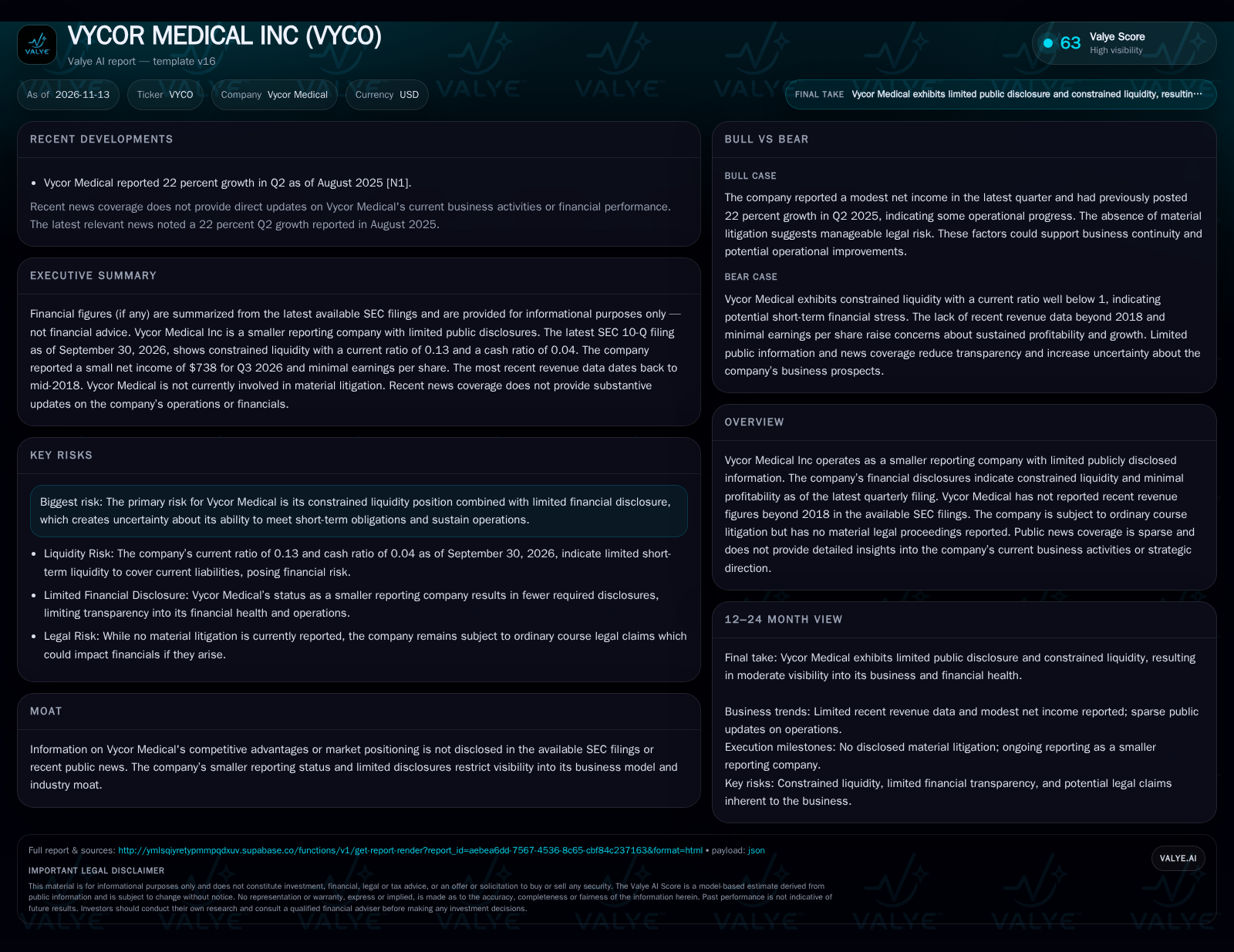
Vycor Medical sits at the intersection of constrained liquidity, limited disclosure, and microcap uncertainty. Its most recent filings show a precarious balance sheet—with current assets dwarfed by current liabilities—and minimal profitability, while a lack of recent revenue figures or operational updates makes it difficult to assess the company's true trajectory. This analysis explores the mechanics, competitive realities, and plausible scenarios for a healthtech microcap where even the available facts offer little clarity and the risks are as much about what is unknown as what is disclosed.
Liquidity Squeeze and Sparse Financials Define Vycor Medical’s Present
As of September 30, 2026, Vycor Medical reported current assets of $653,489 against current liabilities of $5,106,891, yielding a current ratio of just 0.13 and a cash ratio of 0.04. These metrics signal severe short-term liquidity constraints, with the company holding less than five cents in cash for every dollar of current obligations. The company reported only $738 in net income for Q3 2026, and the most recent revenue number in filings is from Q2 2018 ($301,665), providing no insight into recent sales momentum or customer activity. Vycor Medical is not involved in material litigation as of the latest annual report, but remains exposed to ordinary course legal claims. The absence of substantive news or operational updates further clouds the company’s outlook and impedes external assessment. [S1] [S2]
How Vycor Medical’s Economics Could Work—If Operations Are Still Active
The fundamental business mechanics for Vycor Medical likely hinge on developing, manufacturing, and selling specialized medical devices, most plausibly in neurosurgical applications. In theory, such a model could feature high gross margins (typical for innovative device makers) but also high fixed costs in R&D, regulatory compliance, and inventory management. If the company is still operating as a going concern, revenue would depend on a mix of direct hospital sales, distributor relationships, or group purchasing organizations. However, the lack of recent revenue data or disclosures about active products, customers, or contracts means the current revenue mix, pricing power, and unit economics are impossible to verify. Any positive operating leverage would require a return to meaningful sales volume, which is not evidenced in the current filings. [S2]
Further complicating the economic outlook is the capital intensity typically associated with medical device firms, particularly those engaged in neurosurgical technologies. If Vycor Medical remains operational, it would likely face significant ongoing expenses related to clinical trials, regulatory submissions, and quality assurance processes, all of which require sustained investment before realizing revenue. The timing and scale of these investments relative to revenue generation critically affect cash burn rates and the company’s runway. Moreover, the potential for reimbursement challenges or shifts in healthcare policy could materially impact pricing strategies and market access, thereby influencing unit economics and overall profitability. Without visibility into these factors, assessing the viability of the company’s economic model remains speculative.
Opaque Positioning in a Crowded, Regulated Medical Device Landscape
Vycor Medical’s competitive position is largely indeterminate from the available disclosures. In the neurosurgical and broader medtech space, the company would compete against both large multinational device manufacturers and numerous specialized startups. Key sources of potential advantage could include unique intellectual property, regulatory approvals, physician adoption, or integration into clinical workflows. However, the absence of recent operational updates, product launches, or customer wins means there is no evidence of current differentiation, pricing power, or network effects. Switching costs in surgical devices can be meaningful if products are embedded in care protocols, but this is not established for Vycor. The company’s microcap status and constrained resources suggest it could be vulnerable to better-funded competitors, regulatory hurdles, and loss of distribution relationships. Without public data on active products or partnerships, it is unclear whether Vycor possesses any sustainable moat.
In a heavily regulated and innovation-driven sector like neurosurgical devices, intellectual property protection and regulatory clearance are essential barriers to entry and sources of competitive advantage. If Vycor Medical holds meaningful patents or FDA approvals, these could provide a temporary moat; however, maintaining such protections requires ongoing legal and regulatory expenditures. Additionally, adoption by key opinion leaders and integration into hospital procurement processes are critical for sustained market penetration. The absence of disclosed partnerships or endorsements raises questions about the company’s ability to overcome entrenched competitors with established clinical relationships and broader product portfolios. Consequently, even if Vycor’s technology is differentiated, scaling commercial operations without robust distribution channels and clinical validation would be challenging.
What a Turnaround Would Require—and How to Spot Early Evidence
A favorable future for Vycor Medical could materialize if the company is able to restore operational momentum, secure bridge financing, and demonstrate renewed commercial traction. This would likely require: (a) new product launches or clinical adoption, (b) disclosure of material customer wins or recurring sales, and (c) a credible plan to address liquidity—such as a capital raise, debt restructuring, or cost reductions. Early evidence could include a return to regular revenue reporting, positive operating cash flow, and updates on commercial partnerships or regulatory milestones. Confirmation would come from sequential revenue growth, expanded gross margins, and improved balance sheet liquidity. Falsification would be signaled by continued absence of sales data, worsening liquidity, or regulatory setbacks.
Stagnation and Uncertainty in the Absence of Fresh Disclosure
The most plausible scenario, based on public filings, is ongoing operational stagnation with limited or no revenue generation, continued liquidity pressure, and no material change in strategic direction. The company may be minimally active, focused on compliance and survival rather than growth. This scenario would be confirmed by further quarters with negligible net income, no new revenue disclosures, and persistent balance sheet strain. It would be falsified by any evidence of new product activity, customer engagement, or capital infusion that materially alters the company’s trajectory.
How Acute Liquidity Stress Could Lead to Operational Disruption
If Vycor Medical cannot improve its liquidity or secure external funding, the company faces the risk of operational shutdown, creditor actions, or asset liquidation. This could be triggered by unpaid obligations, inability to fund payroll or compliance costs, or default on contracts. Confirming evidence would include disclosure of missed payments, going concern warnings in filings, loss of key personnel, or legal actions by creditors. The absence of revenue and persistent negative working capital amplify the risk of a forced wind-down or bankruptcy filing.
Operational disruption due to liquidity stress often unfolds through a cascade of deteriorating supplier and customer relationships. If Vycor Medical experiences delayed payments or defaults, suppliers may restrict deliveries or demand advance payments, further hampering production capabilities. Concurrently, customers—particularly hospitals and healthcare providers—may deprioritize orders from a financially unstable vendor, exacerbating revenue declines. This feedback loop can accelerate operational decline and diminish the company’s strategic options. Moreover, regulatory compliance requirements in the medical device industry are stringent; failure to meet these due to resource constraints could result in sanctions or product recalls, compounding financial and reputational damage.
Tracking the Vital Signs of Vycor Medical’s Survival and Strategic Options
Any updated disclosure of quarterly or annual revenue—if reported—would be the clearest sign of ongoing commercial activity.
Announcements of new product launches, regulatory approvals, or clinical partnerships would provide evidence of operational momentum.
Disclosure of material customer contracts, recurring sales relationships, or distribution agreements would help clarify the revenue base.
Filing of a going concern warning, missed debt payments, or creditor actions would signal acute financial distress.
Updates on litigation or regulatory proceedings—if any—could impact both operational focus and financial resources.
Management commentary on strategic alternatives, such as asset sales, mergers, or capital raises, would help gauge future direction.
A useful metric would be operating cash flow or burn rate, if disclosed, to assess the sustainability of current operations.
Disclaimer: This is research-only, informational analysis and not investment advice. It may include AI-generated interpretation and general industry context. Always verify important details using primary sources.

Comments