
AmeriServ’s Strategic Shift: Earnings Momentum, Service Realignment, and Franchise Concentration Risks
Recent earnings improvements and the transfer of investment services to Ameriprise mark a pivotal moment for AmeriServ Financial. The company aims to sharpen its banking focus, but faces persistent cost pressures, potential revenue concentration, and the typical credit and rate risks of a regional bank.
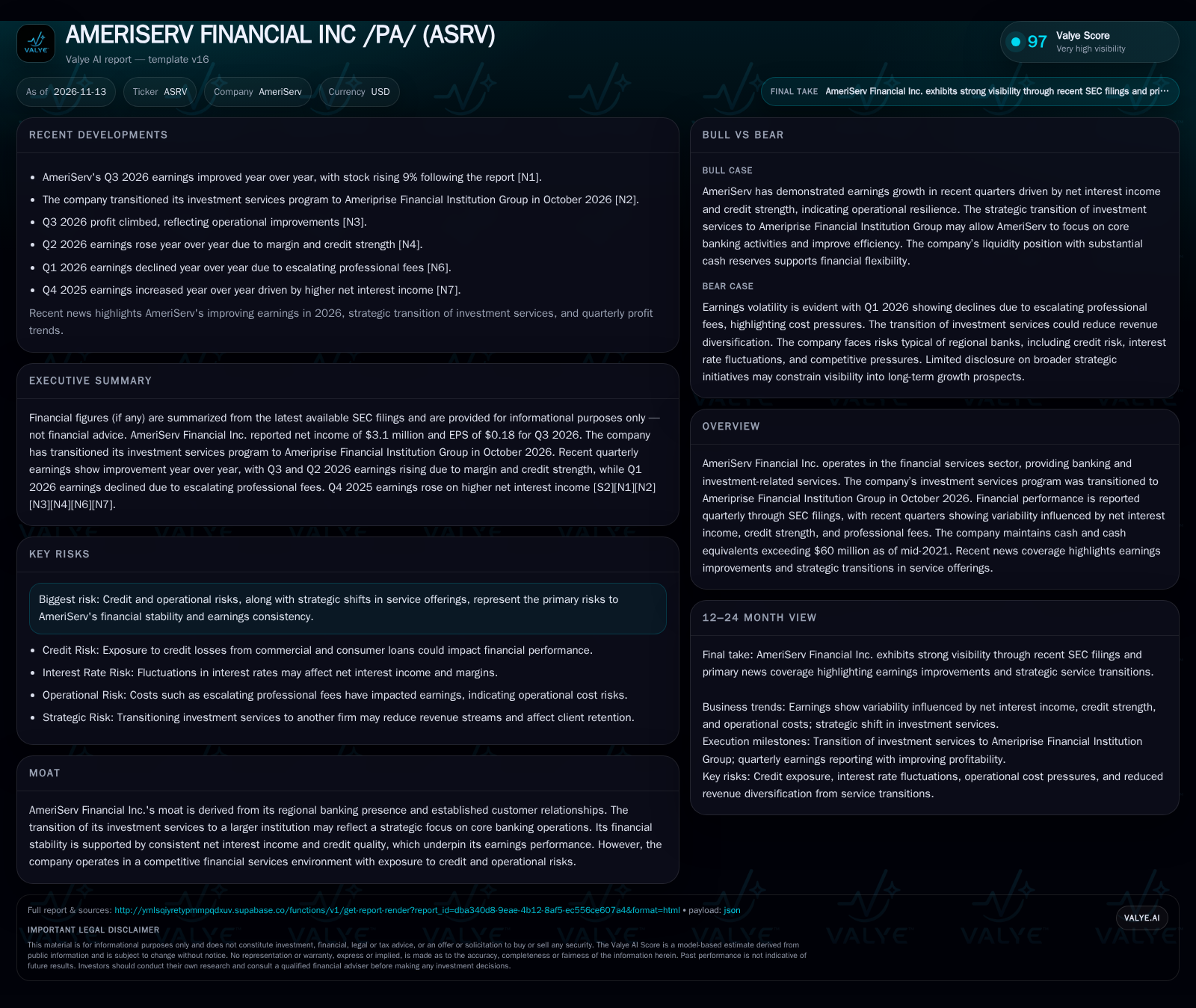
AmeriServ Financial posted Q3 2026 net income of $3.1 million and implemented a major shift by transitioning its investment services program to Ameriprise Financial Institution Group in October 2026. This move could streamline operations and focus resources on core banking, but it also narrows the company’s revenue base and exposes it more directly to the cyclical forces affecting regional banks. Recent earnings gains reflect margin and credit improvements, yet volatility remains due to operational costs and sector-wide risks. The next phase will test whether AmeriServ can sustain profitability and offset the loss of investment services with banking growth or efficiency gains. [S2] [N1] [N2] [N3] [N4] [N6] [N7]
AmeriServ Financial Inc. stands at a strategic crossroads following its Q3 2026 earnings uptick and the October transition of its investment services program to Ameriprise Financial Institution Group. While recent quarters have brought improved net income—reaching $3.1 million in the latest period—the company now faces the challenge of compensating for a narrower revenue mix as it doubles down on traditional banking. This pivot could enhance operational focus, but it also heightens exposure to the inherent risks of regional banking: credit quality swings, interest rate pressures, and the need for disciplined cost control. The next year will reveal whether AmeriServ’s streamlined model can deliver sustainable returns or if the loss of service diversification introduces new fragility.
The Significance of Ameriprise Transition and Recent Earnings Results
AmeriServ Financial’s Q3 2026 net income of $3.1 million and EPS of $0.18 signal a period of improved profitability, continuing a trend of earnings gains in recent quarters [S2] [N1] [N3] [N4]. However, the October 2026 transition of its investment services program to Ameriprise Financial Institution Group marks a major change in business scope [N2]. This move potentially reduces non-interest income and narrows the company’s focus to core banking activities, altering both the risk profile and future growth levers. The fact that Q1 2026 earnings declined due to escalating professional fees underscores persistent cost risks [N6]. These developments combine to set a new baseline for AmeriServ: a streamlined, more banking-centric franchise that must prove it can generate stable margins and earnings with a less diversified portfolio.
Earnings Drivers and Expense Challenges in a Leaner Banking Framework
AmeriServ’s core earnings are shaped primarily by net interest income—driven by the spread between loan yields and funding costs—and, to a lesser extent, by fee income from ancillary services. With the investment services program now transitioned away, the share of fee-based revenue is likely to shrink, making operating results more sensitive to loan growth, deposit pricing, and credit quality. In periods of rising rates, net interest margins can expand if loan yields outpace funding costs, but competitive deposit markets and asset-liability mismatches can quickly compress spreads.
The company reported cash and liquidity metrics for the period; these figures do not by themselves establish operating runway, investment capacity, financial flexibility, or financing capacity. [S2] Operational leverage is a double-edged sword: as a relatively small regional bank, AmeriServ benefits from scale in its local footprint, but fixed costs—especially compliance, technology, and professional fees—can swing earnings materially, as seen in Q1 2026. Without the cushion of investment services income, cost discipline and credit vigilance become even more critical to sustaining profitability.
Industry Consolidation and the Quest for Differentiation in Regional Banking
The competitive landscape for AmeriServ is defined by the intense rivalry among regional banks, community banks, and increasingly, digital-first fintechs. The company’s moat rests on longstanding local relationships and brand familiarity, but these are eroding advantages in an era of digital banking, aggressive rate competition, and rising customer expectations for product breadth. The decision to outsource investment services to Ameriprise may signal a retreat from trying to compete on breadth, focusing instead on depth within core lending and deposit markets.
This narrower focus could allow AmeriServ to sharpen its local differentiation—through high-touch service, community engagement, or niche credit products—but it also increases vulnerability to local economic downturns, loan concentration, and interest rate shocks. Larger regional and national banks, as well as fintech entrants, offer broader digital platforms and often better pricing. Without a diversified non-interest income stream, AmeriServ’s competitive position will increasingly hinge on credit quality, service, and operational efficiency.
Potential Gains from Concentrated Banking Focus and Expense Management
The most favorable scenario for AmeriServ is that the transition away from investment services enables a tighter operational focus, driving improved efficiency and deeper customer penetration in core markets. If management can reinvest freed-up resources into technology upgrades, credit analytics, or customer experience, the bank could achieve higher loan growth and better-quality deposits, supporting margin expansion.
Confirmation of this scenario would come from continued year-over-year earnings growth, stable or improving net interest margins, and a declining ratio of non-interest expenses to average assets. Further, evidence of robust loan growth, improved asset quality (e.g., lower non-performing loan ratios), and increased customer retention rates would signal that the core franchise is strengthening. If AmeriServ can also negotiate favorable terms with Ameriprise that preserve some referral or partnership economics, the earnings drag from lost fee income may be less severe than feared.
Core Regional Banking with Earnings Fluctuations and Margin Constraints
The most plausible outcome is that AmeriServ’s earnings profile becomes more cyclical and exposed to sector trends following the loss of investment services diversification. Net interest income remains the primary driver, fluctuating with loan demand, deposit competition, and macroeconomic conditions. Cost pressures—especially compliance and technology—continue to create volatility, with periodic spikes in professional fees or credit costs.
In this scenario, AmeriServ maintains adequate profitability in stable times but is vulnerable to downturns in local credit markets or sharp interest rate swings. Confirmation would include quarterly earnings that track closely with sector trends, margin compression during periods of rate volatility, and expense ratios that remain stubbornly high. If loan growth is merely in line with peers and there’s no meaningful improvement in cost management, AmeriServ’s returns may hover around the median for regional banks, with little perceived differentiation.
Rising Costs and Credit Issues Threaten the Focused Banking Strategy
The adverse scenario unfolds if the loss of investment services income exposes AmeriServ to sharper earnings swings, and management is unable to offset this through growth or efficiency. Rising professional fees, technology costs, or regulatory expenses could erode margins, especially if net interest income faces compression from deposit competition or asset-liability mismatches.
A local or sector-wide credit downturn—manifesting in higher non-performing loans or charge-offs—could quickly overwhelm the benefits of a focused banking model. Confirmation of this downside would be repeated earnings misses, rising expense ratios, and deteriorating asset quality metrics. If AmeriServ is forced to curtail lending or absorb credit losses without offsetting fee revenue, the franchise could become a candidate for consolidation or face pressure to raise additional capital.
Factors Indicating the Viability of AmeriServ’s Concentrated Business Model
Quarterly trends in net interest margin: Sustained expansion or resilience would indicate effective balance sheet management; compression would signal competitive or rate-driven challenges.
Loan growth relative to regional peers: Outperformance would suggest successful redeployment of resources into core lending; lagging growth may indicate franchise limitations.
Non-interest expense as a percentage of average assets: A declining ratio would confirm improved operational efficiency, while persistently high costs would undermine the benefits of the service transition.
Credit quality metrics (e.g., non-performing loan ratio, charge-offs): Deterioration would quickly erode profitability in the absence of fee income diversification.
Changes in deposit mix and cost of funds: Ability to attract low-cost, stable deposits would help offset revenue concentration risk.
Residual income or referral streams from Ameriprise partnership, if disclosed: Any ongoing economics here could cushion the impact of lost investment services revenue.
Management’s commentary on strategic priorities and cost discipline: Explicit targets or updates would provide insight into the effectiveness and sustainability of the new business model.
Regulatory developments or compliance costs: Any increase in regulatory burden could disproportionately affect a smaller, less diversified bank like AmeriServ.
Disclaimer: This is research-only, informational analysis and not investment advice. It may include AI-generated interpretation and general industry context. Always verify important details using primary sources.

Comments