
Embassy Bancorp: Navigating Commercial Credit Concentration in a Competitive Regional Banking Market
Embassy Bancorp’s strategic focus on commercial real estate lending in Pennsylvania’s Lehigh Valley provides localized strength, but exposes the bank to heightened credit and interest rate risks. The interplay of regional economic health, deposit-driven funding, and competitive dynamics will determine whether the bank’s risk management can sustain earnings amid sector headwinds.
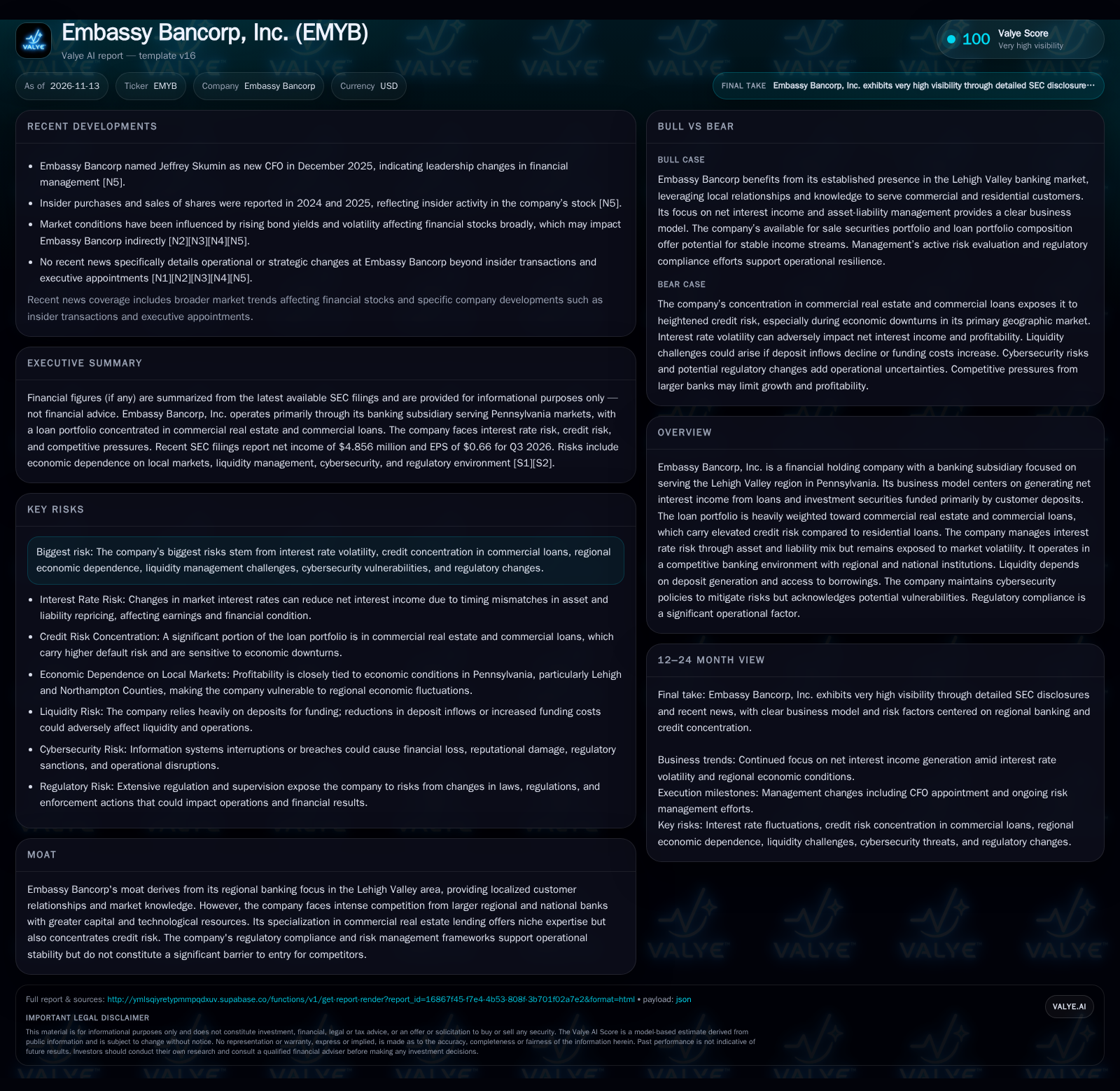
Embassy Bancorp’s recent results highlight its dependence on commercial lending and local economic conditions. While its focus drives relationships and revenue, it also magnifies exposure to credit cycles and interest rate shifts. Sustained profitability will hinge on credit discipline, deposit retention, and navigating a highly competitive market environment. [S1] [S2]
Embassy Bancorp, Inc. stands as a focused regional bank in Pennsylvania’s Lehigh Valley, leveraging deep local relationships and a loan book concentrated in commercial real estate and business lending. Recent financial results show continued profitability, but the company’s core strategy comes with pronounced risks: credit concentration, sensitivity to local economic swings, and exposure to interest rate movements. In a landscape shaped by aggressive competitors and evolving regulatory demands, Embassy Bancorp’s ability to balance growth with prudent risk management will be tested in the next cycle. [S1] [S2]
Recent Profitability and Loan Mix Shape Near-Term Outlook
Embassy Bancorp reported net income of $4.856 million and earnings per share of $0.66 for the third quarter of 2026, demonstrating ongoing profitability in its core banking operations. However, as of the end of 2025, 46.7% of its loan portfolio was allocated to commercial real estate, commercial construction, and commercial loans—segments that inherently carry higher credit risk than residential lending. The company’s available for sale securities portfolio stood at approximately $341.9 million, with unrealized gains impacting shareholders’ equity. These current facts underscore both the bank’s earnings power and its heightened exposure to credit cycles, particularly within its concentrated commercial book. [S1] [S2]
How Net Interest Income Drives Value—and Where It’s Vulnerable
Embassy Bancorp’s revenue model is fundamentally dependent on net interest income—the spread between interest earned on loans and securities, and interest paid on deposits and borrowings. The heavy tilt toward commercial real estate and business lending can boost yields, as these segments typically command higher interest rates than prime residential loans. However, these loans also bring greater default risk and are more sensitive to shifts in local economic conditions.
The bank’s cost of funds is primarily determined by its ability to attract and retain customer deposits, which are generally a lower-cost and more stable funding source than wholesale borrowings. If local deposit competition intensifies or if customers move funds in search of higher yields, Embassy could face higher funding costs or liquidity pressure.
Operating leverage is present but limited by the fixed costs of branch networks and compliance in a tightly regulated industry. Margins are also exposed to interest rate risk: if liabilities reprice faster than assets during rising rate environments, net interest income can compress. Conversely, well-timed asset-liability management can stabilize margins, but requires accurate forecasting and nimble execution.
Capital needs are primarily driven by credit risk provisioning and regulatory capital requirements, both of which can fluctuate rapidly if asset quality deteriorates. The available for sale securities portfolio provides some flexibility, but unrealized losses or gains can introduce volatility to equity and regulatory ratios.
Regional Expertise Meets Scale-Driven Rivals and Digital Disruptors
Embassy Bancorp’s competitive positioning is rooted in its deep local market knowledge and longstanding relationships within the Lehigh Valley. This regional focus can create meaningful switching frictions for established business clients and allow for tailored credit solutions that larger, more bureaucratic banks may struggle to match.
However, the company faces formidable counterforces. Larger regional and national banks possess greater capital resources, broader product offerings, and more sophisticated technology platforms, enabling them to undercut pricing or lure away customers with digital convenience. Non-bank lenders and fintechs are increasingly active in commercial lending, often offering streamlined underwriting or alternative credit products.
Embassy’s niche in commercial real estate and business lending can be an advantage in underpenetrated local segments, but also exposes the bank to concentration risk if local economic conditions deteriorate. Without a significant technology or cost advantage, sustaining growth and defending market share will require relentless customer service and prudent risk selection.
If Local Growth Remains Robust and Credit Quality Holds
A favorable scenario for Embassy Bancorp would see the Lehigh Valley economy continue expanding, with strong demand for commercial real estate and business loans. In this environment, net interest margins could remain healthy if the bank manages to price risk appropriately and retain low-cost deposits.
Confirmation of this scenario would come from stable or improving credit metrics—such as low nonperforming loan ratios and limited charge-offs—alongside continued growth in deposit balances. Evidence of market share gains from local competitors, perhaps through new commercial relationships or expansion into adjacent Pennsylvania markets, would further support the upside case.
This outcome would be falsified by a sharp uptick in delinquencies or if rising funding costs outpace loan growth, eroding net interest income.
Commercial Credit Concentration Drives Both Growth and Risk
The most plausible near-term trajectory for Embassy Bancorp is a continuation of steady, modest profitability, with earnings driven by its commercial loan book and stable deposit base. Net interest income is likely to remain the primary revenue engine, but margin pressure could persist if interest rates remain volatile or if competition for deposits intensifies.
Credit costs may rise gradually as economic growth slows or as specific commercial credits season, but should remain manageable barring a sharp local downturn. The bank’s regional focus will help retain core customers, but limits geographic diversification and leaves the company exposed to local shocks.
This base scenario would be confirmed by stable earnings, manageable credit losses, and deposit trends that track local economic performance. It would be challenged by a material deterioration in the local commercial real estate market or a sudden outflow of deposits to larger rivals offering higher yields.
Economic Weakness and Credit Losses Could Trigger a Negative Spiral
In a downside scenario, the Lehigh Valley region could experience a recession or sector-specific downturn, leading to rising defaults in commercial real estate and business loans. Embassy’s credit concentration would amplify the impact, forcing higher provision expenses and compressing earnings.
If depositors become nervous—either due to local economic fears or more attractive offers from larger banks—the bank could face liquidity pressures or be forced to rely on more expensive wholesale funding, further eroding margins.
Evidence for this scenario would be a spike in nonperforming assets, sharply higher charge-offs, declining deposits, and a deterioration in regulatory capital ratios. The scenario would be less likely if the company demonstrates proactive credit risk management and maintains customer loyalty through the downturn.
Benchmarks That Will Reveal the Success or Strain of Embassy Bancorp’s Strategy
The proportion of nonperforming loans and net charge-offs in the commercial real estate and business loan portfolio, if disclosed, will be critical for assessing credit risk migration.
Net interest margin trends in the context of local deposit competition and broader interest rate movements would help test the effectiveness of asset-liability management.
Deposit growth or retention rates, particularly relative to local market benchmarks, will signal the bank’s ability to sustain its primary funding source.
Changes in the allowance for credit losses, and management’s rationale for adjustments, will reveal expectations regarding future asset quality.
Any shifts in the geographic or sectoral composition of the loan book would clarify whether the company is diversifying risk or doubling down on its core markets.
Updates on regulatory capital ratios and management commentary about capital adequacy would provide early warnings of stress or flexibility.
Evidence of increased competition from non-bank lenders or digital entrants in the Lehigh Valley could pressure growth and margin assumptions.
Material cybersecurity events or disclosures about system vulnerabilities would highlight operational risks beyond credit and market exposures.
Disclaimer: This is research-only, informational analysis and not investment advice. It may include AI-generated interpretation and general industry context. Always verify important details using primary sources.

Comments