
Range Capital Acquisition Corp.: SPAC Structure, Execution Dependencies, and the Search for Value Creation
With no operating business or identified target, Range Capital Acquisition Corp. exemplifies the execution risk and capital market dynamics facing post-IPO SPACs. The company's future hinges on management's ability to source, negotiate, and consummate a business combination before resources are depleted.
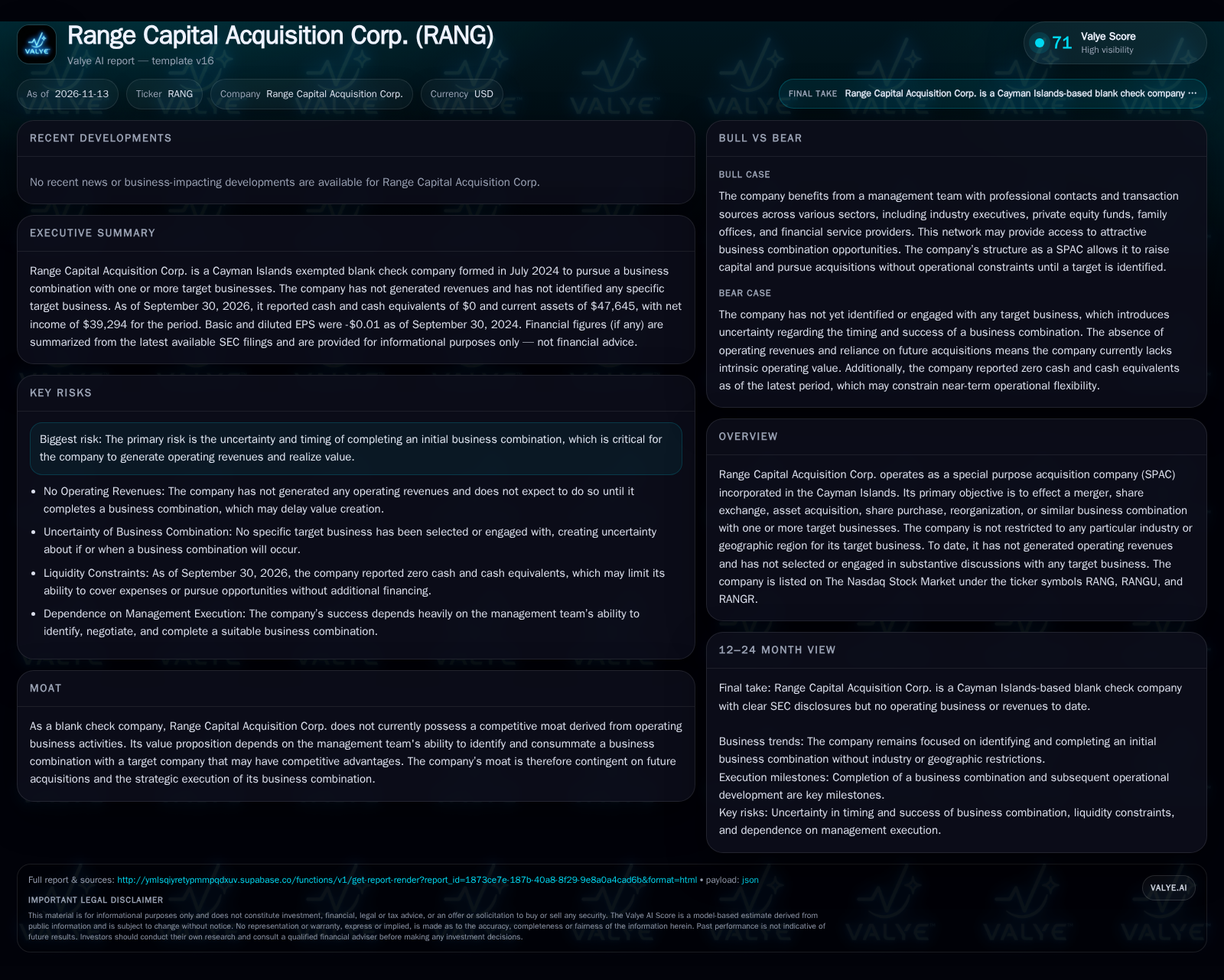
Range Capital Acquisition Corp. is a Cayman Islands-based SPAC that has not yet identified a target for its business combination. As of September 30, 2026, it reported $0 in cash and $47,645 in current assets, reflecting the run-down of IPO proceeds and likely costs of maintaining its public status. No operating revenues have been generated, and the company's future value is wholly contingent on management's ability to secure and complete an acquisition within the remaining timeframe and resources. Investors face binary outcomes: either a value-creating deal or a wind-down scenario.
Range Capital Acquisition Corp. sits at a critical juncture typical of post-IPO SPACs: with no operating business, no identified target, and a rapidly diminishing capital base, the company’s future is entirely dependent on its management team’s ability to source and close a business combination. Investors are exposed to significant binary risk, as the company must either deliver a compelling acquisition or face the prospect of liquidation. Understanding the mechanics of SPAC economics, the dependencies on capital markets, and the execution risks is essential for evaluating the potential outcomes and value proposition for shareholders.
Where Range Capital Stands: No Target, Dwindling Resources, and Imminent Execution Risk
As of September 30, 2026, Range Capital Acquisition Corp. reported zero cash and cash equivalents and just $47,645 in current assets, highlighting a sharp depletion of its initial IPO proceeds [S2]. The company has not generated any operating revenues and has not yet identified or engaged with any target business for a merger, acquisition, or other business combination [S2]. With 16,037,500 ordinary shares outstanding and a market value of $117.3 million as of June 30, 2025, Range Capital’s market capitalization reflects the embedded option value of securing a high-quality acquisition, not the value of an operating entity [S2]. The absence of a selected target, combined with limited remaining resources, places the company at the classic SPAC inflection point where execution risk becomes paramount.
SPAC Value Mechanics: Capital Structure, Cost Burn, and the Binary Nature of Shareholder Outcomes
Range Capital’s economics are defined by its SPAC structure: the company raised gross proceeds of $100 million in its December 2024 IPO, followed by an additional $15 million from over-allotment, and private placements totaling $4.375 million [S2]. These funds are typically held in trust and can only be used for approved business combinations or returned to shareholders upon liquidation. The lack of cash and minimal current assets as of late 2026 suggests that the company has largely exhausted the portion of proceeds not held in trust (such as funds for working capital and ongoing public company costs), raising the urgency for a transaction before time or resources run out.
SPACs are inherently high operating leverage vehicles: their fixed costs (legal, listing, compliance, and management fees) persist regardless of deal progress, while revenue generation is binary—either a successful business combination creates potential upside, or the SPAC is wound down. The capital structure is further complicated by rights and warrants, which can dilute post-combination equity but also serve as incentives for IPO investors to hold through the deal process.
Value creation for shareholders is contingent on management’s ability to source a compelling target at a reasonable valuation, negotiate favorable deal terms, and secure shareholder approval. If no deal is secured within the SPAC’s prescribed timeline (often 18-24 months), the company must liquidate and return the remaining trust proceeds to public shareholders, typically at or near the IPO price per share.
SPAC Competition: Market Saturation, Sponsor Reputation, and the Hunt for Quality Targets
Range Capital operates in a crowded SPAC market, where numerous blank check companies are simultaneously searching for attractive targets. Competitive advantage in this context is primarily a function of sponsor reputation, deal sourcing networks, and the ability to offer attractive terms to potential targets. The absence of a sector focus can be a double-edged sword: it provides flexibility to pursue opportunities across industries and geographies, but also means competing against both specialist and generalist SPACs, as well as traditional private equity and strategic acquirers.
The company's management team cites extensive connections with industry executives, private equity, and other financial intermediaries as a potential sourcing advantage. However, with no announced target or substantive discussions, this has yet to translate into tangible deal flow [S2]. Furthermore, the current macro environment—marked by increased regulatory scrutiny, tighter deal timelines, and more cautious target company boards—heightens competitive pressure and raises the bar for successful SPAC execution.
What Would Drive a Positive Outcome: Securing a High-Quality Target at a Favorable Valuation
A successful outcome for Range Capital would require the identification and consummation of a business combination with a target that offers both compelling growth prospects and reasonable valuation. The causal chain involves management leveraging its network to source proprietary or under-the-radar targets, negotiating deal terms that minimize dilution and maximize post-merger value, and securing shareholder approval for the transaction.
Evidence that would confirm this scenario includes the announcement of a definitive agreement with a target operating in a high-growth sector, favorable deal terms with limited sponsor dilution, and positive market reaction as reflected in share price appreciation above trust value. Further confirmation would come from the target’s financials demonstrating strong revenue growth, margin potential, and a clear path to public-market scalability.
Falsification of this scenario would include failure to announce a meaningful target, excessive dilution from sponsor or warrant structures, or negative market reaction to a proposed deal—particularly if the target is perceived as low quality or overvalued.
Most Likely Trajectory: Extended Search, Potential for a Mediocre or Last-Minute Transaction
The most plausible outcome, given the current facts, is that Range Capital continues to search for a suitable target but faces increasing pressure as its timeline shortens and resources dwindle. In this scenario, the company may announce a business combination late in its SPAC lifecycle, possibly with a target that is smaller or less attractive than originally envisioned, as has been common among late-stage SPACs in recent cycles.
Confirmation would come from a last-minute transaction announcement, potentially accompanied by significant sponsor concessions or backstopping arrangements to secure shareholder approval. If the target is marginal or the deal is highly dilutive, shares may trade at or below trust value, with redemption rates spiking as IPO investors opt for capital return rather than roll into the new entity.
Falsification would occur if Range Capital fails to announce any transaction before its deadline, leading to a forced liquidation and return of remaining trust proceeds to shareholders.
How Value Could Erode: No Deal, Sponsor Exhaustion, and Eventual Liquidation
The adverse scenario is straightforward: management is unable to secure a business combination before the SPAC’s deadline, either due to lack of suitable targets, failure to negotiate acceptable terms, or inability to secure shareholder approval. In this case, the company would be required to liquidate, incurring final wind-down expenses and returning remaining trust proceeds to public shareholders.
Evidence confirming this trajectory would include continued lack of target announcements, further depletion of current assets, and public communications indicating the company is evaluating liquidation or extension options. Market price converging toward trust value as the deadline approaches is another hallmark of this scenario.
Falsification would require the unexpected announcement of a high-quality target and a rapid progression to deal close—an increasingly rare outcome for late-stage SPACs with limited resources.
Milestones That Will Determine Whether Range Capital Can Deliver Shareholder Value
Announcement of a definitive agreement with a target company would be the most concrete sign of progress.
Disclosure of the remaining trust account balance, if available, would clarify how much capital could be returned to shareholders in a liquidation scenario.
Any SEC filing or press release indicating engagement in substantive discussions or the signing of a letter of intent would help test the likelihood of a deal.
Redemption rates at the time of a proposed business combination—if disclosed—would signal investor confidence in the quality of the target.
Changes in the company's remaining timeline (such as extensions or amendments to the business combination deadline) would indicate the urgency and feasibility of a transaction.
Insider transaction activity was reported in the cited source; this activity does not by itself establish insider confidence.
A useful metric would be the amount and terms of any additional financing or backstop arrangements disclosed in connection with a proposed combination.
Disclaimer: This is research-only, informational analysis and not investment advice. It may include AI-generated interpretation and general industry context. Always verify important details using primary sources.

Comments